

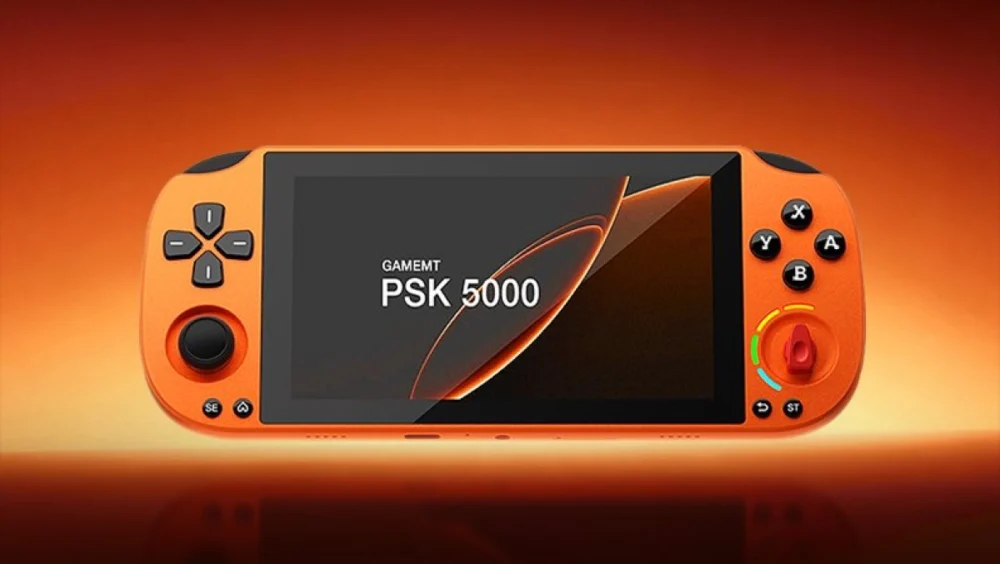
The perennial quest for optimal tactile feedback in portable gaming hardware has led to a fascinating, if occasionally quirky, proliferation of control schemes across the Android handheld ecosystem. For dedicated enthusiasts, the appeal lies squarely in escaping the compromises inherent in reliance on on-screen touch controls—a fundamental limitation of standard smartphones. This drive fuels a niche market saturated with varied implementations of joysticks, D-pads, and trigger configurations, each attempting to carve out a competitive edge. Into this competitive landscape steps the GameMT Pocket Super Knob 5000, a device whose very nomenclature suggests a departure from conventional design philosophy, centering its primary unique feature not on a novel input method for gameplay, but on a highly visible, physical control for system management.
The emergence of the Pocket Super Knob 5000, as surfaced through early promotional materials, presents an interesting case study in feature prioritization within budget-to-midrange Android gaming devices. The device is specified with a 5-inch 1080p display, an inclusion that suggests a focus on crisp visual presentation, even if the underlying processing power is more modest. At its core, it utilizes the MediaTek Helio G85 chipset. While this processor is well-established and capable of handling a significant breadth of emulation tasks and native Android games, it is certainly not positioned at the cutting edge of mobile silicon performance. Its presence echoes configurations seen in previous budget-conscious handhelds, such as the MagicX One35 from the prior year, indicating that GameMT is targeting a specific price point where reliable performance is prioritized over raw graphical horsepower.
However, the defining characteristic—the "Super Knob"—immediately distinguishes this unit. In a market where innovation often focuses on dual analog sticks, advanced shoulder buttons, or ergonomic shells, the Super Knob posits itself as a primary interface element. Crucially, initial analysis suggests this is not intended as an analog game input mechanism, akin to the crank found on the innovative Playdate console, which directly alters game states or progression. Instead, the visual evidence strongly implies a dedicated hardware function: managing the device’s power and performance profiles.
This interpretation is supported by examining predecessor models, specifically the GameMT EX5, which shared a near-identical chassis design and featured this same rotary mechanism. In the EX5 context, the knob was clearly demonstrated as a toggle for switching between distinct operational modes. Extrapolating this functionality to the Pocket Super Knob 5000, the visual cues in the new marketing materials reinforce this hypothesis. Imagery showcasing the device interface highlights four distinct power settings, which appear to correspond directly with the four illuminated LED markers encircling the physical knob. This suggests a tangible, immediate feedback loop between the user’s physical manipulation of the hardware and the system’s operational envelope.
While the prospect of a dedicated rotary input for gameplay might ignite more immediate excitement among purists seeking unconventional mechanics, the practical utility of a rapid-access performance switcher cannot be overstated in the context of emulation and portable gaming. The Android handheld segment often struggles with balancing battery life against performance demands. Running demanding emulators or graphically intensive native Android titles rapidly drains the battery and generates heat. Conversely, operating in maximum performance mode for simple 2D retro titles is inefficient.
A hardware knob offers a superior solution to cycling through software menus or using a cryptic key combination. The ability to physically twist a dial and instantly observe the system’s state via dedicated LEDs transforms a background system setting into an accessible, on-the-fly adjustment. This provides gamers with granular, immediate control over the trade-off between sustained frame rates and thermal management, a critical factor when attempting to push the Helio G85 chipset to its limits across various emulation layers, from PS1 to perhaps lighter PSP or GameCube titles. This moves performance management from a technical configuration step to an integrated part of the gaming session itself.
Contextualizing the Hardware Choice
To fully appreciate the strategic placement of the Pocket Super Knob 5000, one must consider the broader context of the Android gaming handheld market. This sector is intensely competitive, largely driven by enthusiast communities focused on retro gaming emulation (up to the fifth and sixth console generations). Key players often differentiate themselves through processor choice (Ayn Odin, Retroid Pocket series), screen quality, or control layout fidelity. However, these premium differentiators inevitably push the price upward.
The inclusion of the Helio G85 places the Super Knob 5000 firmly in the accessible tier. This chipset, while aging, possesses sufficient GPU capabilities (Mali-G52 MC2) and CPU cores to offer a satisfying experience for most 8-bit, 16-bit, and 32-bit emulation, and even passable performance for some early 3D consoles, provided users manage expectations regarding high-resolution scaling. The decision to focus development effort on an external physical control—the knob—rather than investing in a significantly more powerful chipset (like a Dimensity 1200 or Snapdragon 8 series derivative) signals a clear marketing strategy: target the value-conscious user who values immediate system tuning capabilities over raw computational headroom.
Furthermore, the inclusion of Hall effect thumbsticks is a significant nod to quality-of-life improvements. Hall effect sensors eliminate the mechanical wear associated with traditional potentiometer-based sticks, drastically reducing the incidence of stick drift—a perennial hardware failure point in the portable gaming industry. This inclusion suggests GameMT is aware of established user pain points and is willing to incorporate durable components even within a budget framework.
Industry Implications and the Role of Tactile Feedback
The Super Knob 5000’s design choice has implications that extend beyond its immediate user base, touching upon the evolving philosophy of portable hardware interaction. Traditional computing paradigms, whether on PCs or smartphones, default to abstract software interfaces for managing system resources. Gaming hardware, historically, has offered more direct control—think of adjustable fan speeds on dedicated PC GPUs or physical overclocking switches on older motherboards.
The implementation here attempts to bridge that gap in the mobile handheld space. By externalizing the performance spectrum control, GameMT validates the idea that performance management is a first-class interaction, not a secondary setting. If this feature proves highly effective and popular, it could influence future budget handheld designs. Competitors might feel compelled to adopt similar physical toggles, perhaps for features like RAM allocation switching, refresh rate control (if the display supports it), or even dedicated fan speed overrides.
The success hinges entirely on the execution. If the knob feels cheap, wobbly, or if the system transition between modes is sluggish (e.g., requiring a reboot or a multi-second lag), the feature becomes a gimmick. Conversely, if the transition is near-instantaneous and the haptic feedback of the click between levels is satisfying, it becomes a powerful, intuitive tool. This mirrors the success of physical switches on mechanical keyboards; their appeal is rooted in the tactile certainty they provide over digital buttons.
Expert Analysis: Performance Tiers and User Experience
From an expert perspective, the Helio G85 presents a bottleneck that the knob seeks to manage rather than overcome. A typical four-mode setup likely corresponds to:
- Eco Mode (Low Power): Ideal for 2D retro emulation (NES, SNES, Genesis) and media consumption, maximizing battery life.
- Balanced Mode: Suitable for most N64, Dreamcast, and lighter PS1 titles, offering a reasonable compromise.
- Performance Mode: Pushing the chipset for more intensive 3D emulation (e.g., early GameCube/PS2 attempts, demanding Android titles). This mode will certainly tax the thermal solution.
- Turbo/Overclock Mode (Speculative): Potentially an unlocked or slightly overclocked state, which would be risky but highly attractive to tinkerers, indicated by the highest LED setting.
The challenge for GameMT lies in ensuring that the software layer correctly interprets and enforces these settings. This requires robust firmware development to map the physical rotation directly to CPU/GPU clock governors, potentially even managing thermal throttling limits differently across the four defined states. Poor software integration would render the knob useless, as the system might ignore the hardware input in favor of software constraints.
The choice of a 1080p screen with this processor is also noteworthy. While 1080p is visually sharp for native Android apps and high-resolution 2D games, rendering demanding emulated content (which often targets lower native resolutions) upscaled to 1080p places a heavier burden on the GPU than rendering to a standard 720p panel common in this segment. The knob thus becomes doubly important: users will likely need to drop down to Balanced or Eco mode for many 3D emulation targets to maintain acceptable frame rates on the 1080p panel.
Future Impact and Market Trajectories
The trajectory of the Android handheld market suggests an increasing bifurcation: a high-end segment dominated by powerful, often expensive devices (like the Steam Deck alternatives) and a burgeoning budget segment obsessed with squeezing maximum value from accessible hardware. The Pocket Super Knob 5000 appears to stake its claim in the latter by introducing a novel, tangible feature that costs less to implement than a generational leap in silicon.
If this tactile approach to system management proves successful, it could signal a shift away from chasing benchmark scores in the budget tier toward optimizing the user experience around existing, cost-effective components. In an era where many devices feel functionally identical save for slight variations in stick quality, a standout physical feature—even one dedicated to performance toggling—provides immediate marketing distinction.
Furthermore, the prominence of this knob hints at a growing acceptance among mainstream handheld manufacturers that emulation is a core pillar of this market, requiring specific hardware considerations beyond what a standard smartphone controller attachment provides. While dedicated controllers (like those from Razer or Backbone) focus on replicating console layouts, manufacturers like GameMT are attempting to integrate the system itself into the control scheme.
The planned April release date places this device squarely in the spring competitive window, suggesting GameMT aims to capture early adopters looking for a unique gadget before potentially larger releases later in the year. Success will ultimately be measured by its ability to deliver a satisfying, multi-tier performance experience that is immediately accessible, making the simple act of adjusting system power as engaging as starting a game itself. The Pocket Super Knob 5000 is not just a device with a knob; it represents an experiment in making system tuning an integral, physical aspect of the portable gaming narrative.
