

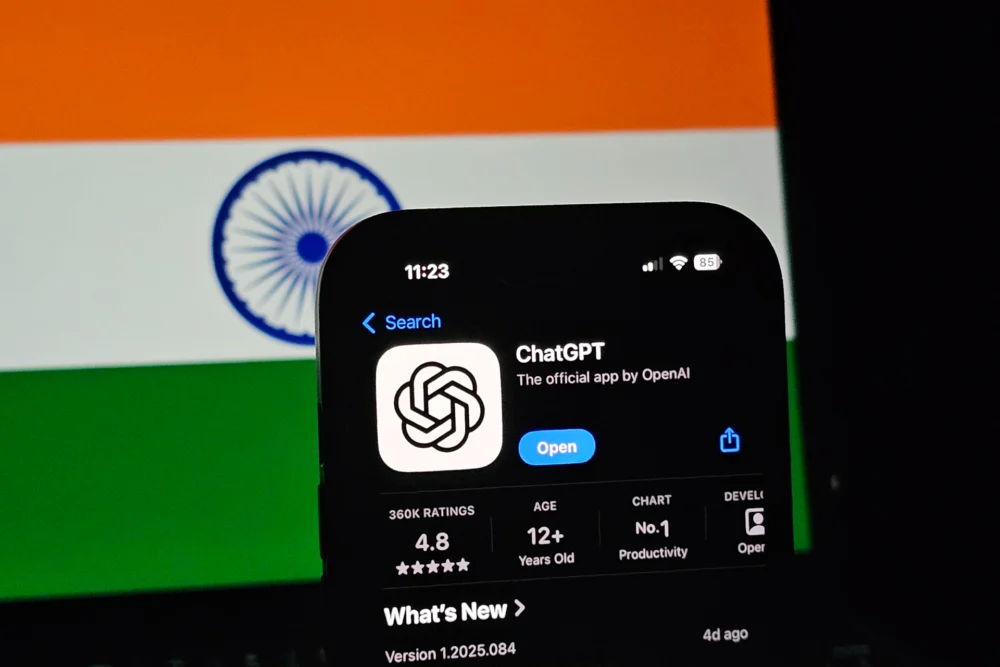
The rapid acceleration of artificial intelligence has found its most significant growth engine in the world’s most populous nation. Sam Altman, CEO of OpenAI, recently confirmed that India has reached a staggering milestone of 100 million weekly active ChatGPT users. This figure not only cements India’s position as OpenAI’s second-largest market globally, trailing only the United States, but also signals a fundamental shift in the center of gravity for the global AI ecosystem. As the company prepares for the five-day India AI Impact Summit in New Delhi, the disclosure of these metrics underscores a calculated and aggressive strategy to capture the South Asian market through localized pricing, educational integration, and high-level government engagement.
The scale of India’s adoption is part of a broader global surge for OpenAI. As of late 2025, ChatGPT’s total weekly active user base has climbed toward the 900 million mark, meaning that more than one in every ten ChatGPT interactions globally now originates from an Indian IP address. For a company that only established its formal presence in New Delhi in August 2025, the speed of this penetration is unprecedented. It reflects a unique intersection of India’s massive, young, mobile-first population and a cultural readiness to bypass traditional technological legacy systems in favor of cutting-edge automation.
The Educational Engine: Students as Early Adopters
Perhaps the most telling statistic shared by Altman is that India now hosts the largest number of student users of ChatGPT in the world. This demographic trend is not merely a statistical quirk; it is the cornerstone of OpenAI’s long-term retention strategy. By embedding its tools within the learning workflows of millions of Indian students, OpenAI is effectively training the next generation of the global workforce to view its interface as the primary gateway to information and productivity.
The competition for the "classroom of the future" in India has become a high-stakes battleground between Silicon Valley giants. Google, recognizing the threat to its traditional search dominance, has moved aggressively with its Gemini platform. In late 2025, Google offered Indian students a free one-year subscription to its premium AI Pro plan, a move designed to counteract OpenAI’s momentum. According to Chris Phillips, Google’s Vice President and General Manager for Education, India already leads the world in using Gemini for learning purposes. This rivalry highlights a critical realization among AI developers: whoever wins the Indian student market wins the global talent pipeline for the next decade.
Localization and the Challenge of the "Price-Sensitive" Market
Despite the massive user numbers, the transition from "active users" to "paying subscribers" remains a complex hurdle in the Indian context. India is famously price-sensitive, a market where the standard $20-per-month ChatGPT Plus subscription is prohibitively expensive for the average consumer. To address this, OpenAI has demonstrated a level of flexibility rarely seen in its Western operations.
The introduction of the "ChatGPT Go" tier—a sub-$5 monthly plan—was a direct response to local economic realities. However, in an even bolder move to secure market share against competitors like Google and Anthropic, OpenAI later made this tier free for a year for Indian users. This "freemium-at-scale" model serves a dual purpose: it builds brand loyalty while generating a massive volume of localized data that can be used to fine-tune Large Language Models (LLMs) for Indian languages and cultural nuances.
This strategy of deferred monetization is a gamble on the future. OpenAI is betting that by the time these promotional periods end, the AI tool will have become so indispensable to Indian professional and academic life that users will find a way to pay for it, or that enterprise-level partnerships with Indian conglomerates will offset the costs of individual access.
The India AI Impact Summit: A Geopolitical Pivot
The timing of Altman’s disclosures coincides with the India AI Impact Summit, an event that transcends mere corporate networking. The summit features a rare convergence of global tech CEOs—including Anthropic’s Dario Amodei and Google’s Sundar Pichai—and world leaders such as French President Emmanuel Macron and Brazilian President Luiz Inácio Lula da Silva. The presence of such high-level political figures indicates that AI has moved beyond the realm of "tech news" and into the sphere of national security and international diplomacy.
For the Indian government, the summit is a platform to showcase the "IndiaAI Mission." This national program is designed to build independent computing capacity and ensure that India is not just a consumer of foreign AI, but a developer of indigenous models. The government’s focus on "sovereign AI" and public-service adoption creates a delicate dance for companies like OpenAI. They must prove that their tools are "democratic" and beneficial to the public good to avoid the regulatory crackdowns or protectionist policies that have occasionally hampered foreign tech firms in the country.
Analysis: Toward "Democratic AI" and Practical Literacy
Sam Altman’s recent writings emphasize a vision of "democratic AI"—a concept where technology is adopted at scale in a way that benefits a broad cross-section of society rather than a narrow elite. In the Indian context, this means ensuring that AI literacy reaches beyond the tech hubs of Bengaluru and Hyderabad into the rural heartlands and smaller Tier-2 and Tier-3 cities.
The challenge, as Altman noted, is that uneven access could concentrate economic gains in too few hands. If AI tools are only available to those with high-speed internet and high-end devices, the digital divide in India could widen into an "AI divide." To mitigate this, OpenAI is signaling a deeper collaboration with the Indian government to expand infrastructure and practical AI literacy. While specific details of these upcoming partnerships remain under wraps, they are expected to focus on integrating AI into public infrastructure, health diagnostics, and agricultural advisory services—areas where the impact of the technology can be measured in human lives rather than just stock prices.
The Infrastructure Gap and Monetization Hurdles
While 100 million users is a landmark achievement, the infrastructure required to support this volume of traffic is immense. India currently faces constraints in high-performance computing (HPC) and specialized AI chips (GPUs). The Indian government’s plan to subsidize the creation of domestic GPU clusters is a necessary step, but for the immediate future, companies like OpenAI must rely on global data centers, which introduces latency and data sovereignty concerns.
Furthermore, the economic impact of 100 million users has yet to fully manifest in India’s GDP. For AI to become a true economic multiplier, it must move beyond "chatting" and into "doing." This means transitioning from basic query-response interactions to agentic AI that can perform complex tasks, manage supply chains, and write software. Indian startups are at the forefront of this transition, using OpenAI’s APIs to build localized solutions for everything from legal research in multiple Indian languages to automated customer support for the country’s massive e-commerce sector.
Future Outlook: India as the AI Testing Ground
Looking ahead, India is poised to become the primary laboratory for how AI scales in emerging markets. The lessons OpenAI learns in New Delhi and Mumbai will likely dictate its strategy in Southeast Asia, Africa, and Latin America. The company’s ability to navigate India’s linguistic diversity—where dozens of major languages and hundreds of dialects are spoken—will be the ultimate test for the multilingual capabilities of its next-generation models, such as GPT-5.
We can expect OpenAI to announce more formalized partnerships with local giants like Reliance Industries or the Tata Group, similar to how it has collaborated with Microsoft in the West. These partnerships would provide the localized distribution and political cover necessary to operate at a truly national scale.
In conclusion, the milestone of 100 million weekly users is more than just a success story for OpenAI; it is a signal that India has arrived as a central pillar of the global AI narrative. The coming years will determine whether this massive adoption translates into a broad-based economic revolution or remains a tool for the tech-savvy few. With Sam Altman and other global leaders now focusing their attention on New Delhi, the stakes for the "India AI experiment" have never been higher. The world is watching to see if the subcontinent can turn its massive user base into a global lead in the most transformative technology of the 21st century.
