

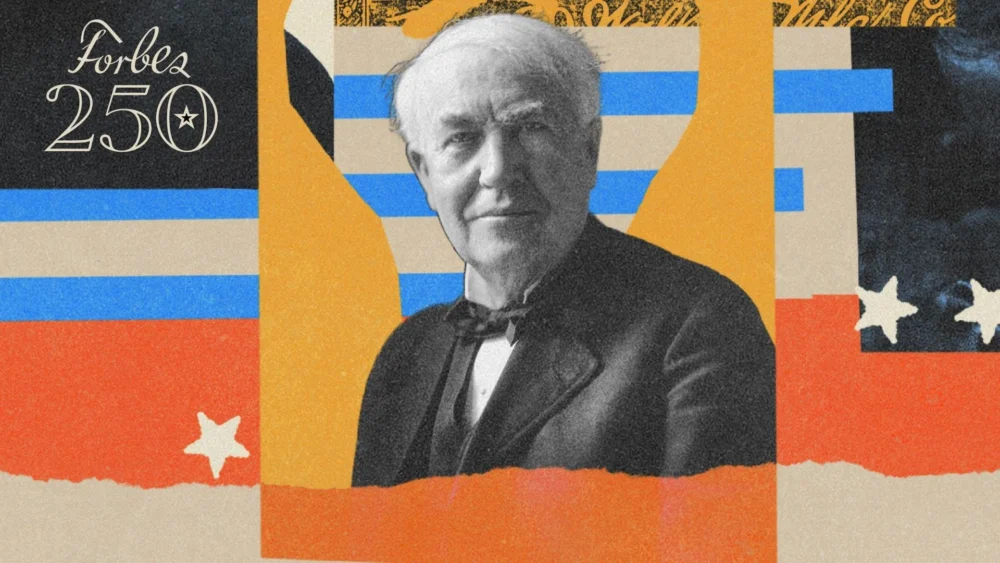
In the twilight of his life, sitting amidst the subtropical warmth of his Fort Myers estate in 1929, Thomas Alva Edison remained a man obsessed with the horizon. At eighty-two, the "Wizard of Menlo Park" had already fundamentally altered the trajectory of human history. He had captured sound on wax, trapped light in a vacuum, and laid the literal copper foundations of the modern world. Yet, as he looked out across a landscape rapidly being transformed by his own creations, Edison did not see a finished masterpiece. Instead, he saw a world that had barely begun to scratch the surface of its potential. To Edison, the sprawling electrical grids and the burgeoning industrial complexes of the late 1920s were not signs of maturity; they were the first shaky steps of a "yelling baby."
The core of Edison’s philosophy in his later years was a profound, almost spiritual belief in the efficiency of nature and the relative inefficiency of man. He was famously critical of the human brain, once noting that most people utilize only a fraction of their mental capacity. He viewed the brain as an engine, one that he personally ran at a hundred percent capacity until the very end. This relentless mental labor led him to a startling conclusion that is only now, nearly a century later, becoming the central pillar of global energy policy: the necessity of harvesting energy directly from the sun.

Edison’s perspective on energy was rooted in a sophisticated understanding of resource depletion that was decades ahead of its time. He characterized fossil fuels—coal and petroleum—as a "bank account" of stored sunlight. He recognized that the energy contained within a lump of coal was merely the preserved radiation of a sun that shone millions of years ago, captured by prehistoric vegetation. To Edison, relying on these finite reserves was a form of economic and technological laziness. He argued that mankind was essentially walking through a "golden shower of money" every day—the constant influx of solar radiation—and yet lacked the collective intelligence to stoop down and pick up a single coin.
His prediction was bold: he believed that mankind would eventually find a way to draw electrical energy on a massive scale directly from the sun’s rays. In 1929, this was the stuff of science fiction. The first silicon solar cell wouldn’t be developed at Bell Labs for another twenty-five years. Yet Edison, with the intuition that had served him through over a thousand patents, saw the direct conversion of light to power as an inevitability. He didn’t fear the exhaustion of oil or coal; he simply viewed them as a primitive bridge to a more elegant, radiant future. This vision aligns perfectly with the modern transition toward photovoltaics and renewable infrastructure, validating his status not just as a tinkerer, but as a systems-level strategist for the species.
Beyond the mechanics of power, Edison’s 1929 reflections offer a masterclass in the psychology of innovation. When questioned about the future of the "independent inventor," a role he practically invented, Edison remained a staunch individualist. Despite the rise of massive corporate R&D departments—the "industrial research hordes" of companies like General Electric and Westinghouse—Edison maintained that the most revolutionary breakthroughs would always emerge from the private individual or the "exceptional man" within a laboratory. He was skeptical of the committee-driven approach to discovery, believing that the "centrifugal" force of a single, focused mind was more powerful than the diffused efforts of a bureaucracy.

This belief was inextricably linked to his views on intellectual property. Edison proposed a radical restructuring of the patent system, suggesting a federal "patent court" that would hold inventions "in trust" for the creator. He saw the legal battles over patents as a drain on the creative spirit. His motivation for inventing was never purely altruistic, nor was it purely mercenary. He famously stated that he invented "to obtain money to go on inventing." This cycle of reinvestment—where capital was merely fuel for the next experiment—defined his entire career. It is a model that mirrors the modern "venture-backed" startup culture, though Edison performed this cycle within his own skin.
His deafness, often viewed as a tragic disability, was framed by Edison as a strategic advantage. He claimed that the silence allowed him to meditate and think without the "small talk" and "trivial noises" of the world interrupting his focus. In an era before the term "deep work" was coined, Edison was its ultimate practitioner. He was a "giver-out" of ideas, not a "taker-in" of noise. This internal focus allowed him to see connections that others missed, such as the "Edison Effect." While he didn’t fully realize in 1883 that his discovery of negative electricity emission from filaments would lead to the vacuum tube and the entire field of electronics, by 1929 he recognized that "wired electricity" would remain dominant unless a truly transformative discovery in the field of wireless transmission occurred.
Interestingly, Edison was somewhat skeptical of the wireless transmission of power, a dream famously pursued by his rival Nikola Tesla. While Edison’s own discoveries formed the basis of radio telephony, he remained a pragmatist regarding the grid. He predicted that aircraft would likely never be electrically driven without wireless power, and he saw the electrification of the world’s railroads as a high priority. When asked about the potential exhaustion of petroleum, he didn’t panic. He saw a menu of alternatives: powdered coal, benzol, and alcohol. His faith in "Nature" was absolute; he believed that as long as the sun shone and the earth turned, man’s demand for power would be met, provided man was willing to do the "real labor of thinking."

This labor of thinking was, in Edison’s view, the rarest commodity on earth. He kept a maxim by his desk: "There is almost nothing in the world which a man will not resort to in order to avoid the real labor of thinking." He applied this labor not just to light bulbs and phonographs, but to the very biology of survival. In his final years, he turned his attention to domestic rubber production. Concerned that a global conflict or a blockade could cut off America’s supply of rubber, he began "Burbanking" (a reference to his friend Luther Burbank) thousands of species of weeds and plants in Florida to find a domestic source of latex. He eventually settled on Goldenrod, proving that even in his eighties, his mind was still looking for ways to bridge the gap between natural abundance and human need.
The historical context of Edison’s 1929 insights is critical. He had emerged as a young telegraph operator in the wake of the Civil War, a time when the United States was a collection of fragmented, agrarian communities. He lived to see it become a unified industrial titan. He witnessed the birth of the Bessemer steel process, the rise of the transcontinental railroad, and the first oil booms. He saw electricity evolve from a laboratory toy into the literal nervous system of civilization. Yet, he insisted that we were only on the "sandy beach" of the Epoch of the Volt and Ampere.
Analyzing Edison’s "yelling baby" analogy today reveals the depth of his foresight. In 1929, the electrical industry was focused on basic illumination and rudimentary motor power. Edison anticipated an evolution toward "other forms of energy not yet discovered." If we look at the late 20th and early 21st centuries, we see the fulfillment of this through the discovery of nuclear power, the development of semiconductors, and the rise of quantum computing. We are now moving into an era of "smart grids" and solid-state batteries—technologies that Edison would have recognized as the "adolescence" of his child.

The enduring legacy of Thomas Edison is not found in any single invention, but in the methodology of the "1% inspiration and 99% perspiration." He codified the process of modern innovation: identify a need, conduct exhaustive and systematic experimentation, and scale the result into an industry. As we face the modern challenges of climate change and energy transition, Edison’s 1929 predictions serve as both a roadmap and a challenge. He saw a future where we would stop "overdrawing" our ancient sunlight bank account and start living off the "current revenue" of the sun. He saw a world where the individual inventor would still be the primary driver of progress. Above all, he saw a world that was still waiting to be truly discovered, provided we are willing to undertake the hard, quiet work of thinking.
As the 1920s drew to a close, the "Wizard" remained a "centrifugal" force, spinning out ideas that would continue to tingle through the wires of the world long after he was gone. He didn’t just power the past; he provided the intellectual spark for a future that is still unfolding. The "yelling baby" he described has grown into a titan, but as Edison would likely remind us if he were here today, the ocean of discovery is still vast, and we have still only wet our shins.
