

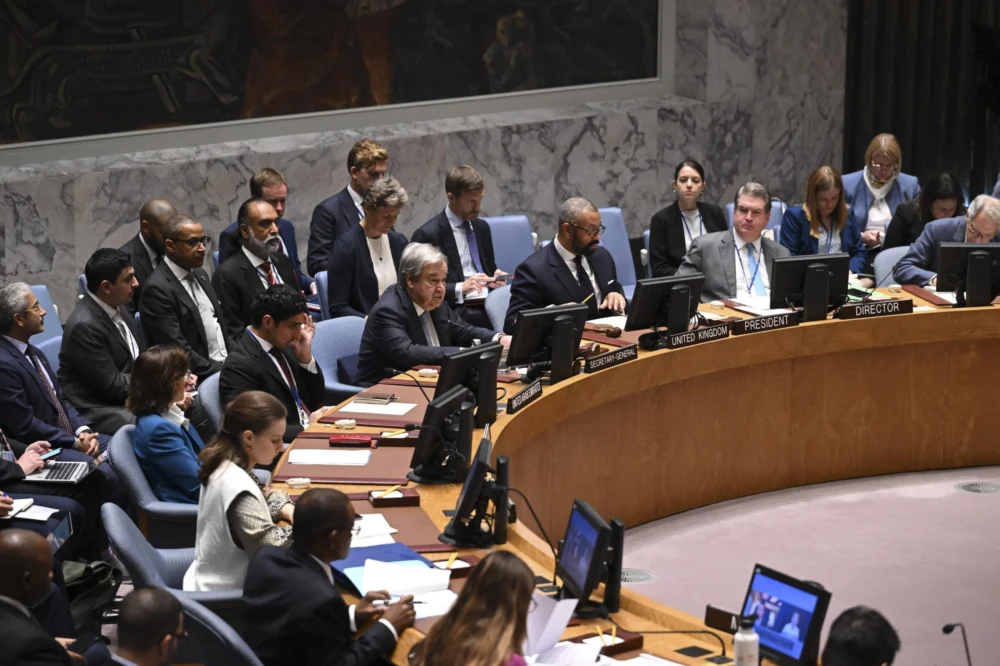
In a move that signals a profound shift in the international community’s approach to emerging technologies, the United Nations General Assembly has formally approved the creation of a 40-member Independent International Scientific Panel on Artificial Intelligence. This new body is tasked with the monumental responsibility of conducting recurring, evidence-based assessments of AI’s impacts, opportunities, and risks. However, the landmark decision was not met with universal consensus. While 117 member states voted in favor of the initiative, the United States and Paraguay cast "no" votes, while Ukraine and Tunisia abstained, highlighting the deep-seated geopolitical tensions that now define the global race for technological supremacy.
The establishment of this panel represents the first time a fully independent global scientific body has been chartered under the UN banner specifically to bridge the widening knowledge gap in artificial intelligence across different nations. As AI capabilities accelerate at an exponential rate, the international community has struggled to find a common language for governance. The new panel is intended to provide that shared foundation, delivering annual reports that synthesize existing research and cross-disciplinary expertise to inform future policy.
Defining the Mandate: Assessment, Not Regulation
To understand the significance of this vote, it is essential to distinguish between scientific assessment and regulatory enforcement. Despite some initial framing of the move as the UN "regulating" the digital frontier, the General Assembly’s action was more procedural and advisory in nature. The 40-person panel does not possess the authority to draft binding treaties, impose fines on tech giants, or revoke access to critical computing infrastructure. It is not an enforcement agency, nor does it create an international licensing regime for large language models.
Instead, the panel is modeled after the Intergovernmental Panel on Climate Change (IPCC). Just as the IPCC does not pass environmental laws but provides the authoritative scientific consensus that shapes global climate negotiations, this AI panel is designed to create a "ground truth" for policymakers. By publishing rigorous, independent summaries of AI’s real-world effects—ranging from economic labor shifts and social impacts to catastrophic safety risks—the body aims to harmonize the data upon which different governments base their own domestic regulations.
The panel’s influence will likely be felt through "soft power." In the world of international standards and trade, independent assessments often serve as the bedrock for procurement requirements and safety certifications. If the panel’s reports become a trusted reference point, they could indirectly dictate the "rules of the road" for developers and corporations seeking to operate in the 117 countries that supported the panel’s creation.
The Geopolitical Friction: Why the U.S. Said No
The most striking aspect of the General Assembly’s vote was the dissent of the United States. As the global leader in AI research, development, and compute capacity, the U.S. position carries immense weight. The American delegation’s "no" vote was rooted in concerns regarding both the panel’s mandate and the transparency of its formation process.
Publicly, U.S. officials argued that AI governance should not necessarily fall under the overarching jurisdiction of the United Nations, favoring instead more agile, multi-stakeholder frameworks or alliances between like-minded democratic nations. There is a persistent concern in Washington that a UN-anchored body could be susceptible to "mandate creep," eventually evolving from a scientific observer into a bureaucratic hurdle that stifles innovation.
Beneath the procedural objections lies a strategic subtext. Artificial intelligence is increasingly viewed through the lens of national security and economic competitiveness. The U.S. delegation voiced anxieties that international oversight bodies could be influenced by authoritarian regimes to promote standards that favor state-controlled technological ecosystems or restricted access to information. By establishing a "scientific consensus" within a UN framework, the U.S. fears that countries with fundamentally different political systems could gain a platform to shape international expectations on sensitive issues like surveillance, disinformation, and the use of AI in critical infrastructure.
The dissent of the U.S. is particularly notable because many of its traditional allies, including the United Kingdom and several European Union member states, voted in favor of the panel. This divergence suggests a fragmentation in how Western powers view the role of international institutions in the digital age. While Europe often leans toward centralized, rights-based governance—exemplified by the EU AI Act—the U.S. has historically preferred a more decentralized, industry-led approach.

Membership and the Politics of Representation
The legitimacy of any scientific body rests on its perceived independence and the caliber of its members. The selection process for the 40-member panel was reportedly rigorous, drawing from a pool of thousands of candidates. The final roster reflects a commitment to multi-disciplinary expertise, moving beyond computer science to include specialists in ethics, law, and social impact. Notable members include Nobel Peace Prize laureate Maria Ressa, whose work on disinformation and press freedom highlights the panel’s focus on the societal consequences of algorithmic systems.
However, the inclusion of certain experts has already become a flashpoint for international conflict. Ukraine’s decision to abstain from the vote was a direct protest against the inclusion of a Russian expert, Andrei Neznamov, who is recognized for his work in AI regulation and ethics. For Ukraine, the presence of a representative from a nation currently engaged in an aggressive war undermines the ethical standing of the panel. This objection underscores a harsh reality: in the current global climate, even "independent" scientific endeavors are inseparable from the realities of geopolitics. When a member state links the validity of a panel to the nationality of its participants, it signals that the body’s future assessments will be scrutinized not just for their data, but for their perceived political biases.
Industry Implications and the "Brussels Effect"
For the private sector, the establishment of the UN panel adds another layer to an already complex regulatory landscape. Tech companies are currently navigating a patchwork of domestic laws, from the comprehensive EU AI Act to various U.S. executive orders and China’s targeted algorithmic regulations.
The UN panel’s reports could accelerate the "Brussels Effect"—a phenomenon where the most stringent or widely accepted standards become the global default because it is more efficient for companies to comply with one high standard than to manage dozens of different ones. If the UN panel identifies specific AI training methods or deployment scenarios as "high risk," those findings could quickly be adopted by national regulators, insurance underwriters, and institutional investors.
Furthermore, the panel’s focus on "bridging knowledge gaps" is particularly relevant for the Global South. Many developing nations lack the domestic expertise to independently audit complex AI systems. For these countries, the UN panel provides a vital resource, allowing them to participate in the AI economy without being entirely dependent on the assessments provided by the companies themselves or by the world’s two or three dominant tech superpowers.
Future Trends: Towards a Global AI Accord?
As the panel begins its multi-year terms, its first task will be to establish a methodology that can withstand intense political pressure. The challenge will be to produce assessments that are concrete enough to be actionable for governments, yet neutral enough to avoid being dismissed as partisan by the world’s major AI powers.
The long-term impact of this body may depend on whether it can foster a "shared reality" regarding the risks of frontier models. If the panel successfully identifies universal safety benchmarks, it could pave the way for a more formal international treaty in the future—something akin to the Non-Proliferation Treaty for nuclear weapons or the Montreal Protocol for ozone-depleting substances.
However, the "no" vote from the United States suggests that such a grand bargain remains a distant prospect. Without the buy-in of the nation that controls the vast majority of the world’s AI talent and hardware, the UN panel risks becoming a forum that represents the "rest of the world" while the actual technological frontier continues to be governed by a small group of private entities and a few powerful states.
The next phase of global AI governance will be defined by this tension between the desire for inclusive, international oversight and the reality of strategic competition. The UN panel is now officially a part of that landscape, and its annual reports will likely become the primary battleground where the world’s differing visions for the future of intelligence are debated. Whether it becomes a trusted authority or a sidelined bureaucracy will depend on its ability to navigate the fine line between scientific truth and political compromise. For now, the vote serves as a stark reminder that while the code of AI may be universal, the rules governing it are anything but.
