

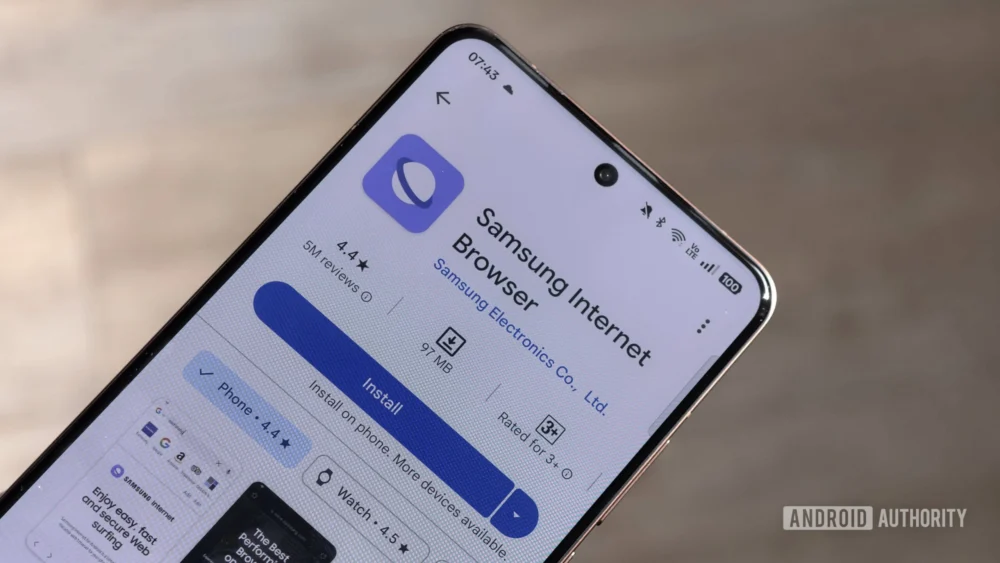
The cadence of software development within the Android ecosystem often means that while current-generation interfaces are still receiving their final polish—as evidenced by the beta testing of One UI 8.5, slated for debut alongside the anticipated Galaxy S26 series later this month—the groundwork for the subsequent major iteration is already being laid. A recent deep dive into pre-release test firmware for One UI 9 has provided an early, revealing glimpse into Samsung’s strategic roadmap, particularly concerning the evolution of its proprietary Samsung Internet browser. This preliminary analysis suggests that Samsung is moving far beyond incremental feature additions, positioning its browser as a central hub for generative AI interaction on its mobile hardware, a move expected to coincide with the unveiling of the next generation of Galaxy Z Foldables mid-year.
The existing implementation of AI within Samsung Internet, branded under the "Browsing Assist" umbrella, currently offers foundational capabilities. These include automated page summarization, real-time translation services, and the extraction of key news highlights from visited content. These features, while useful, represent a relatively passive form of AI integration, primarily focused on content consumption efficiency. The current description for Browsing Assist accurately reflects this: "Browsing assist uses AI to summarize, translate, read summarized webpages aloud, and tell you the latest news highlights."
However, the analysis of the One UI 9 test builds reveals a significant pivot toward active, conversational AI integration. The core innovation appears to be a newly surfaced feature designated internally as “Ask AI.” This is not merely an enhancement to existing summarization tools; it represents the transformation of the browser interface into an interactive Q&A environment directly tied to the content being viewed. The updated documentation within the leaked firmware explicitly redefines the scope of Browsing Assist, suggesting a much broader mandate: "Browsing assist uses AI to answer questions about webpages and other topics, summarize and translate text, and read highlights aloud."
The inclusion of "answer questions about webpages and other topics" fundamentally alters the user expectation for a mobile browser. It signals Samsung’s intent to compete directly with browser extensions and dedicated AI chatbots by embedding these capabilities natively and contextually within the browsing experience.
Further scrutiny of the string resources within the test build confirms the conversational depth Samsung is targeting. Code snippets indicate robust support for iterative dialogue, essential for complex information retrieval: strings such as "ask_anything" and "ask_follow_up" strongly suggest that users will be able to engage in multi-turn conversations. This capability is critical; the utility of generative AI often lies not in the first answer, but in the ability to refine, challenge, or explore related sub-topics without reloading or re-contextualizing the initial query. For instance, a user reading a technical specification could ask an initial question about a component, and subsequently ask, "What are the implications of that on battery life?"—all within the context of the original webpage.
Perhaps the most significant, and potentially contentious, element uncovered relates to data handling and personalization. The development strings explicitly detail how Samsung intends to leverage user data to refine these AI interactions: "When you ask questions, Samsung processes the page content and, for questions, your browsing history. Past questions and answers are also stored by Samsung to personalize results." This reveals a clear strategy: to transition from general-purpose AI responses to highly contextualized, personalized assistance driven by the user’s longitudinal browsing activity within the Samsung Internet application. This level of data linkage between browsing habits and conversational AI output places Samsung on a path similar to deep ecosystem integrations seen in other major tech platforms, albeit one that will undoubtedly attract heightened scrutiny regarding privacy compliance and user consent mechanisms.
The implications of this personalized data usage extend beyond simple convenience. By storing and analyzing past queries alongside the content that prompted them, Samsung is creating a specialized, user-specific knowledge graph accessible through the browser. This promises superior contextual recall compared to session-based AI tools, but it necessitates a transparent and granular control structure for users concerned about data retention.
The firmware analysis provided an early look at these retention controls, specifically highlighting the "Keep Ask AI activity" settings. While the leak only clearly revealed a "Session only" option, accompanied by a note that activity "may be retained for up to 3 days," the structure suggests that more comprehensive options—such as weekly, monthly, or indefinite storage—will likely be presented in the final public release. This granular control over conversational history will be a key differentiator, particularly in the European market where strict data governance regulations prevail. The current string notes that the user’s choice "will immediately apply to all of your devices," underscoring Samsung’s commitment to a unified, cross-device experience, a hallmark of its One UI strategy.
Furthermore, the discovery of accompanying graphical assets—both light and dark theme icons specifically for the "Ask AI" feature—confirms that this functionality is slated for deep integration into the user interface, rather than being hidden behind obscure settings menus. This visual confirmation suggests that Samsung views "Ask AI" as a headline feature for One UI 9, designed to be immediately discoverable and central to the new user experience.
Background and Industry Context
To fully appreciate the magnitude of this anticipated update, one must consider the current state of the mobile browser market and the broader "AI arms race" among major technology players. For years, the browser market has been dominated by a duopoly, with Google Chrome holding the lion’s share globally, followed by a scattering of alternatives like Apple’s Safari and Mozilla’s Firefox. Samsung Internet has carved out a significant niche, particularly among Galaxy device owners, often favored for its performance, customization options, and specific features like ad-blocking support.
However, the advent of powerful Large Language Models (LLMs) has turned the browser into the new battleground. Google has aggressively integrated Gemini directly into Chrome, focusing on AI summaries and generative search. Microsoft has leveraged Copilot within the Edge browser to provide a persistent sidebar assistant capable of analyzing current content. Samsung’s move with "Ask AI" is a clear declaration that it intends to fully participate in this shift, utilizing its native browser as a primary vector for showcasing its own AI capabilities, presumably powered by the Samsung Gauss models or customized iterations of Google’s Gemini Nano where applicable.
Samsung’s strategy here is twofold: differentiation and ecosystem lock-in. By deeply embedding AI into its own browser, rather than solely relying on the default Google integration, Samsung differentiates the Galaxy experience. This encourages users to remain within the Samsung software environment, strengthening the perceived value of owning a Galaxy device over a competitor running a stock version of Android.
Expert Analysis: The Shift from Information Retrieval to Knowledge Synthesis
The transition from the current Browsing Assist (summarization) to "Ask AI" (conversational query) represents a critical evolution from information retrieval to knowledge synthesis. Traditional search engines and basic AI tools deliver facts or condense existing text. A true conversational agent, as suggested by the follow-up query capability, synthesizes knowledge by cross-referencing the current page, stored browsing history, and external knowledge bases.
This capability moves the browser from being a passive window to the web into an active research assistant. For professionals, students, or power users, the ability to interrogate complex documents—financial reports, academic papers, lengthy legal texts—in real-time, and then build upon those interrogations, represents a genuine productivity leap. The contextuality derived from browsing history is the secret sauce; if the AI knows the user has been researching semiconductor manufacturing processes for the last week, its answers regarding a new chip announcement will be inherently more insightful than a generic query result.
However, this architectural shift places enormous pressure on Samsung regarding latency and model efficiency. For an interaction to feel seamless, the response time for complex queries must approach real-time performance, which often requires significant on-device processing (for privacy and speed) or highly optimized cloud communication. The success of "Ask AI" will heavily depend on Samsung’s ability to balance the computational load across its flagship silicon.
Industry Implications and Future Trends
The embedding of sophisticated, context-aware AI into the default browser has profound industry implications. Firstly, it further marginalizes third-party browser extensions designed for similar tasks. If Samsung Internet offers superior, native integration for summarization and Q&A, the incentive for users to install and manage external tools diminishes significantly. This centralization of functionality reinforces the platform holder’s control over the user experience.
Secondly, this development signals the direction for all mobile software interfaces. The trend is clear: every core application—messaging, email, settings, and now the browser—will eventually feature a persistent, context-aware AI layer. We are moving toward an operating system where the AI acts as a meta-layer, interpreting user intent across multiple applications. The integration seen in One UI 9’s Internet browser is a strong leading indicator of this forthcoming "AI-native OS" paradigm.
Looking ahead, the future impact centers on digital literacy and information consumption habits. If AI can instantly distill the essence of any webpage, users may become less inclined to read deeply or critically evaluate source material. The risk of confirmation bias amplification is also heightened when the AI is explicitly using personalized history to tailor results. Therefore, Samsung’s commitment to transparency regarding data retention—and the sophistication of the controls offered—will become as important as the AI’s accuracy.
The fact that this feature is being prepared for One UI 9, which is slated for a mid-year release alongside the foldables, suggests that Samsung views this advanced browsing capability as a key selling point for its next hardware cycle, potentially targeting the unique multitasking and consumption patterns inherent to foldable form factors. The larger screen real estate of a device like the Galaxy Z Fold is perfectly suited for complex, multi-pane AI interactions that the "Ask AI" feature promises.
In summary, the emergence of "Ask AI" in early One UI 9 builds suggests Samsung is aggressively positioning its native browser to become a highly personalized, interactive knowledge synthesizer. This leap from passive assistance to active conversation, underpinned by the processing of extensive user history, marks a significant strategic investment that will redefine the competitive landscape for mobile web interaction over the next generation of software. The industry will be watching closely to see if Samsung can deliver the promised intelligence while simultaneously maintaining the robust privacy assurances expected by the modern user base. The true test will be how seamlessly this powerful, history-aware intelligence integrates without feeling intrusive or compromising user autonomy.
