


The proliferation of sophisticated information-stealing malware, exemplified by the ongoing evolution of Atomic MacOS Stealer (AMOS), signals a fundamental shift in cybercriminal operations. AMOS is no longer merely a piece of software; it represents a vital, high-yield node in a vast, industrialized data-harvesting infrastructure. Instead of being the final destination, these stealers act as highly efficient, scalable data extraction mechanisms, feeding a thriving underground economy where digital identities, authenticated sessions, and financial keys are commodities traded for subsequent criminal exploitation.
The enduring efficacy of these campaigns stems from a calculated reliance on social engineering, wherein threat actors dynamically pivot to exploit the latest technological trends. Whether manipulating search engine results, compromising trusted software ecosystems, or, more recently, infiltrating emerging Artificial Intelligence (AI) platforms, the core objective remains the same: tricking the end-user into self-executing the payload. This potent synthesis of industrialized data monetization and adaptive psychological manipulation solidifies infostealers as the preeminent, low-friction entry vector in the contemporary threat landscape.
Recent forensic analysis, detailed in reports such as the 2026 Enterprise Infostealer Identity Exposure study by Flare researchers, underscores the increasing centrality of infostealers to cybercrime revenue streams and the cascading impact that widespread identity exposure has on organizational resilience. Examining AMOS through this lens reveals not just a threat to individual users, but a systemic vulnerability rooted in the trust users place in software distribution channels, particularly those associated with cutting-edge technologies like generative AI.
The Operational Calculus of Infostealers
To appreciate the threat posed by AMOS, one must understand the role of infostealers within the modern cyber kill chain. They serve as crucial force multipliers, converting a single point of user error into a comprehensive breach of digital assets. Upon execution on a compromised macOS endpoint, the malware initiates a rapid sweep: targeting credentials stored in web browsers, native keychain access points, cryptocurrency wallets, instant messaging caches, and localized sensitive files. The extracted data—including authentication tokens, session cookies, and proprietary documents—is immediately exfiltrated to infrastructure controlled by the operators.
This process prioritizes breadth and speed over deep system persistence, aligning perfectly with the business model of Malware-as-a-Service (MaaS). The goal is rapid acquisition of usable credentials, not long-term espionage, which allows the malware to be cheap to develop and highly disposable.
ClawHavoc: Weaponizing the AI Ecosystem
The most recent, and perhaps most illustrative, campaign involving AMOS, dubbed "ClawHavoc," demonstrates the threat actor’s relentless pursuit of novel distribution vectors. Security researchers at Koi Security have detailed how this large-scale supply-chain compromise targeted the OpenClaw and ClawHub ecosystem—a popular personal AI assistant framework.
The attack cleverly circumvented traditional security postures by poisoning the very marketplace designed to host trusted extensions or "skills" for the AI application. Attackers leveraged the intense hype surrounding AI tools. As organizations and individuals eagerly onboarded OpenClaw for perceived productivity gains, AMOS distributors injected malicious skills disguised as legitimate utilities: productivity boosters, cryptocurrency management tools, or integrations for common services like Google Workspace.

Once installed, these compromised skills acted as Trojan horses, deploying AMOS to pilfer credentials, crypto wallet data, active browser sessions, and even SSH keys. The ClawHavoc incident serves as a stark warning: any ecosystem featuring a decentralized, low-scrutiny marketplace for user-generated content—especially one hyped by emerging technology—becomes an immediate, high-leverage target for infostealer distribution. The weakness is not in the code of the AI assistant itself, but in the vetting process of its peripheral components.
AMOS: A Historical Context of Evolution
AMOS first surfaced in public view around May 2023, advertised on Telegram channels. Its initial marketing materials clearly outlined a comprehensive capability set tailored specifically for the Apple ecosystem: harvesting passwords from the macOS Keychain, aggressive file exfiltration, detailed system profiling, comprehensive browser session theft, and dedicated modules for extracting cryptocurrency wallet information. The operational cost at that time reflected a premium MaaS offering, often priced around $1,000 monthly, payable in privacy-focused cryptocurrencies like USDT (TRC20), ETH, or BTC.
Since its debut, AMOS has matured from a niche Mac-focused tool into a recognized component of the broader criminal data market. The primary value proposition has shifted: while some actors use it directly, many others are now secondary purchasers, buying the raw "stealer logs" generated by AMOS infections. These logs—containing validated credentials and session tokens—are the raw material for subsequent, more specialized attacks, such as complex account takeovers or initial access brokering for ransomware operations. An observed advertisement from a Russian-speaking threat actor explicitly seeking AMOS logs for follow-on crypto theft perfectly encapsulates this industrial layering.
Modus Operandi: The Shifting Attack Surface
AMOS’s distribution methods have continuously adapted, moving beyond traditional vectors like generic phishing emails and trojanized installers to embrace platform abuse.
The GitHub/SEO Poisoning Tactic
A notable campaign focused on impersonating software brands and targeting users searching for productivity tools. Attackers established hundreds of fraudulent GitHub repositories, meticulously mimicking the branding of over 100 legitimate software vendors. This effort was amplified through Search Engine Optimization (SEO) poisoning across major search engines like Google and Bing. Victims, searching for trusted software, were directed to these malicious repositories. The final stage often involved ClickFix-style social engineering, where users were convinced to paste and execute specific Terminal commands, which silently fetched and ran the AMOS payload. The resilience of this approach lies in the attackers’ ability to automate the creation of new GitHub accounts, transforming a trusted developer platform into a highly scalable, ephemeral distribution infrastructure.
Deep Integration with AI Hype Cycles
ClawHavoc was not the first instance of AMOS exploiting the AI narrative. Earlier campaigns, documented in late 2025, targeted users of large language models like ChatGPT. In these instances, threat actors utilized the legitimate, trusted chat-sharing functionality inherent to the platform (chatgpt.com) to host malicious "installation guides." Lured via malvertising promoting fake "ChatGPT Atlas browsers" for macOS, victims were directed to these trusted domains and instructed to execute a single-line command in their Terminal. This demonstrated a sophisticated understanding of trust propagation: if the instruction originates from a domain the user implicitly trusts (like OpenAI’s), the likelihood of execution increases dramatically. This strategy weaponizes the perceived security of a high-profile service against its own user base.
Enduring Traditional Vectors
Despite these high-tech diversions, AMOS continues to rely on proven, low-tech social engineering methods. This includes deploying malware concealed within seemingly legitimate disk images (DMG files) impersonating popular software like Tor Browser, Adobe products, or Microsoft Office suites. Malvertising remains a critical component, driving traffic from search queries for legitimate software directly to look-alike domains hosting the malicious installers.
The instruction-based execution technique, often termed "ClickFix," remains a favored method against macOS users. Rather than relying on zero-day vulnerabilities, attackers manipulate users into willingly executing malicious code by providing seemingly innocuous steps—such as dragging an icon into a Terminal window or pasting a multi-part command—thereby sidestepping many automated detection systems that monitor file execution, focusing instead on user-initiated terminal activity.
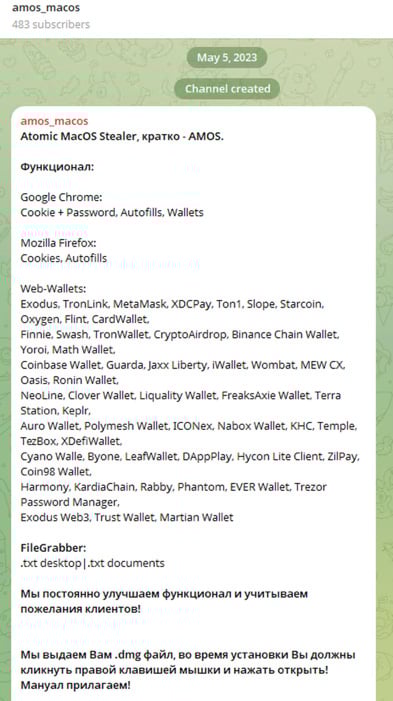
Deconstructing the Underground Economy Model
The AMOS operational structure perfectly illustrates the mature Malware-as-a-Service ecosystem. This supply chain is divided into three specialized tiers:
- Developers/Operators: These actors maintain the core AMOS platform, providing technical updates, managing command-and-control infrastructure, and often offering a web-based management panel for affiliates. This tier operates on a subscription model, typically commanding $1,000+ per month in cryptocurrency.
- Distributors (Affiliates): This layer comprises the most visible and tactically innovative segment. Distributors purchase access to the MaaS tool and focus entirely on creating compelling lures, optimizing SEO poisoning, launching malvertising campaigns, and refining the psychological manipulation necessary to achieve maximum infection volume across their chosen target segments (e.g., AI enthusiasts, LastPass users, etc.).
- Log Consumers (Monetizers): These are the downstream threat actors who purchase the resulting "stealer logs." This group includes access brokers selling initial footholds to ransomware gangs, account takeover specialists targeting high-value SaaS platforms, and dedicated financial fraud units specializing in crypto liquidation.
This layered approach ensures that the primary malware developers are insulated from direct end-user interaction, and the distributors are focused solely on delivery, creating a highly efficient, multi-stage revenue pipeline. The core capability set of the malware itself evolves slowly—minor feature updates or evasion tweaks—but the distribution tactics are constantly revolutionized by the affiliate layer, which responds immediately to emerging technological trends like the AI boom.
Industry Implications and Expert Analysis
The evolution of AMOS highlights a critical convergence point: the intersection of consumer enthusiasm for new technology and the cybercriminal imperative to monetize user trust. For organizations utilizing macOS environments, the implication is profound. Traditional perimeter defenses, focused on network intrusion, are increasingly ineffective against attacks initiated by user action based on sophisticated social engineering.
Industry Impact:
- Erosion of Platform Trust: The successful infiltration of AI extension marketplaces (like OpenClaw) and developer platforms (like GitHub) shows that trust boundaries within the modern software supply chain are porous. Security teams must now vet not just the software they install, but the components and add-ons that integrate with their workflows, especially when those components involve cloud-based AI services.
- Credential Theft as Initial Access: AMOS reinforces the reality that stolen credentials, particularly session cookies, are the preferred initial access mechanism over complex zero-day exploits. Session cookies bypass standard multi-factor authentication (MFA) protections that only check login events, as the cookie itself represents an already authenticated session.
- The macOS Target Shift: While Windows has historically dominated malware targets, AMOS and similar macOS-specific stealers prove that Apple’s ecosystem is now a lucrative, targeted market. This is driven by the perception among attackers that macOS users often hold higher-value targets (e.g., developers, finance professionals, creative industries) and may possess laxer security habits compared to enterprise Windows environments.
From an expert security standpoint, the resilience of AMOS campaigns points to a failure in user-level security education regarding execution mechanisms. Techniques that require users to manually type or paste commands into a privileged shell (Terminal) are highly effective because they bypass application sandboxing and permission dialogues that often stop standard application installers.
Future Trajectories and Mitigation
The trajectory of AMOS suggests that future infostealer campaigns will double down on exploiting digital ecosystems that rely on community-vetted add-ons. Expect to see similar attacks targeting integration marketplaces for developer tools, specialized productivity suites, and, most significantly, the nascent ecosystems surrounding enterprise-grade AI agents and automation platforms.
Future Impact and Trends:
- Hyper-Personalized Social Engineering: As LLMs become more capable, the generation of highly believable, context-aware phishing content will accelerate, making manual user detection significantly harder.
- Focus on Session Hijacking: Expect continued refinement in modules that target session tokens (e.g., browser storage, cloud sync tokens) over static passwords, increasing the dwell time attackers can maintain before a compromise is noticed.
- AI-Driven Evasion: Developers of AMOS will likely integrate AI models to test new code obfuscation and signature evasion techniques in real-time against security scanners, further increasing the lifecycle of the malware before detection signatures are widely distributed.
Mitigation requires a multi-layered defense strategy focusing heavily on endpoint behavior analysis rather than signature matching. Organizations must implement robust application control policies that restrict arbitrary command execution, particularly via the Terminal. Furthermore, security awareness training must evolve beyond recognizing basic phishing emails to educating users on the dangers of executing unknown code snippets sourced from external, non-vetted platforms, regardless of how trusted the parent domain appears. The battleground has moved from network intrusion to human trust, and only through vigilant verification of execution sources can the AMOS-style threat be effectively countered.
