

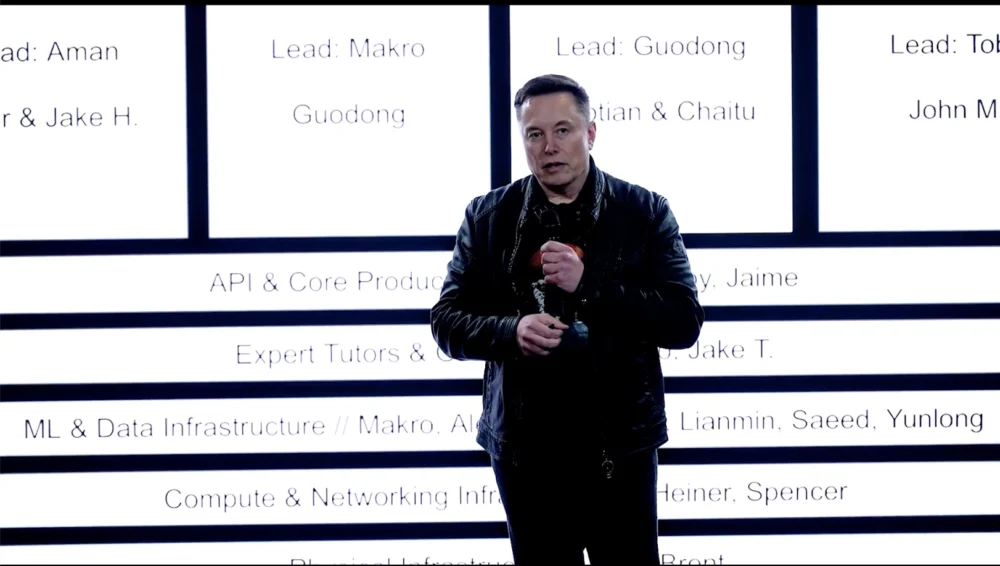
In a move that defies the standard operating procedures of Silicon Valley’s notoriously secretive artificial intelligence sector, xAI recently pulled back the curtain on its internal operations, broadcasting a 45-minute all-hands meeting directly to the public. While the decision to release the footage may have been a reactive maneuver following high-profile leaks, the content of the presentation itself offers an unfiltered look at a company attempting to bridge the gap between terrestrial software and interplanetary infrastructure. The briefing served as both a status report on the company’s volatile internal culture and a manifesto for a future where artificial intelligence is not merely a chatbot, but the primary architect of a spacefaring civilization.
The transparency comes at a precarious moment for the startup. Behind the scenes, xAI is navigating a significant period of internal friction, marked by the departure of several high-ranking employees, including members of the original founding team. Elon Musk, the company’s founder, framed these exits not as a sign of instability, but as a necessary "evolution" of the organizational chart. In the high-stakes arms race of generative AI, the transition from a lean research lab to a product-driven powerhouse often results in such structural shedding. However, the loss of foundational talent raises questions about the long-term continuity of the lab’s original mission versus its current trajectory as a support pillar for the broader X (formerly Twitter) ecosystem.
Under the newly unveiled organizational structure, xAI has been bifurcated into four distinct operational divisions, each tasked with a specific vertical of the company’s roadmap. The first team remains focused on Grok, the conversational AI that serves as the flagship interface for users on X. This team is now prioritizing multi-modal capabilities, specifically voice integration, as xAI seeks to compete with the likes of OpenAI’s GPT-4o and Google’s Gemini. The second division is dedicated to the "app’s coding system," an essential component for automating the very platform that hosts the AI. The third branch manages "Imagine," the image and video generation engine that has become a central, albeit controversial, feature of the X user experience.
Perhaps the most ambitious of the four is the "Macrohard" project. Led by Toby Pohlen, Macrohard is designed to be more than just a productivity tool; it is being built as a "Large Action Model" (LAM) capable of navigating any digital environment a human can. The scope of Macrohard extends from basic computer task automation to the complex modeling of entire corporate structures. During the all-hands, Pohlen articulated a vision where AI does not just assist engineers but takes the lead in heavy industry. The ultimate goal, according to Pohlen, is for AI to independently design and optimize rocket engines—a clear nod to the vertical integration planned between xAI and SpaceX. This signals a shift in the AI narrative from "content generation" to "physical world engineering."
The economic health of this ecosystem was also a focal point of the presentation. Nikita Bier, a prominent product leader at X, revealed that the platform has surpassed $1 billion in annual recurring revenue (ARR) specifically from subscriptions. This milestone is significant, as it suggests that the integration of xAI’s tools—particularly Grok and the Imagine suite—is successfully driving a "prosumer" model on a platform that was historically reliant on advertising. The company reported staggering usage statistics, claiming that the Imagine tool is currently generating 50 million videos per day and has produced over 6 billion images in the last month alone.
However, these figures do not exist in a vacuum. The surge in image generation coincides with a period of intense scrutiny regarding the proliferation of deepfake content on X. Analysts point out that the platform’s engagement metrics have been heavily influenced by a "flood" of AI-generated explicit material. Estimates suggest that nearly 2 million sexualized deepfakes were generated in a span of just nine days earlier this year. This creates a complex narrative for xAI: while the technical capability of their models is clearly scaling at an exponential rate, the social and ethical externalities of that scale remain a primary point of friction with regulators and the public. The challenge for xAI moving forward will be to decouple its legitimate creative usage from the viral spread of harmful synthetic media without stifling the "free-speech" ethos Musk has championed.

The presentation’s finale shifted from terrestrial metrics to the realm of "computational cosmopolitics." Musk reiterated his conviction that the future of heavy-duty AI training lies not on Earth, but in orbit. The logic is driven by the brutal economics of energy and cooling. On Earth, data centers are increasingly constrained by power grid limitations and environmental regulations. In space, the potential for solar energy collection is orders of magnitude higher, and the vacuum of space offers a unique, if challenging, environment for thermal management.
Musk’s vision for this orbital infrastructure involves a "lunar factory" dedicated to the production of AI satellites. To solve the problem of launch costs—which remain the primary bottleneck for space-based industry—he proposed the construction of a lunar "mass driver." This electromagnetic catapult would allow for the low-cost delivery of hardware from the Moon’s surface into orbit or deeper into the solar system. By leveraging the Moon’s lower gravity and lack of atmosphere, xAI and its partners could theoretically bypass the "gravity well" of Earth, creating a self-sustaining loop of silicon and steel in the cosmos.
This "interplanetary ambition" is not merely about placing servers in the sky. Musk spoke of building AI clusters capable of capturing significant portions of the sun’s total energy output—a concept that edges close to the "Dyson Swarm" theory of advanced civilizations. At this scale, the intelligence being developed would cease to be a tool for human use and would become a planetary, or even galactic, phenomenon. "It’s difficult to imagine what an intelligence of that scale would think about," Musk mused, acknowledging the profound philosophical shift that comes with moving AI into the realm of Type II civilization-level energy consumption.
The implications for the technology industry are profound. If xAI successfully integrates its intelligence models with SpaceX’s launch capabilities and Tesla’s robotics, it will have created a closed-loop system that controls the means of production, the intelligence that directs it, and the infrastructure that hosts it. This level of vertical integration is unprecedented. While competitors like Microsoft and Google are focused on dominated the cloud-based software market, xAI appears to be betting on the "physicality" of intelligence—the idea that the ultimate winner in the AI race will be the one who controls the hardware in the most advantageous locations, whether that be a data center in Texas or a satellite orbiting the Moon.
However, the path to this galactic future is littered with immediate hurdles. The "Macrohard" project must prove it can operate reliably in complex, real-world environments without catastrophic errors. The "Imagine" tool must navigate a tightening web of global AI safety legislation. And perhaps most importantly, xAI must stabilize its internal culture to prevent the further drain of the intellectual capital that started the company. The departure of founding members is a warning sign that the "hardcore" culture Musk demands may eventually hit a point of diminishing returns, even for the most brilliant minds in the field.
As we look toward the 2030s, the "all-hands" video serves as a historical marker. It captures a moment where the tech industry’s goals shifted from "connecting people" to "re-engineering the solar system." Whether xAI can actually build a lunar mass driver or if it will remain a company defined by the chaos of its social media integration remains to be seen. What is certain, however, is that the scale of the ambition has never been higher. The transition from a Silicon Valley startup to a galactic infrastructure provider is a gamble of historic proportions—one that will either result in the most significant technological leap in human history or serve as a cautionary tale of the limits of singular vision.
The strategic pivot revealed in this meeting suggests that xAI is no longer content to be just another player in the LLM (Large Language Model) space. It is positioning itself as the operating system for a new era of human expansion. By linking AI development directly to the colonization of space, Musk is betting that the constraints of Earth—political, environmental, and physical—will eventually make terrestrial AI companies obsolete. In this worldview, the "intelligence of the scale" Musk envisions isn’t just a software upgrade; it’s the next step in evolution, and the Moon is merely the first workstation.
