

The foundational shift in the generative artificial intelligence landscape has begun, as OpenAI initiates testing for targeted advertising within its widely adopted ChatGPT platform. The move, announced earlier this week, targets users relying on the Free access tier and the recently introduced, low-cost ‘Go’ subscription, signaling a critical pivot toward commercial monetization necessary to sustain the enormous operational costs of advanced large language models (LLMs). This initial phase of ad integration is strictly confined to the United States, carving out a clear distinction between subsidized public access and premium, ad-free enterprise services.
The ‘Go’ tier, priced affordably at $8 per month in the U.S. following its global debut in mid-January, represents an effort to bridge the gap between entirely free, often resource-limited access and the full-power capabilities reserved for higher-priced plans. By introducing advertising into both the free and budget-conscious Go segments, OpenAI is effectively using commercial revenue streams to subsidize the high computational demands required to serve millions of users. Subscribers utilizing the more robust, professional tiers—including Plus, Pro, Business, Enterprise, and Education—will remain shielded from advertisements, underscoring the value proposition of premium subscriptions centered on uninterrupted focus and maximum performance.
The Inevitable Monetization Imperative
The decision to adopt an ad-supported model, despite initial consumer skepticism and high-profile industry criticism, is rooted in the stark economic realities of running cutting-edge AI. Unlike traditional cloud services or software-as-a-service (SaaS) platforms, the operational expenditure (OpEx) for generative AI, particularly the "inference costs" associated with generating real-time responses, is staggeringly high. Training the underlying models, such as GPT-4, requires investments in the tens or hundreds of millions, but serving billions of tokens in conversation across a global user base incurs continuous, substantial costs.
Industry analysts estimate that even a short, complex conversation on a highly optimized LLM can cost several cents. Multiplied across the hundreds of millions of monthly users ChatGPT commands, the sheer financial burden of maintaining a free service quickly becomes unsustainable, even for a company backed by major capital injections. For OpenAI, transitioning from a pure research entity to a self-sustaining commercial enterprise requires diversified revenue streams beyond high-margin enterprise licenses and API access. The ad model, perfected by giants like Google and Meta for scaling digital services, offers the clearest pathway to subsidizing mass access while covering the escalating compute costs.
OpenAI is acutely aware of the consumer backlash that often accompanies the introduction of advertising into previously clean interfaces. The company faced internal and external criticism late last year during earlier experiments involving app suggestions that closely resembled promotional placements. Addressing these pervasive concerns proactively, OpenAI issued strong assurances regarding the integrity of the core AI interaction. In its public announcement, the company stressed that advertisements are algorithmically segregated: “Ads do not influence the answers ChatGPT gives you, and we keep your conversations with ChatGPT private from advertisers.”
The stated goal is a delicate balancing act: enabling wider access to powerful AI tools while preserving the user’s trust. This trust is paramount, given that users frequently rely on ChatGPT for sensitive, professional, and personal tasks, where the perception of commercial bias could fundamentally undermine the utility of the tool.
The Competitive Gauntlet and Philosophical Divide
The move to integrate ads has not occurred in a vacuum, but rather amidst intense competitive pressure and a public relations battle for the ethical high ground in AI development. The announcement was immediately preceded and magnified by a series of Super Bowl television commercials launched by Anthropic, a prominent rival and developer of the Claude LLM series.
Anthropic’s campaign was a direct, albeit veiled, critique of OpenAI’s monetization strategy. The commercials featured satirical portrayals of AI chatbots—rendered by glassy-eyed actors—who would abruptly interrupt helpful advice to deliver poorly targeted commercial pitches. The message was clear: an ad-supported AI experience fundamentally compromises the cognitive purity and user focus of the interaction.
This public jab escalated tensions at the highest levels. Sam Altman, CEO of OpenAI, reacted sharply to the competitive maneuvers, publicly decrying the rival’s commercials as “dishonest” and labeling Anthropic an “authoritarian company.” This heated exchange reveals the depth of the philosophical chasm emerging within the AI industry: is the ideal LLM experience a commercially subsidized utility accessible to all, or a pristine, subscription-gated service prioritizing maximum neutrality and performance?
For Anthropic, which has often positioned itself with a stronger focus on AI safety and constitutional principles, the ad-free model becomes a crucial differentiator, appealing to users and enterprises wary of the monetization compromises seen in legacy tech giants. For OpenAI, the adoption of advertising, while pragmatic, risks positioning the company as adopting the monetization playbook of Web 2.0 giants, potentially alienating a segment of users who initially embraced AI as a fresh break from ad-cluttered digital environments.
Navigating the Algorithmic Integrity Dilemma
The most significant challenge facing OpenAI is not technical implementation, but the maintenance of perceived and actual algorithmic neutrality. While the company explicitly denies that ads influence the chatbot’s responses, critics remain skeptical. In the history of digital media, commercial pressures invariably find subtle ways to influence content delivery, often through optimization metrics designed to maximize engagement or ‘helpfulness.’
OpenAI claims that ads will be optimized based on "what’s most helpful to you." This phrase is critical. If the system learns that certain types of conversational responses lead to higher ad engagement (views or clicks), there is an inherent risk, however small, that the underlying response generation algorithm could be subtly steered toward topics or tones that are commercially fertile. This is a form of algorithmic bias unique to conversational AI: the potential for commercial intent to distort informational integrity.
For instance, if a user queries ChatGPT for home improvement advice, and the system knows that mentioning specific, heavily advertised brands results in higher click-through rates on sponsored links, the AI might unconsciously favor those brands in its organically generated response, even if the ad itself is clearly separated. This is the sophisticated dilemma of integrated advertising: separation on the interface does not guarantee separation in the deep learning model’s decision-making process.
To mitigate these fears, OpenAI has detailed a comprehensive set of privacy and transparency protocols. The targeting mechanism relies on contextual relevance—matching ads to the subject matter of ongoing conversations, past chat history, and previous ad interactions. For example, a user engaging in a discussion about planning a camping trip might be served an ad for outdoor gear or specific travel booking services.
Crucially, OpenAI asserts that advertisers will not gain access to granular user data or the raw content of conversations. They will only receive aggregated, anonymized metrics related to ad performance, such as total views, click-through rates, and general demographic buckets. This commitment to data aggregation is vital for maintaining the privacy standards expected of a conversational AI tool, which often processes highly sensitive or personal information.
User Control and Regulatory Horizon
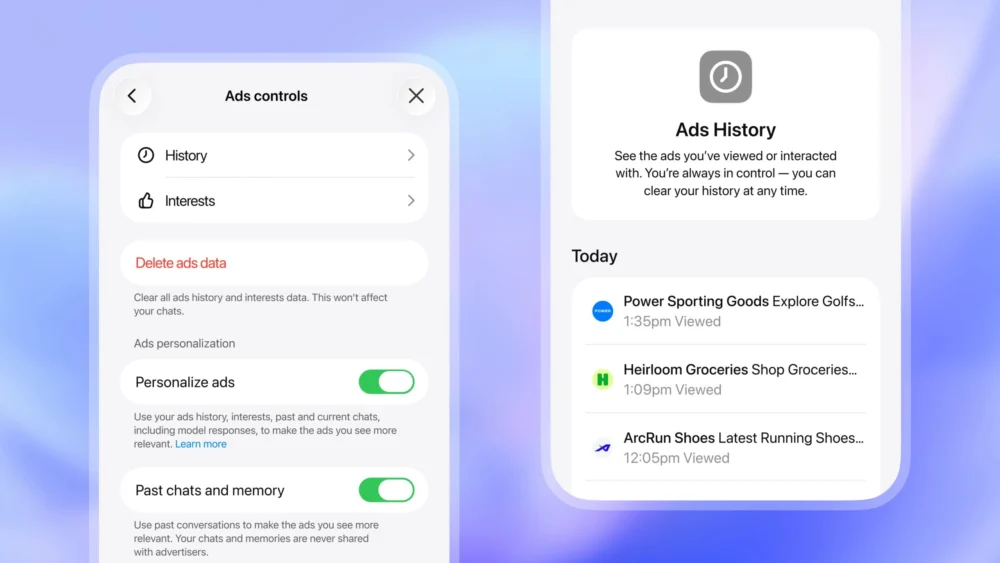
Recognizing the need for user agency in an ad-supported ecosystem, OpenAI is providing extensive controls designed to alleviate intrusion concerns. Users will be able to review their history of interactions with advertisements, clear that history at any time, dismiss specific ads, provide feedback on ad relevance, and adjust personalization settings. These measures are standard in mature digital advertising ecosystems but are essential trust-building steps in the nascent AI interaction space.
Furthermore, the company has implemented explicit content restrictions, ensuring that ads will not be served to users under the age of 18, nor will they be placed adjacent to sensitive or regulated conversational topics, including health advice, political discourse, or mental health consultations. This regulatory self-policing aims to avoid the pitfalls of early social media platforms, where ad placement often led to brand safety issues and ethical controversies.
The introduction of advertising by a market leader like OpenAI sets a powerful precedent for the entire generative AI industry. It signals that a hybrid monetization model—combining ad-supported free access with premium subscription purity—is likely the inevitable economic path forward for foundational model providers. Other major players, including those developing services based on models like Google Gemini and Meta’s Llama, will closely observe the success and reception of ChatGPT’s ad platform. If successful, this model ensures that the vast majority of the global population can continue to access sophisticated AI capabilities, albeit with a commercial trade-off.
The ultimate impact of this pivot will be measured not just in revenue generation, but in the long-term perception of AI as a trusted information source. OpenAI must successfully execute a strategy that proves its sophisticated targeting algorithms can be commercially effective without compromising the core value proposition: providing unbiased, intelligent, and helpful responses. The integration of advertising into ChatGPT is more than a simple monetization move; it is a defining moment that charts the economic future of artificial intelligence, placing the cost of cognition squarely at the center of the user experience debate.
