

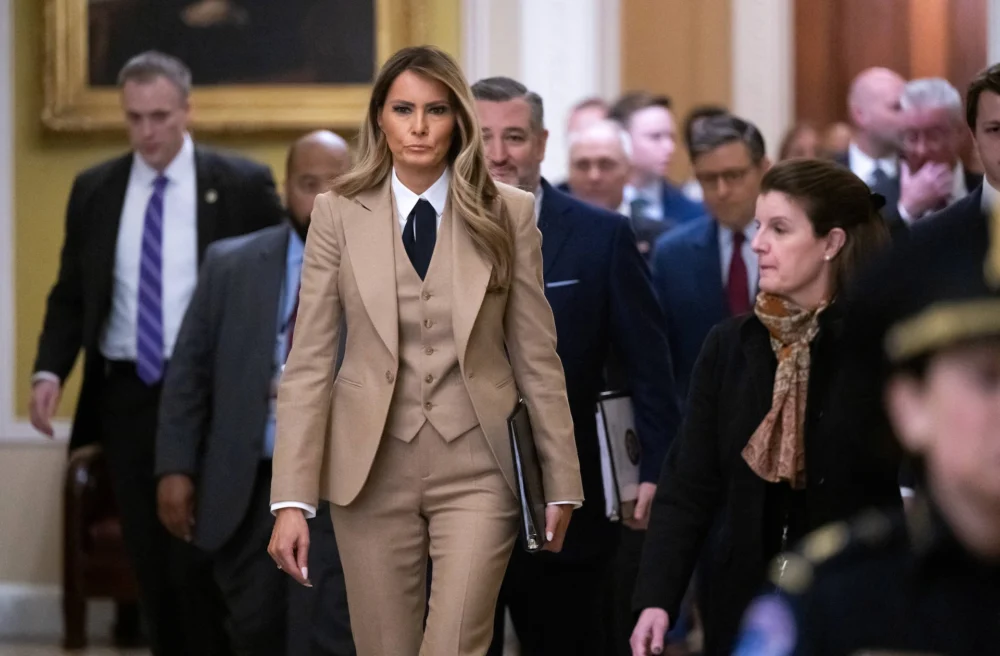
The highly anticipated, and equally controversial, documentary centered on former First Lady Melania Trump, titled Melania, experienced a precipitous drop in its second weekend of theatrical release, severely undermining Amazon’s costly strategic investment in the project. Following a debut that slightly outperformed modest industry expectations, the film suffered a colossal 67% decline in domestic box office receipts, pulling in an estimated $2.37 million. This sharp erosion in audience attendance confirms widespread fears among financial analysts that the documentary, acquired and promoted with an unprecedented budget for the genre, will ultimately fail to recoup its staggering investment through traditional theatrical channels.
Amazon Studios committed an estimated $75 million to bring this specific political narrative to market: $40 million allocated purely for the acquisition rights and an additional $35 million dedicated to prints and advertising (P&A) for the theatrical window. With a cumulative gross standing at approximately $13.5 million to date, nearly all generated within the United States, the financial trajectory is clear. The film must generate several multiples of its current total merely to reach the break-even point against its acquisition and marketing outlay—a virtually impossible feat given the current market dynamics and the depth of its second-weekend plunge.
The Political Economy of Content Acquisition
The astronomical price tag attached to the Melania project sparked immediate internal and external controversy upon its initial announcement. In the realm of high-end documentaries, where acquisition costs rarely exceed the low eight figures unless significant production elements or exclusive access are involved, the $40 million figure stood out as a glaring outlier. Before the film even hit theaters, a former Amazon film executive publicly questioned the motivation behind the expenditure, suggesting that such a sum could only be justified as an attempt to "curry favor" with influential political figures or, more cynically, as a form of "outright bribe" designed to ease regulatory pathways or secure favorable treatment for the tech behemoth in Washington D.C.
This context is critical when evaluating the financial performance. Unlike traditional studio releases where the primary metric is theatrical profit, content purchased by vertically integrated technology platforms like Amazon often carries a complex strategic mandate. The calculus extends beyond mere box office revenue to encompass political capital, subscriber acquisition (or retention for Prime Video), and brand prestige. When a major corporation spends a sum disproportionate to the expected commercial return, the investment is often categorized as a lobbying or corporate influence expense disguised within the media division’s budget. The box office failure, therefore, is less a sign of poor content judgment and more a visible measurement of whether that political capital investment yielded immediate commercial or strategic dividends.
A Deeper Look at Theatrical Erosion
The steepness of the 67% decline in weekend-over-weekend gross is particularly concerning, even accounting for the typically soft market surrounding the annual Super Bowl championship game. The weekend featuring the Super Bowl is universally recognized as a challenging period for cinema attendance, often resulting in a noticeable deceleration across the board. However, this slowdown is usually managed. For comparison, the weekend’s chart-topping film, the comedy Send Help, experienced a decline of only 47%. The Melania documentary’s significantly steeper fall-off suggests a profound lack of repeat business, weak word-of-mouth among general audiences, or a rapid saturation of its core demographic.
The film dropped dramatically from third place in the charts during its opening week to ninth place in its second frame. This rapid descent implies that the initial, stronger-than-expected opening was driven primarily by political curiosity and front-loaded demand from a dedicated, highly motivated base audience. Once that initial cohort of viewers had seen the film, the lack of crossover appeal, compounded by overwhelmingly negative reviews, left the documentary without the necessary momentum to sustain a viable theatrical run.
The Disconnect: Critics vs. Audience Score Integrity
Adding a layer of complexity to the film’s narrative is the extreme polarization between professional critical appraisal and consumer sentiment. Melania garnered near-universal condemnation from established critics, reflected in a deeply negative score on aggregate platforms such as Metacritic. Yet, simultaneously, the film boasted an almost pristine 99% audience approval rating on Rotten Tomatoes (RT).
This vast chasm highlights a growing fracture in the media landscape, particularly concerning highly politicized content. While film critics often evaluate documentaries based on journalistic rigor, narrative balance, and filmmaking technique, audience scores on such platforms are increasingly susceptible to coordination and political mobilization.
The extreme nature of the 99% score prompted Rotten Tomatoes itself to issue an unprecedented statement insisting that their auditing processes confirmed the score was genuine and derived from verified ticket purchasers. This action, necessary to defend the platform’s integrity, underscores the technological challenge platforms face in distinguishing organic audience passion from coordinated online campaigns designed to signal political alignment rather than cinematic merit.

For Amazon, the high audience score, even if driven by a small, highly engaged political base, provides a crucial marketing tool for the next phase of the film’s distribution. When the documentary inevitably transitions to Prime Video, the 99% RT rating serves as a potent data point to entice subscribers who align with the subject matter, effectively neutralizing the overwhelmingly negative critical consensus.
The Corporate Pivot: Amplifying Streaming Value
Anticipating the inevitable narrative of box office failure, Amazon’s executive team initiated a defensive strategic pivot. Kevin Wilson, the head of domestic theatrical distribution for the studio, released a statement attempting to reframe the metrics of success: “Together, theatrical and streaming represent two distinct value creating moments that amplify the film’s overall impact.”
This statement provides critical insight into the modern media giant’s approach to content monetization. For tech companies operating streaming services, the theatrical run is increasingly viewed not as a profit center but as a massive, subsidized P&A exercise. The ‘value creating moments’ are defined as:
- The Theatrical Halo: Generating public awareness, sparking media debate, and establishing prestige (especially during awards season, regardless of critical reception).
- The Streaming Asset: Providing an exclusive, high-profile asset that drives subscriber acquisition (churn reduction) and engagement on Prime Video.
In this model, the $75 million investment, even with a $60+ million theatrical shortfall, might still be rationalized internally if the film successfully delivers a measurable surge in Prime Video sign-ups or significantly reduces the rate of cancellations among specific, high-value political demographics. The logic dictates that if the documentary manages to retain, for example, 500,000 subscribers for a year who otherwise would have churned, the revenue generated by those subscriptions could offset the theatrical losses.
Industry Implications and Future Trends
The costly misfire of Melania serves as a significant case study for the entire streaming industry, particularly concerning the acquisition of politically charged, personality-driven documentaries. It reinforces the volatile nature of audience demand for non-fiction content, especially when it is designed to appeal to a narrow, partisan base.
1. Reassessing Political Content Costs: This outcome will likely force streaming executives to re-evaluate the risk profile of high-cost political acquisitions. While access to powerful political figures remains valuable, the financial returns must be scrutinized more harshly. Future political content acquisitions may shift back toward lower-budget, independent productions, or focus on multi-part docuseries which inherently offer better content-per-dollar value for streaming retention.
2. The Enduring Power of the Theatrical Window: Amazon’s attempt to leverage the theatrical window to validate the film’s prestige was technically successful in generating buzz, but failed commercially due to poor critical reception and weak mainstream appeal. This suggests that for prestige documentaries to succeed theatrically, critical validation is still paramount. The box office cannot be sustained merely on political loyalty.
3. The Deepening Divide in Media Consumption: The critical/audience disparity illustrates the balkanization of the media landscape. Streaming services are increasingly catering to highly defined, partisan tribes. This trend accelerates the move away from broad-appeal content toward hyper-specific, high-cost content designed to capture and hold niche audiences, regardless of universal quality metrics.
4. Technology and Audience Score Manipulation: The controversy surrounding the 99% score highlights the vulnerability of review platforms. As political and culture wars increasingly play out in the digital realm, media companies and tech platforms must invest heavily in sophisticated AI and verification systems to ensure that audience metrics remain genuine indicators of consumer satisfaction rather than instruments of political signaling or targeted manipulation. The perceived failure of Melania in theaters will quickly be replaced by its success metrics on Prime Video—namely, completion rates and the effect on churn—which are far more opaque to external analysis. The true cost of this documentary, therefore, will not be measured in dollars lost at the box office, but in the long-term strategic benefits—or detriments—it generates within Amazon’s core subscription ecosystem, making the financial success highly subjective and internally defined.
Ultimately, the trajectory of the Melania documentary epitomizes the high-stakes gamble inherent in the streaming wars: sacrificing immediate, measurable profit for elusive, long-term strategic advantage in the intensely competitive landscape of global media dominance. The steep theatrical decline confirms the commercial risk, but the true measure of Amazon’s success or failure will only be known years from now, when the political and subscriber dividends of this $75 million gamble are fully realized.
