

The critical infrastructure supporting countless U.S. commercial transactions has suffered a significant blow, as payment solutions provider BridgePay Network Solutions confirmed a debilitating ransomware attack that has brought core processing systems to an immediate standstill. The incident, which commenced late last week, rapidly expanded from localized performance degradation into a systemic, nationwide service disruption, forcing businesses across various sectors to revert to manual, cash-only transactions, effectively illustrating the fragility of tightly integrated digital payment ecosystems.
BridgePay, a key entity in the complex web of financial technology that facilitates point-of-sale (POS) authorizations and electronic fund transfers for numerous merchants and municipal entities, issued a statement acknowledging the cyber intrusion. This confirmation followed initial reports of widespread transaction failures that began manifesting early Friday morning. The company’s status monitoring dashboards reflected severe degradation, starting around 3:29 a.m., initially impacting services such as the virtual terminal, reporting tools, and Application Programming Interfaces (APIs) linked to its Gateway.Itstgate.com infrastructure. This gradual onset suggests a sophisticated, multi-stage infiltration rather than a simple denial-of-service event.
Escalation and Official Response
By Friday evening, BridgePay formally identified the root cause as an active ransomware operation. In an official update dated February 6th, the company detailed the immediate steps taken to contain the threat and commence remediation. Crucially, BridgePay has formally engaged high-level federal authorities, specifically citing the involvement of the Federal Bureau of Investigation (FBI) and the U.S. Secret Service. This level of engagement underscores the potential gravity of the incident, given the Secret Service’s jurisdiction over financial system integrity.
In an effort to reassure affected clients and the public, BridgePay has provided preliminary findings from its internal forensic investigation, supported by external cybersecurity recovery specialists. The company asserts that, based on these initial assessments, there is currently "no evidence of usable data exposure," and critically, that "no payment card data has been compromised." The official narrative indicates that the attackers succeeded in encrypting accessible files, characteristic of modern ransomware deployment, but stopped short of confirming large-scale data exfiltration. However, the absence of confirmed data theft does not mitigate the immediate operational fallout caused by system encryption and subsequent unavailability. BridgePay has, to date, refrained from publicly identifying the specific ransomware strain or the threat actor group responsible for the attack.
The Ripple Effect: Commerce Grinds to a Halt
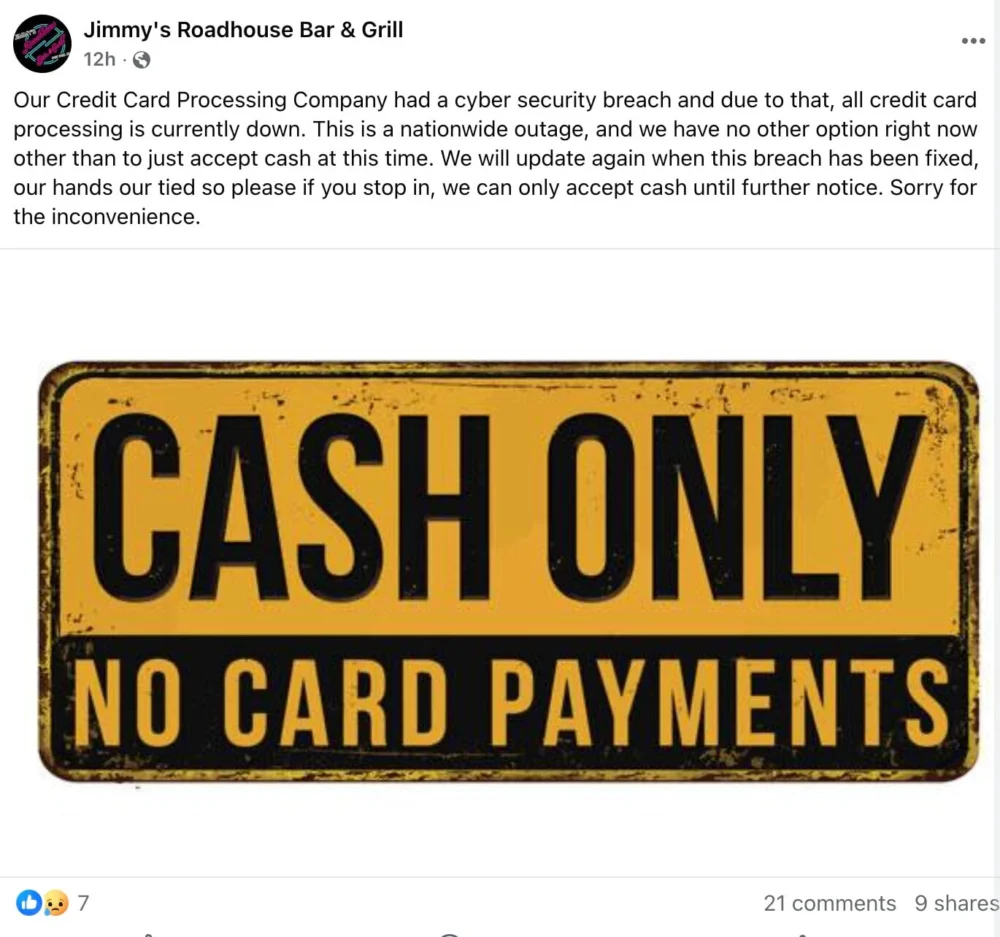
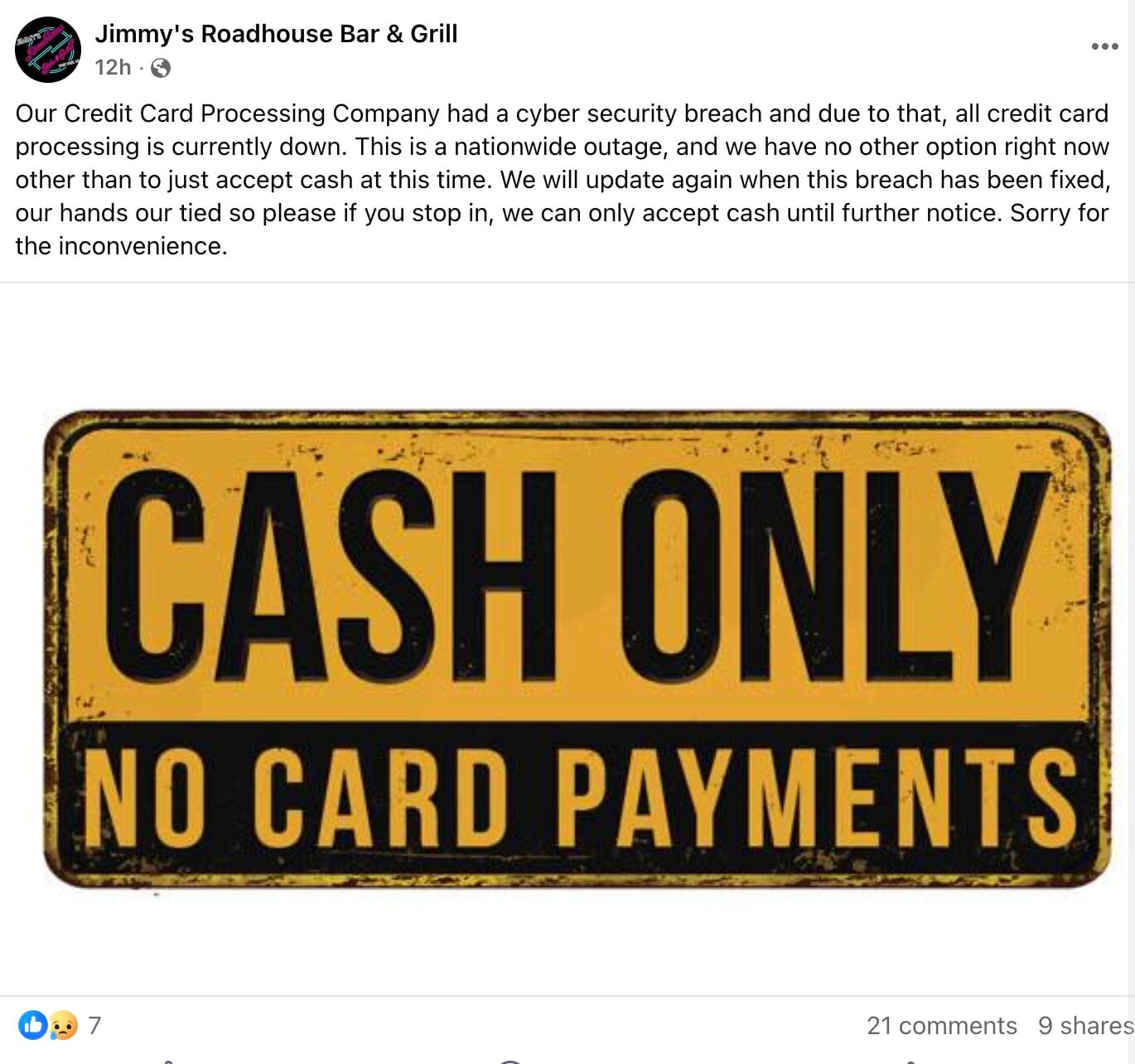
The direct impact of the BridgePay outage was immediately felt on the front lines of commerce. Numerous U.S. merchants, ranging from independent restaurants to large retail operations utilizing BridgePay-integrated POS systems, were compelled to notify their customer bases that electronic payments were inaccessible. Social media channels and direct customer communications became the primary means for businesses to announce the emergency pivot to cash-only transactions.

One notable example highlighted the operational paralysis: a local restaurant publicly disclosed that their "credit card processing company had a cyber security breach," resulting in a nationwide inability to process card payments. Such anecdotal evidence paints a stark picture of how reliant modern small and medium-sized enterprises (SMEs) are on third-party payment processors; a disruption at one central node can instantly sever their ability to transact revenue electronically.
The disruption was not limited to private enterprise. Public sector entities relying on BridgePay for streamlined digital billing faced immediate administrative hurdles. The City of Palm Bay, Florida, issued an alert confirming that its third-party vendor, BridgePay Network Solutions, was experiencing a nationwide service disruption. This directly impacted the city’s online utility payment portal, rendering it inoperable. The municipality advised residents to utilize in-person options—paying with cash, check, or card at physical locations—or, where applicable, making payments via telephone, demonstrating the significant friction introduced when digital payment rails fail.
Beyond these direct reports, the dependency map shows broader systemic linkage. Organizations such as Lightspeed Commerce, a major provider of POS and e-commerce platforms, and ThriftTrac, alongside other municipal bodies like the City of Frisco, Texas, acknowledged experiencing service degradation or outages directly attributable to the BridgePay incident. This connectivity confirms that BridgePay serves as a critical intermediary, meaning its failure propagates downstream across diverse user bases that may not even be aware of their direct connection to the compromised gateway.
Technical Deep Dive: Anatomy of a Gateway Failure
The technical scope of the outage, as detailed on BridgePay’s internal status page, is extensive, affecting core production systems that underpin transaction processing. While the exact list of affected services was broad, the early warning signs pointed specifically to the systems responsible for authorizing, routing, and recording transactions. The initial symptoms—degraded performance across the virtual terminal, reporting modules, and the core API—suggest that the attackers targeted the operational backbone of the service.
Ransomware targeting payment gateways presents a unique threat vector compared to attacks on standard corporate IT networks. Payment processing relies on near-perfect uptime and low latency. When encryption locks down transaction authorization servers, the immediate result is not just data loss or internal business stoppage, but the inability of external merchants to convert goods and services into realized revenue. The complexity of PCI DSS (Payment Card Industry Data Security Standard) compliance means that any disruption involving cardholder data environments (CDEs) triggers intense regulatory scrutiny, even if the preliminary assessment suggests no exfiltration.
The fact that the attack was confirmed as ransomware, rather than simpler malware or a distributed denial-of-service (DDoS) attack, implies the threat actors achieved deep system access, likely through a compromised credential or a vulnerability exploited in a peripheral service that provided a foothold into the primary processing environment. Encrypting these essential services effectively places a digital stranglehold on the client base’s ability to operate financially.

Industry Implications and Risk Assessment
The BridgePay incident serves as a potent, high-profile reminder of the concentration risk inherent in the modern financial technology stack. As payment processing continues to consolidate around fewer, larger, and more capable providers—often specialized gateways like BridgePay—the potential blast radius of a single successful attack magnifies exponentially.
Vendor Risk Management: For merchants and service providers dependent on BridgePay, this event necessitates an immediate, rigorous reassessment of their third-party risk management (TPRM) frameworks. Relying on a vendor’s self-attestation of security is no longer sufficient. Clients must now demand deeper insights into the resilience, segmentation, and incident response capabilities of their critical service providers. The concept of ‘supplier dependency’ has shifted from a logistical concern to an existential cybersecurity threat.
Regulatory Scrutiny: The involvement of the FBI and Secret Service, combined with the nature of the service (handling financial data flows), virtually guarantees intense scrutiny from regulatory bodies, including those overseeing consumer financial protection and data security standards. Even with the current assurance that card data was not exfiltrated, the prolonged outage and the operational chaos caused by the encryption event will likely trigger mandated audits and potential enforcement actions related to operational resilience and business continuity planning.
The Ransomware Economy: This attack further entrenches the trend of ransomware actors pivoting towards critical infrastructure, recognizing that downtime in essential services—like utilities, healthcare, and financial processing—yields maximum leverage. The calculus for these criminal enterprises shifts: crippling a payment gateway ensures a near-universal sense of urgency from numerous, diverse victims, potentially encouraging faster ransom payments to restore the flow of commerce. The "no-payment" policy advocated by many government agencies is severely tested when an entire sector’s revenue stream is halted.
Expert Analysis: Resilience vs. Recovery
From a cybersecurity perspective, the narrative focuses sharply on the tension between resilience and recovery speed. Resilience aims to prevent the attack from succeeding or minimizing its initial impact through robust segmentation and zero-trust architectures. Recovery focuses on the speed and integrity of returning to operations post-compromise.
BridgePay’s status updates suggest the ransomware achieved a level of success that demanded a full shutdown and forensic engagement. The commitment to a "secure and responsible manner" for recovery implies a methodical process of rebuilding or restoring encrypted systems, often involving validation that backdoors have been eliminated and the environment is clean before bringing high-value services back online. This process is inherently slow, especially when dealing with systems that must adhere to strict transactional integrity standards.
A key analytical point remains the unconfirmed identity of the threat actor. Intelligence surrounding the group’s tactics, techniques, and procedures (TTPs) is vital. If the group is known for double extortion (exfiltrating data before encrypting files), the company’s initial assessment that "no usable data exposure" exists may evolve. Forensic teams must meticulously analyze egress points and shadow copies to definitively rule out data theft, which carries far greater legal and reputational risks than the encryption event itself.
Future Trajectories in Payment Infrastructure Security
The BridgePay incident is not an anomaly but a clear indicator of future threat trends impacting the fintech sector. As transaction volumes migrate increasingly to digital channels, the centralized choke points—the payment gateways and processors—will remain prime targets.
Decentralization and Redundancy: The aftermath of this outage will undoubtedly accelerate industry conversations around mandatory redundancy for critical payment functions. Can merchants afford to have only one primary processor? The pressure may mount for financial institutions to mandate active-active failover capabilities across geographically diverse, independent processing stacks.
API Security Hardening: Since APIs were among the first services to show degradation, the attack highlights the vulnerability of modern, interconnected application programming interfaces. Payment gateways increasingly rely on microservices communicating via APIs. Securing these inter-service communications through advanced API gateways, mutual TLS authentication, and continuous runtime monitoring will become a non-negotiable requirement, moving beyond standard perimeter defense.
Operational Technology (OT) Mindset in IT: The prolonged downtime suggests that the recovery process might be treated with the same meticulous, slow approach traditionally reserved for Operational Technology (OT) environments, where a failed reboot can lead to physical safety hazards. Applying this high-stakes, slow-and-steady validation process to core financial IT reflects the high stakes involved in restoring transactional integrity.
Ultimately, the BridgePay ransomware incident underscores a harsh reality: in the hyper-connected digital economy, the security posture of the weakest link in the payment chain can determine the operational viability of thousands of businesses. As BridgePay works through its complex remediation and forensic processes, the entire financial services industry is watching, forced to confront the cost of relying on single points of failure in an environment increasingly hostile to centralized digital services. The transition back to full operational capacity will not just be a measure of BridgePay’s technical competence, but a barometer for the sector’s collective preparedness against sophisticated cyber extortion.
