

The modern enterprise ecosystem has fundamentally shifted its gravitational center. Where data once resided primarily on on-premise servers and applications were accessed via dedicated clients, today’s operational reality is overwhelmingly browser-centric. Software-as-a-Service (SaaS) platforms, cloud-based identity providers, administrative control panels, and the proliferation of generative Artificial Intelligence (AI) tools have cemented the web browser as the default, and often sole, interface for accessing critical corporate assets and executing daily tasks. This transition represents a monumental architectural change, yet the security scaffolding built to protect these digital environments has lagged severely behind.
The irony is stark: the application that handles the most sensitive interactions—the browser—is treated as an afterthought by many prevailing security architectures. Detection and response mechanisms remain heavily invested in perimeter defenses and legacy endpoints. Endpoint Detection and Response (EDR) systems focus intently on processes, file system activity, and memory injection on the host operating system. Network security tools, including Secure Access Service Edge (SASE) frameworks, scrutinize traffic flows, TLS inspection, and egress/ingress points. Email security solutions diligently scan inbound and outbound correspondence for malicious payloads or phishing links. These layers are designed to secure the environment around the browser, not the dynamic, interactive environment within it.
This architectural disparity creates a critical chasm in visibility. When employee-facing compromises occur—and they increasingly do so through subtle browser manipulation—security operations centers (SOCs) are left grasping for answers to the most basic investigative question: What precisely transpired during the user’s session in the browser tab? This deficiency in deep, contextual visibility defines an entire, rapidly expanding category of stealthy, high-impact cyberattacks. For threat actors, the browser has effectively become a "safe haven," a central point of operational failure where traditional controls often cease to provide meaningful insight.
The Evolving Threat Landscape: Browser-Native Attacks Flourishing in 2026
The difficulty in mitigating these threats stems not from a single novel exploit, but from the convergence of multiple attack vectors exploiting this shared visibility gap. These attacks bypass conventional indicators of compromise (IOCs) because they often leverage legitimate browser functionality or inherent user trust. By 2026, organizations are observing persistent attacks across several categories that leave minimal forensic evidence traceable by legacy tools:
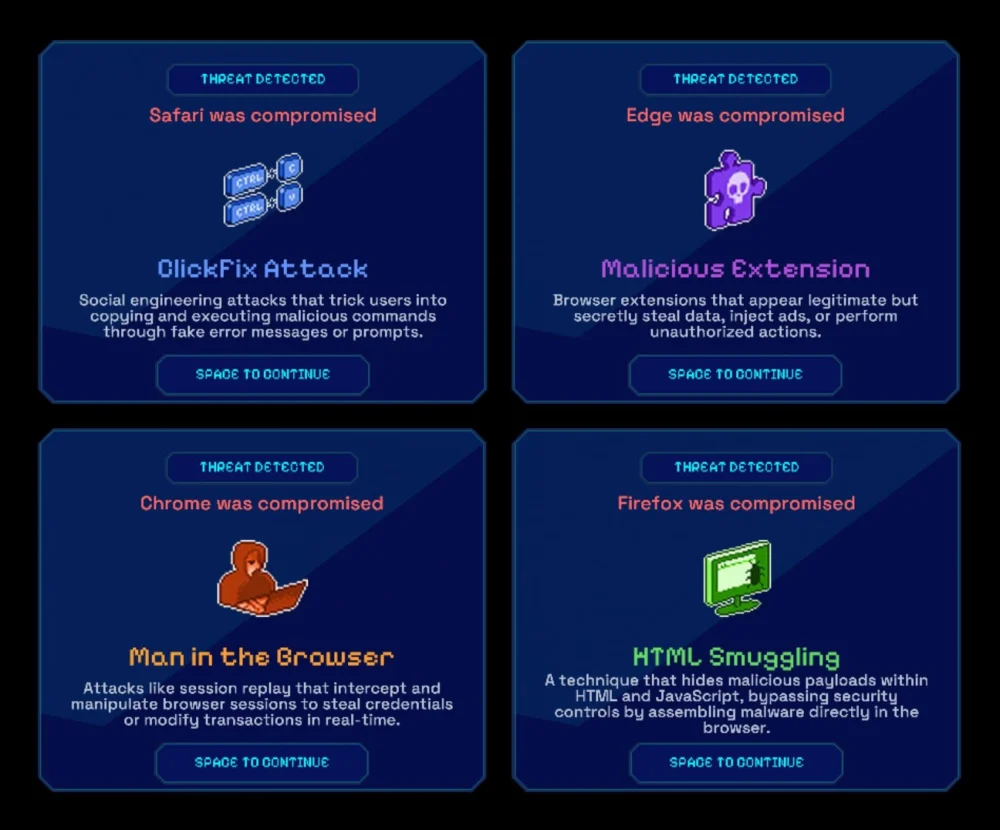
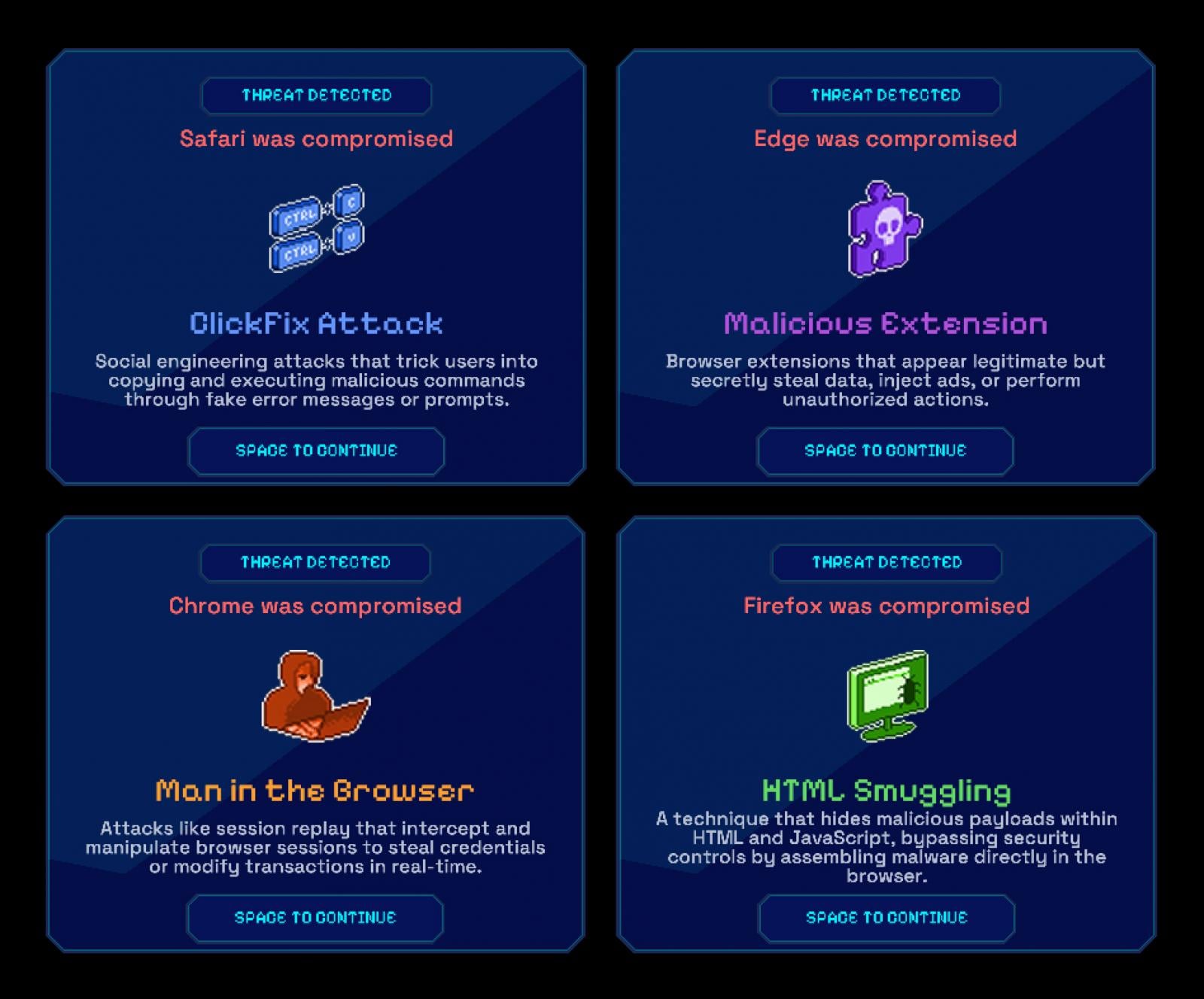
1. UI-Driven Social Engineering and ClickFix Vectors:
Perhaps the most pervasive browser-borne threat vector involves sophisticated social engineering campaigns that guide the user into performing actions that benefit the attacker. This methodology, sometimes termed "ClickFix," involves presenting users with highly convincing, context-aware, but fake browser prompts, dialog boxes, or notifications—often injected via compromised advertising networks or subtle client-side scripts. The objective is not to deliver malware, but to coerce the user into voluntarily copying sensitive data (like API keys or session tokens) or pasting malicious commands into an otherwise legitimate application interface. Since the user initiates the final action, EDR and network monitoring see only authorized keystrokes or copy/paste operations, resulting in a nearly invisible trail for forensic investigation.
2. Covert Malicious Extensions and Session Hijacking:
Browser extensions, installed either through deception or via low-level administrative compromise, remain a potent delivery mechanism. While security teams often manage extension whitelisting, sophisticated adversaries employ extensions that appear benign for extended periods. These modules quietly monitor page content, passively intercept form submissions (including credentials entered into legitimate login fields), or establish persistent connections to exfiltrate data piecemeal. From the perspective of endpoint telemetry, the extension operates within the browser’s sandboxed process, executing seemingly normal JavaScript operations. Post-incident analysis often reveals a vacuum of data regarding the extension’s specific activities across different domains.
3. Advanced Man-in-the-Browser (AiTB) and Session Replay Attacks:
These attacks move beyond traditional malware injection by exploiting the trust inherent in an already authenticated session. Utilizing advanced techniques—often involving session cookie manipulation, sophisticated JavaScript hooks, or exploiting legitimate WebSockets—attackers can hijack, manipulate, or replay user interactions. The critical danger here is that authentication mechanisms function perfectly: the user enters correct credentials, approves Multi-Factor Authentication (MFA) challenges, and performs actions that are logged as authorized. Security systems confirm a real user identity and a valid session token, but possess no mechanism to discern whether the sequence of events leading to a high-value transaction was manipulated by an adversary inside the session context.
4. In-Browser Payload Assembly via HTML Smuggling:
HTML Smuggling represents a significant evasion technique targeting static analysis and traditional download scanners. The malicious payload—often a fully functional executable or script—is not delivered as a file. Instead, obfuscated JavaScript is delivered within an HTML document. Upon rendering, the browser’s native engine reconstructs the malicious content client-side, assembling the final file or script directly in memory or the cache before it can be intercepted by network proxies or download reputation systems. The network traffic seen by SASE tools is benign, as the "malware" only manifests locally within the browser’s execution environment.

The Inherent Limitations of Security Tool Design
It is crucial to frame this challenge correctly: these vulnerabilities are not indicative of flawed EDR, email gateway, or SASE products. Instead, they highlight the fundamental design constraints of these security pillars. Each tool excels at its intended domain, but that domain deliberately excludes deep, real-time monitoring of user-application interaction.
EDR is tethered to the operating system’s kernel and process space; it monitors file writes, registry modifications, and suspicious process spawning. It rarely receives granular data on what text a user copied from a SharePoint document and pasted into a Slack message within a browser tab, or what specific DOM element was clicked.
Email security focuses on transport and initial reception—the link click or attachment open. Once the user navigates to a SaaS application, the email gateway’s influence evaporates.
SASE and traditional web proxies enforce network policies based on URLs, IP reputation, and bandwidth consumption. While they can block access to known malicious domains, they struggle to differentiate between a legitimate user uploading a sensitive document to an approved cloud storage service and an extension surreptitiously streaming the same data out under the guise of normal background activity, provided the destination IP is whitelisted.
When the browser becomes the ubiquitous execution engine, where critical authorization, data entry, and content manipulation occur, prevention and detection frameworks lose the necessary context. Controls might permit or deny an action based on coarse policy, but without the ability to observe the intent and content of the interaction within the rendering engine, investigations are reduced to conjecture, and remediation efforts become reactive rather than proactive.
Industry Implications and Research Context
This pervasive blind spot has significant ramifications for regulatory compliance, insider threat programs, and general data loss prevention (DLP). Organizations are increasingly aware that their most valuable data is being processed in this unmonitored domain.
Vendor-neutral research efforts, such as the "Own the Browser" initiative, have sought to quantify this gap by evaluating security posture across a broad spectrum of browser environments. Evaluating over twenty different browser types—spanning consumer-grade, hardened enterprise editions, and emerging AI-native interfaces—revealed a consistent pattern: While policy enforcement mechanisms (like group policies or configuration profiles) are widely deployed, the telemetry required to verify the efficacy of those policies in real-time user workflows is almost universally absent. Security teams possess the rules, but lack the observable data points to confirm adherence or detect evasion at the point of action.
This research underscores that the issue is not merely the absence of security products, but the absence of structured, actionable behavioral telemetry originating from the browser itself. Without this insight, security policies remain static and blunt, unable to evolve dynamically based on how users actually interact with modern web applications.
The Accelerating Factor: AI Workflows and Data Exfiltration
The integration of generative AI tools—such as large language models (LLMs) like ChatGPT, Claude, and Gemini—has dramatically exacerbated the browser visibility deficit. These tools are inherently designed to ingest and process large volumes of data submitted via simple copy/paste or file upload interfaces directly within the browser window.
The normalization of sensitive data processing within these AI workflows presents a complex risk calculus. An employee summarizing proprietary source code or pasting confidential financial reports into an external AI summarizer appears, on the surface, to be a standard, permitted workflow. From a DLP perspective, blocking all pasting into AI interfaces is impractical, as it cripples productivity. However, allowing unrestricted access means that vast quantities of intellectual property can be exfiltrated instantaneously through perfectly legitimate user actions.
Security controls must transition from binary allow/deny decisions to context-aware risk evaluation. This requires observability into what data is being submitted, where it is going, and how the browser is handling that submission—information that resides deep within the rendering pipeline, inaccessible to traditional perimeter tools. As AI-driven processes become the default mode of operation, any prevention strategy that is not intrinsically informed by real-time browser behavior is destined to be perpetually reactive and inadequate.
The Transformative Power of Browser-Level Observability
Introducing comprehensive, granular observability directly into the browser environment fundamentally alters the security posture, shifting capabilities from post-incident forensics to real-time risk management.
Proactive Prevention Informed by Reality:
When security systems can observe the actual flow of data—tracking a user copying content from a secure internal application and subsequently attempting to paste it into an unapproved external AI tool—controls can intervene precisely at the moment of risk. This allows for the implementation of highly nuanced policies: perhaps blocking the paste, masking the data during the transfer, or flagging the session for immediate review, all while ensuring that legitimate, low-risk workflows proceed unimpeded.
Enhanced Detection and Contextual Analysis:
Detection moves beyond file hashes and network signatures. Behavior can now be evaluated within its true operational context. For example, a sequence of events—a user rapidly switching between an HR portal and an external document viewer, followed by an unusual data upload—can be correlated instantly. This contextual correlation dramatically reduces false positives and allows SOC analysts to accurately assess the severity of an event based on the intent demonstrated through browser interactions, rather than just the resulting network traffic.
Reconstructible Incident Response:
In the event of a confirmed breach, the ability to reconstruct the exact series of user actions, keystrokes, clicks, and data transfers within the browser is invaluable. This level of detail transforms an investigation from a forensic search for the initial intrusion point to a precise mapping of the data path and impact, ensuring that containment is thorough and reporting is accurate.
Continuous Policy Refinement:
Observability closes the feedback loop that is currently broken in most security programs. Every interaction—whether a high-risk action is blocked, paused, or permitted—generates data that refines the underlying behavioral models. Over time, security policies transition from generalized rules based on organizational assumptions to highly optimized controls based on observed, empirical usage patterns across diverse enterprise roles.
Ultimately, the challenge presented by the browser-centric workspace demands a commensurate shift in security investment. The central question facing CISOs today is not whether their EDR or SASE platforms are effective in their respective domains, but rather, if a sophisticated, browser-native attack occurred within their environment right now, could they definitively prevent it, and subsequently, could they explain every step of the compromise? The failure to answer affirmatively to both signifies the presence of the critical visibility gap that current security paradigms were not engineered to address. Securing the enterprise now requires moving defenses from the perimeter to the interaction layer itself.
