

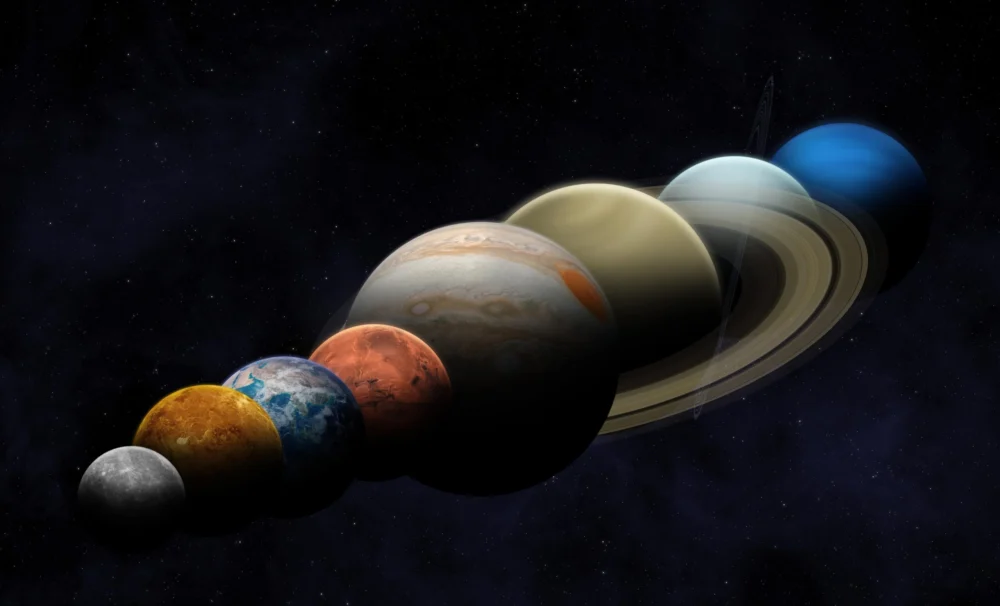
The final weeks of February 2026 are set to offer a rare visual treat for both seasoned astronomers and casual stargazers as six planets in our solar system—Mercury, Venus, Jupiter, Saturn, Uranus, and Neptune—prepare to congregate in the evening sky. This phenomenon, often colloquially termed a "planet parade," represents a significant moment of geometric fortuity. While the term "planetary alignment" is frequently used in headlines, the reality of the event is rooted in the specific orbital mechanics of our solar system and the perspective afforded by Earth’s position within it. Starting this weekend and peaking toward the end of the month, this celestial gathering provides a unique window into the scale and motion of our neighboring worlds.
The Anatomy of a Planet Parade
To understand what is happening in the night sky this weekend, one must first distinguish between a visual grouping and a physical alignment. In a true physical alignment, the planets would need to sit in a straight line extending outward from the Sun. Such events are extraordinarily rare and would not be visible from Earth as a "parade" across the sky. Instead, what observers will witness is a visual clustering along the ecliptic—the imaginary path that represents the plane of Earth’s orbit around the Sun. Because all the major planets orbit the Sun in roughly the same flat plane, they always appear to travel along this same narrow track in our sky.
A "planet parade" occurs when several planets happen to occupy the same section of the ecliptic from our vantage point on Earth. This weekend’s event is particularly noteworthy because it involves a diverse cross-section of the solar system: the rocky inner planets (Mercury and Venus), the massive gas giants (Jupiter and Saturn), and the distant ice giants (Uranus and Neptune). While they appear to be neighbors in the sky, they remain separated by hundreds of millions, and in some cases billions, of miles of vacuum.
Identifying the Participants: From Naked-Eye Brilliancy to Telescopic Targets
The visibility of the six planets varies significantly, dictated by their distance from Earth, their size, and their proximity to the Sun’s glare. Observing the full parade requires a combination of timing, clear horizons, and, for the more distant planets, optical assistance.
Venus and Mercury: The Twilight Duo
The most immediate challenge for observers will be catching the inner planets. Venus and Mercury are currently positioned in the western sky, trailing closely behind the Sun. Venus, often called the "Evening Star," will be the easiest to spot. Its thick cloud cover reflects sunlight with such efficiency that it often appears as a steady, brilliant white light, far brighter than any star. This weekend, it will be "hugging" the horizon shortly after sunset.
Mercury, the smallest and innermost planet, is notoriously elusive due to its tight orbit. It will appear just above Venus, but its window of visibility is incredibly narrow. As the sun sets, Mercury emerges from the glare, only to follow the sun below the horizon shortly thereafter. Observers will need an unobstructed view of the western horizon—free of buildings, trees, or mountains—to catch this pair before they disappear.

Jupiter and Saturn: The Solar System Anchors
While the inner planets require haste, Jupiter and Saturn offer more stability. Jupiter is currently a dominant fixture in the eastern sky. High above the horizon, it is easily identifiable by its bright, creamy-white glow that does not twinkle like a star. As the night progresses, Jupiter will become increasingly prominent, serving as the visual anchor for the parade.
Saturn, meanwhile, is located toward the southwest. Though not as bright as Jupiter or Venus, it is easily visible to the naked eye with a distinct yellowish hue. During this weekend’s event, Saturn will be positioned relatively low in the sky, eventually moving closer to the Sun’s glare as we progress toward March.
Uranus and Neptune: The Hidden Giants
The inclusion of Uranus and Neptune in this parade is what elevates it to a six-planet event, though they remain the most difficult to observe. Neptune is currently positioned very close to Saturn in the sky. However, at a distance of nearly 2.8 billion miles, it is far too faint for the naked eye. To see the eighth planet, a telescope and a detailed star chart are mandatory. It will appear as a tiny, bluish dot, indistinguishable from a star to the untrained eye.
Uranus is slightly more accessible but still requires effort. It is located roughly between Jupiter and Saturn, positioned beneath the famous Pleiades (M45) star cluster. Under exceptionally dark skies, those with keen eyesight might catch a glimpse of Uranus as a faint "star," but for most, a pair of binoculars (7×50 or 10×50) is necessary to reveal its pale cyan disk.
The Peak Moment: February 28, 2026
While the parade begins this weekend, NASA and various astronomical organizations point to Saturday, February 28, as the optimal viewing night. By the end of the month, the geometry of the solar system will have shifted slightly to our advantage. Venus and Mercury will have climbed a bit higher in the post-sunset sky, extending the duration they are visible before setting. Conversely, Saturn will have dipped lower, creating a more elongated "string" of planets across the sky.
Adding to the spectacle on February 28 will be the presence of a near-full moon. While the moon’s brightness can sometimes wash out faint deep-sky objects like nebulae or galaxies, it has a negligible effect on the visibility of planets. In fact, the moon’s position along the ecliptic serves as a helpful guide, highlighting the path where the planets reside.
Technical Strategies for Successful Observation
To maximize the chances of seeing all six planets, observers should adopt a structured approach. The first requirement is a location with a clear western horizon. Light pollution, while a major hurdle for seeing the Milky Way, is less of an issue for planetary observation because planets are relatively close and bright. However, "atmospheric seeing"—the stability of the air—is crucial. Observing over a hot parking lot or through a window can distort the image.

- The Sunset Window: Begin your observation approximately 20 to 30 minutes after sunset. This is the "sweet spot" where the sky is dark enough for planets to pop out, but the inner planets haven’t set yet.
- Optical Aid: While Jupiter, Saturn, and Venus are naked-eye objects, binoculars are the "secret weapon" for a planet parade. They will help you find Mercury in the twilight glow and are essential for spotting Uranus near the Pleiades.
- Stability: If using binoculars to find Uranus or a telescope for Neptune, stability is key. Use a tripod or lean against a solid object to minimize hand tremors, which can make faint planets disappear.
The Broader Context: Eclipses and Celestial Calendars
The planetary parade is not the only significant event on the February 2026 astronomical calendar. This month serves as a prelude to a series of high-profile celestial occurrences. On February 17, an annular solar eclipse—often called a "ring of fire"—will take place. While this specific eclipse is primarily visible from Antarctica, its timing is culturally significant, as the accompanying new moon marks the beginning of the Chinese New Year (the Year of the Horse) and, shortly thereafter, the start of Ramadan.
The true "showstopper" for North American observers, however, arrives on March 3, 2026. A total lunar eclipse will occur, turning the moon a deep, rusty red—a phenomenon known as a "blood moon." This eclipse will be visible across much of North America, with the best views reserved for those in western regions. The transition from the six-planet parade at the end of February to a total lunar eclipse in early March makes this a landmark period for amateur astronomy.
Industry Implications and the Rise of Modern Stargazing
The surge of interest in events like the February planet parade reflects a broader trend in the technology and hobbyist industries. The "democratization of space" is no longer just about commercial rockets; it is also about the tools available to the public. The market for "smart telescopes"—devices equipped with GPS and automated sky-tracking software—has exploded in recent years. These devices allow users to find elusive targets like Neptune or Uranus with the push of a button on a smartphone, removing the steep learning curve traditionally associated with amateur astronomy.
Furthermore, the rise of mobile applications like Stellarium, SkySafari, and NASA’s own "Watch the Skies" blog has turned the smartphone into a real-time celestial map. These tools use augmented reality (AR) to overlay planetary positions onto the user’s camera view, making it easier than ever to identify which "star" is actually Jupiter or Saturn.
From an industry perspective, these celestial events drive significant engagement for science communication platforms and hardware manufacturers. Each major event serves as a "gateway" for the public to learn more about orbital mechanics, light pollution advocacy, and the importance of space exploration. As Venus continues its ascent to become the "Evening Star" for much of 2026, the sustained visibility of our neighboring planets will likely keep public interest at a high point throughout the year.
The Final Verdict on the "Parade"
While the term "planet parade" may be a marketing-friendly label, the scientific reality is a testament to the orderly, predictable nature of our solar system. Seeing six of our eight siblings in the sky at once is a humbling reminder of our place in the cosmos. It requires a bit of luck with the weather and a dash of patience with the twilight glare, but the reward is a rare, panoramic view of the solar system’s grand design. Whether viewed through a high-end telescope or simply spotted during an evening walk, the gathering of 2026 is a celestial highlight not to be missed.
