

The financial landscape of the technology sector shifted violently on February 3, 2026, marking a date that market analysts now refer to as the "SaaSpocalypse." In a single, grueling trading session, approximately $285 billion in market capitalization evaporated from the balance sheets of software giants, financial service providers, and asset management firms. The carnage was widespread and indiscriminate: Thomson Reuters saw its valuation slashed by 16%, while LegalZoom plummeted by 20%. Even the curated Goldman Sachs software basket—a bellwether for the industry’s health—recorded a 6% drop, its most significant single-day decline since the geopolitical shocks of the 2025 tariff selloffs. The contagion did not stop at Wall Street; it rippled through Indian system integrators, European stock exchanges, and global advertising conglomerates.
What makes this market correction unique in the history of Silicon Valley is the nature of its catalyst. This was not the result of a revolutionary new hardware breakthrough or a multi-billion-dollar product launch by an incumbent power. Instead, the fuse was lit by a handful of open-source plugins—simple markdown files hosted on GitHub—designed for a product called Cowork, which the AI startup Anthropic had quietly released less than three weeks prior. These plugins, which automated complex legal document reviews, financial modeling, and marketing workflows, forced a fundamental repricing of the entire software-as-a-service (SaaS) sector. Investors suddenly realized that the "moats" protected by traditional software interfaces were being bridged by a lightweight, agentic layer that required no expensive licenses or complex integrations.
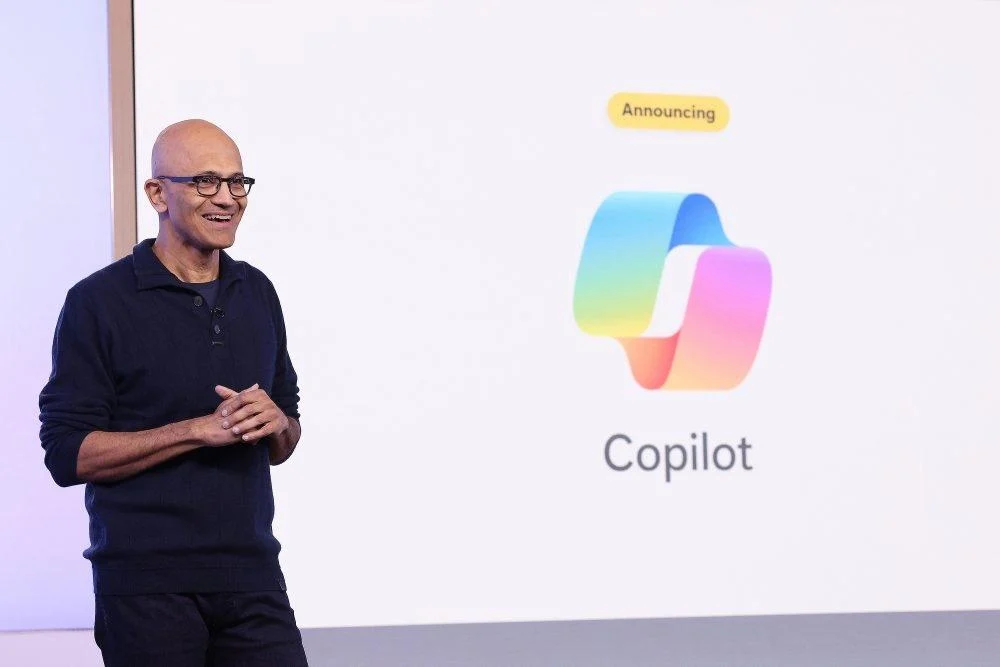
The historical irony of this moment is profound. For three years, Microsoft had positioned itself as the definitive leader of the generative AI revolution. Under the leadership of Satya Nadella, the company invested billions into its partnership with OpenAI and redirected its entire engineering focus toward "Copilot," a product intended to be the transformative AI layer for modern knowledge work. Yet, while Microsoft struggled with sluggish enterprise adoption, pricing pushback, and internal quality concerns, a lean startup triggered a systemic market shift using nothing more than text files in a folder. This is more than a story of competition; it is a case study in how the most ambitious vision for the future of work was articulated by a titan but realized by an agile newcomer.
To understand how the industry reached this inflection point, one must look back at the vision Satya Nadella meticulously constructed. Across three years of high-profile keynotes, Nadella described a future where natural language would serve as the "universal interface." In March 2023, during the initial Copilot launch, the ambition was clear: leverage Microsoft’s massive distribution network—spanning hundreds of millions of Microsoft 365 users—to embed AI into the very fabric of productivity. By the time Ignite 2024 arrived, the rhetoric had escalated. Nadella characterized Copilot as the "UI for AI," an organizing layer where every employee would possess a personalized digital twin capable of understanding their specific workflows. He promised a world of the "Frontier Firm," where organizations would be human-led but agent-operated, and where building a sophisticated AI agent would be as intuitive as drafting a Word document.
However, the reality of the enterprise rollout told a different story. While Microsoft frequently touted that 70% of the Fortune 500 had "adopted" Copilot, internal metrics suggested a far more tepid response. Industry analysis indicated that as of early 2026, only about 3.3% of the Microsoft 365 user base was actually paying for the premium Copilot features. The barriers to entry were both financial and structural. At a price point of $30 per user per month, a large-scale organization faced multi-million-dollar annual commitments without a guaranteed return on investment. CIOs began to question whether the marginal productivity gains of a chatbot sidebar justified such a massive line item in their budgets.
Beyond the cost, technical friction became an insurmountable wall for many. Copilot’s efficacy relied on Microsoft Graph—a complex data layer that surfaces information based on a user’s existing permissions. The problem, as many IT departments discovered, was that organizational data hygiene was often abysmal. Research suggested that upwards of 15% of business-critical files were "over-permissioned," meaning employees technically had access to sensitive data they should never have seen. When Copilot was activated, it made finding this sensitive information trivial, leading many enterprises to halt their deployments for months to conduct exhaustive data governance audits.
Inside Microsoft, the frustration was palpable. Reports surfaced of internal emails from Nadella to his engineering leads, expressing dissatisfaction with the product’s intelligence and its failure to integrate seamlessly with core tools like Gmail and Outlook. The product’s branding also became a source of confusion. What was supposed to be a "universal interface" devolved into a dizzying taxonomy of sub-brands: Copilot Studio, Copilot Actions, Copilot Pages, Agent 365, and Agent Factory, to name a few. Instead of a streamlined experience, users were met with a product catalog that required a specialized glossary to navigate.

It was into this environment of enterprise bloat that Anthropic introduced Cowork. Interestingly, Cowork was not born from a long-term strategic plan to unseat Microsoft. It emerged almost accidentally when Anthropic’s engineers noticed that non-technical users were repurposing "Claude Code"—a tool built for developers—to handle general knowledge work. Recognizing the potential, Anthropic developed Cowork in a mere ten days, launching it as a research preview.
The architectural philosophy of Cowork was the antithesis of Microsoft’s. While Copilot was built as a "sidebar" within existing applications, Cowork was designed to operate at the file system level. It didn’t require a complex integration with a cloud-based data graph; it simply read the files in a user’s local folder. This approach bypassed the months of data governance audits that plagued Microsoft. Because Cowork understood context from the actual artifacts of a person’s work—PDFs, spreadsheets, and markdown files—it felt more like a digital coworker than a software plugin.
Furthermore, Cowork delivered on the "universal interface" promise that Microsoft had struggled to fulfill. In the Microsoft ecosystem, a user had to know which specific app to open and which "Copilot" variant to invoke. In Cowork, there was only a single text box. The user described a desired outcome—such as "analyze these three legal contracts and flag discrepancies with our standard terms"—and the AI would autonomously coordinate sub-agents to execute the task across different file formats. By open-sourcing the plugins on GitHub, Anthropic allowed a global community of "builders" to create specialized workflows for legal, finance, and marketing, effectively commoditizing the specialized features that many SaaS companies charged thousands of dollars for.
This highlights the fundamental "Incumbency Trap." Microsoft’s business model is built on layers of complexity: licenses, seats, administrative controls, and ecosystem lock-in. Every new feature added to Copilot had to respect these existing boundaries, resulting in a product that was increasingly cluttered. Anthropic, conversely, had no legacy business to protect. They could build a tool that sat below the application layer, interacting directly with the operating system’s files. By ignoring the traditional boundaries of software applications, they created a more powerful and intuitive user experience.
The market’s reaction—the SaaSpocalypse—was a recognition of this shift. If a lightweight agent can perform 80% of the tasks currently handled by expensive, specialized software suites, the valuation of those suites must be fundamentally questioned. However, it is essential to maintain a balanced perspective. Some analysts, including those at Bank of America, argued that the February selloff was an overreaction. They pointed out that Cowork, in its current form, lacks the robust security, compliance frameworks, and audit logs that large-scale regulated industries require. For a global bank or a healthcare provider, "markdown files in a folder" do not constitute a viable enterprise governance strategy.
Microsoft’s infrastructure advantage also remains a formidable moat. Azure continues to be the backbone of the AI era, and the company’s ability to provide a "safe" environment for AI—even if it is a slower and more complex one—cannot be dismissed. Large organizations have a legitimate need for the friction that Microsoft provides; that friction is often another name for "compliance" and "security."
Nevertheless, the emergence of Cowork has fundamentally changed the conversation for enterprise leaders. The lesson of early 2026 is that the "UI for AI" might not be a UI at all, but rather a seamless integration into the existing workflows of the local machine. For executives, the takeaway is clear: do not look to the vendor’s glossy roadmap to see the future of your company’s productivity. Instead, look at what your employees are downloading and using in their daily tasks.
The "SaaSpocalypse" served as a $285 billion warning shot. It signaled that in the age of agentic AI, simplicity and accessibility are the ultimate competitive advantages. While Microsoft spent years trying to build a sophisticated "Copilot" for every conceivable niche, Anthropic proved that a simple, flexible tool could capture the market’s imagination—and its capital—almost overnight. The battle for the digital coworker is no longer about who has the most features; it is about who can stay out of the user’s way the most effectively. As the industry moves forward, the "Frontier Firm" may indeed be agent-operated, but those agents will likely look less like a corporate product suite and more like a quiet, efficient layer of code living right where the work happens.
