

Microsoft has officially finalized the end-of-life timeline for its venerable Exchange Web Services (EWS) API within the Exchange Online ecosystem, setting a definitive cut-off date of April 2027. This decision marks the conclusion of a nearly two-decade era for an API that served as a foundational bridge for third-party applications seeking programmatic access to core mailbox components—including email, calendaring, and contact data—across various Exchange environments. The announcement confirms a phased decommissioning strategy that, while providing significant lead time, necessitates urgent planning for thousands of dependent applications and the IT departments managing them.
EWS, which debuted with the advent of Exchange Server 2007, established itself as the ubiquitous standard for cross-platform application development interfacing with Microsoft’s messaging platform. Its longevity underscores its utility, but as the technological landscape evolves, Microsoft asserts that EWS no longer satisfies contemporary demands for security, scalability, and operational reliability. The transition is unequivocally directed toward the Microsoft Graph API, which the company positions as the modern, unified endpoint for accessing Microsoft 365 data.
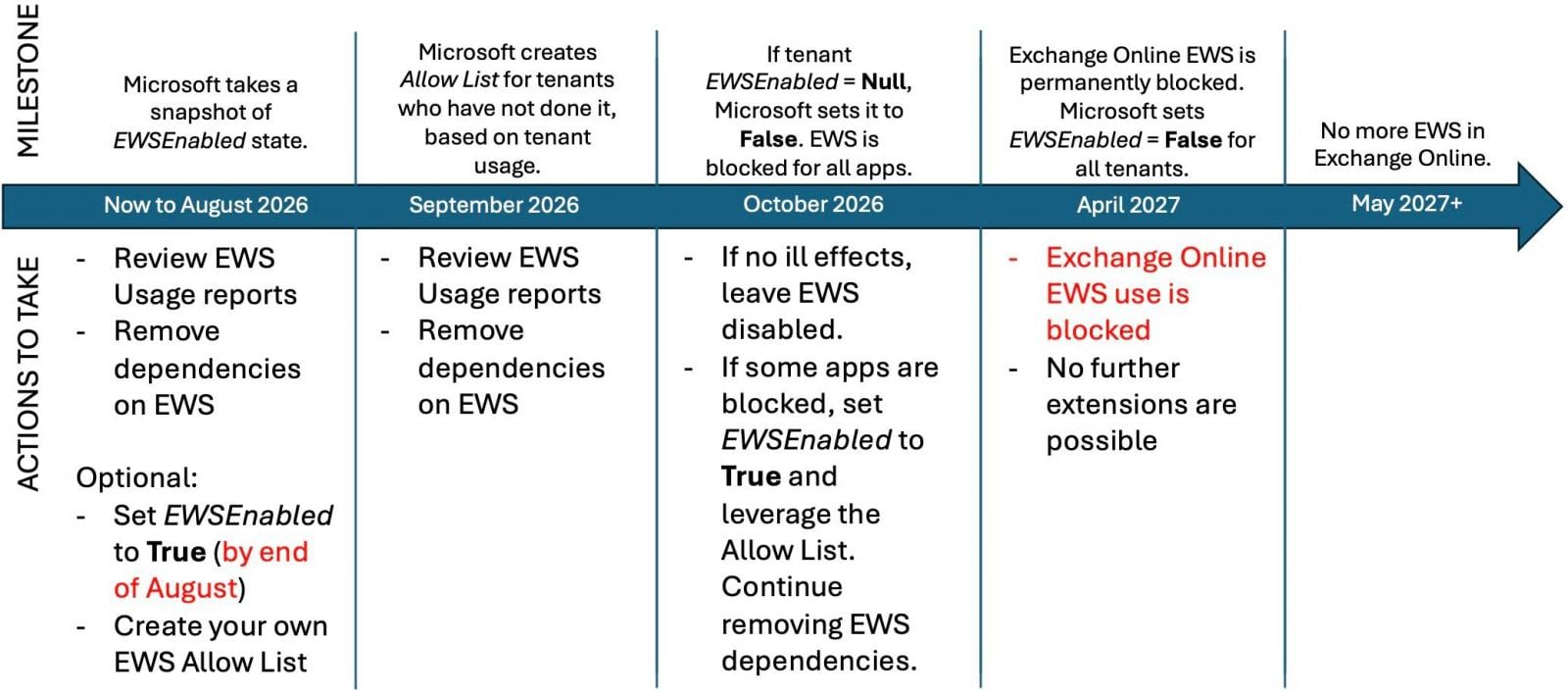
The decommissioning roadmap is structured with distinct phases designed to force migration while allowing administrators a controlled means of identifying and addressing dependencies. The initial hardening phase commences on October 1, 2026, when EWS access in Exchange Online environments will be disabled by default. Crucially, Microsoft offers a temporary reprieve via an application allowlist mechanism. Organizations that proactively configure these allow lists before the end of August 2026 will bypass this initial automatic block. For those slower to act, Microsoft intends to automatically populate these allow lists starting in September 2026, basing the inclusions on observed tenant usage patterns—a measure aimed at preventing widespread, immediate service disruption from forgotten dependencies.

However, the grace period ends definitively on April 1, 2027, when the final, non-negotiable shutdown of EWS access in Exchange Online takes effect. No exceptions will be granted post this date. To assist in the discovery phase, Microsoft plans to execute periodic, temporary "scream tests," briefly disabling EWS functionality to intentionally surface latent application dependencies that might otherwise remain hidden until the final cutover. Regular communication regarding these tests, along with tenant-specific usage summaries, will be delivered via monthly Message Center notifications, emphasizing the operational burden now squarely placed on IT administration teams.
The On-Premises Conundrum and Hybrid Architecture
A vital distinction in this retirement is its scope: the comprehensive shutdown applies exclusively to Microsoft 365 and Exchange Online tenants. EWS will remain operational for applications connecting to on-premises installations of Exchange Server. This differentiation introduces significant complexity, particularly for organizations operating in hybrid environments—those maintaining both cloud and local mailboxes.
Microsoft’s guidance clarifies that while on-premises mailboxes may continue to leverage EWS for application connectivity, mailboxes residing in the cloud absolutely must transition to the Graph API. The Autodiscover service is expected to guide applications in identifying the correct mailbox location and, consequently, the appropriate API endpoint. However, a significant caveat has emerged regarding hybrid synchronization: applications utilizing the Graph API for communication with Exchange Online mailboxes will necessitate that the corresponding on-premises mailboxes be hosted on Exchange Server 2019 Cumulative Update 13 (CU13) or later, referred to as Exchange Server Subscription Edition (SE). This requirement forces hybrid customers to ensure their on-premises infrastructure is sufficiently modernized to support Graph-based interactions directed toward cloud resources, adding another layer to the pre-migration checklist.
Industry Context: The Inevitable Shift to Unified APIs
This announcement is not a sudden pivot but the culmination of years of strategic realignment within Microsoft’s developer ecosystem. Warnings regarding EWS deprecation began as early as 2018, when Microsoft indicated that EWS would cease receiving new feature updates. This was followed by a formal announcement in September 2023 detailing the planned October 2026 initial retirement phase. Furthermore, in 2021, Microsoft began actively pruning the EWS surface area, deprecating the 25 least-utilized APIs in 2021 and removing support for them in March 2022, citing security and maintenance overhead as key drivers.
The strategic imperative behind retiring EWS centers on Microsoft Graph. Graph is designed as the unified gateway to the entire Microsoft 365 stack—encompassing Teams, SharePoint, OneDrive, and, critically, Exchange Online. Consolidating disparate APIs like EWS and the older Outlook API onto a single, modern RESTful framework simplifies Microsoft’s maintenance burden, enhances security posture through standardized authentication protocols (like OAuth 2.0), and improves feature parity across the entire productivity suite. Microsoft suggests that Graph has already achieved near-complete feature parity with EWS for the vast majority of common use cases, which serves as a strong technical justification for the migration.
Expert Analysis: Security, Scale, and Technical Debt
From a security engineering perspective, the retirement of EWS is a significant positive step. Legacy APIs often carry substantial technical debt. EWS, designed nearly two decades ago, predates many modern authentication and authorization standards that are now mandatory for cloud services operating at hyperscale. Migrating to Graph inherently pushes developers toward OAuth 2.0 flows, which offer granular permission scopes and better control over application access tokens compared to older, potentially more permissive authentication mechanisms associated with EWS. The Exchange Team explicitly stated that EWS no longer aligns with "today’s security, scale, or reliability requirements," highlighting that maintaining an aging protocol at the scale of Exchange Online introduces unnecessary risk vectors.
For independent software vendors (ISVs) and enterprise developers, the timeline presents a critical inflection point. Applications that relied heavily on niche EWS features that have not yet been perfectly mirrored in the Graph API face the most challenging migration path. While feature parity is high, subtle behavioral differences or missing endpoints can break mission-critical workflows. Development teams must allocate significant resources not just to code rewriting, but to rigorous validation, ensuring that data synchronization, complex calendar operations, and compliance-related data extraction function identically under Graph.
The phased rollout, while generous in duration (nearly three years from the initial disclosure of the final timeline), places pressure on IT governance. Identifying every application—internal custom tools, third-party management suites, archival systems, and security monitoring agents—that touches EWS is an exercise in technical archaeology. The "scream tests" are an acknowledgment of this difficulty, but organizations cannot afford to wait for these tests to identify broken integrations. Proactive auditing using tenant-specific usage data provided by Microsoft will be essential.
Industry Implications and the Future of Connectivity
The shift from EWS to Graph has broader implications for the enterprise integration landscape. It signals Microsoft’s unwavering commitment to standardizing on Graph as the sole long-term access layer for cloud data services. This consolidation benefits developers who can master one API set rather than several, but it also establishes a dependency on Microsoft’s roadmap for Graph feature evolution. Any future changes to mailbox access will occur within the Graph framework, bypassing the legacy EWS path entirely.
For third-party archiving and compliance solutions, this transition requires immediate attention. These tools often require deep, persistent access to mailbox content. While Graph supports these needs, the transition process must be validated against regulatory requirements, especially for industries with stringent data retention mandates.
Furthermore, the distinction between on-premises and cloud functionality highlights the complexity of hybrid IT governance. Organizations utilizing hybrid Exchange must now manage two parallel connectivity strategies: maintaining EWS compatibility for local resources while simultaneously re-engineering cloud connections for Graph. This duality forces a strategic decision: accelerate the full migration to Exchange Online to simplify infrastructure management, or commit to maintaining the infrastructure necessary (like Exchange SE) to support EWS parity for local operations that cannot yet move to the cloud.
In summary, the April 2027 deadline for Exchange Online EWS termination is a definitive declaration that the era of legacy protocol integration is ending. It mandates a wholesale pivot to the Microsoft Graph API, compelling developers and IT departments to finalize modernization efforts or face operational silence for any applications dependent on cloud mailbox access after that date. The next three years will be characterized by intensive auditing, API rewriting, and strategic infrastructure alignment across the global Microsoft 365 user base.
