

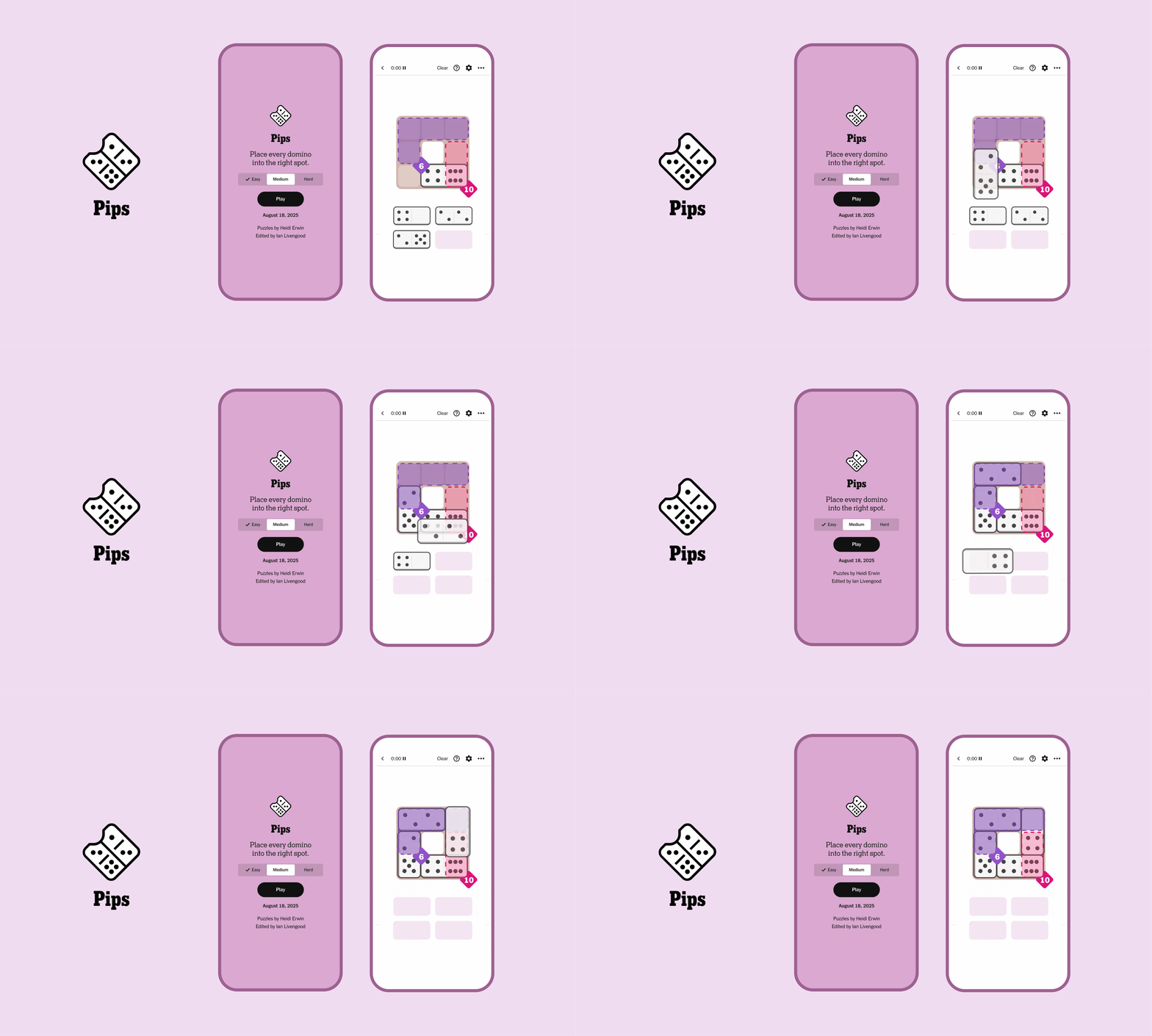
The digital landscape of the 21st century has seen a remarkable transformation in the way audiences consume short-form intellectual content. While traditional crosswords and Sudoku puzzles once dominated the morning routines of the cognitively inclined, a new era of logic-based challenges has emerged, blending classic tactile mechanics with sophisticated algorithmic design. Among these, the resurgence of domino-based grid puzzles represents a fascinating intersection of mathematical constraint satisfaction and spatial reasoning. As we examine the specific challenges presented on this first Thursday of February—traditionally associated with the Norse god Thor—we find that the attributes of strength and protection are perhaps less relevant than the wisdom of Mímir when navigating the intricate requirements of today’s numerical landscapes.

The Architectural Foundation of Grid-Based Domino Puzzles
To understand the appeal and the inherent difficulty of these puzzles, one must first deconstruct their structural components. At its core, the game utilizes the "pip" system—the traditional dots found on dominoes—and transposes them into a digital grid defined by multicolored zones. Each zone is governed by a specific "condition" or mathematical rule that must be satisfied. These conditions range from simple arithmetic totals to complex logical constraints, such as inequalities (greater than or less than) or non-equivalence (not equal to).
The player is tasked with utilizing a finite set of dominoes to fill the grid entirely. The complexity arises from the fact that every domino must be placed, every square must be filled, and every localized condition must be met simultaneously. This creates a high-stakes environment where a single miscalculation in an early quadrant can lead to a cascading failure in the final stages of the solve. Unlike linear puzzles, these grid challenges are holistic; they require a global perspective where the player anticipates how a placement in the "Easy" corner might inadvertently restrict the possibilities for the "Hard" section.

Analyzing the Daily Challenge: February 5
The puzzles for February 5 offer a progressive difficulty curve that serves as an excellent case study for strategic logic. The "Easy" tier serves as an introductory exercise in basic sum matching, while the "Medium" tier introduces more restrictive spatial constraints. However, it is the "Hard" tier that demands a sophisticated walkthrough, as it utilizes a combination of high-value sums and strict equality rules that leave little room for error.
The Hard Tier: A Tactical Walkthrough
For the advanced practitioner, the Hard grid for February 5 presents a formidable array of conditions. Success in this tier is rarely the result of trial and error; rather, it requires identifying "anchor points"—zones where the numerical possibilities are most restricted.

Phase 1: Identifying the High-Value Anchors
In today’s Hard puzzle, the Purple group requiring a sum of 18 is the logical starting point. In a standard set of dominoes, reaching a sum of 18 within a restricted number of squares necessitates the use of the highest available pips. Specifically, the two dominoes containing 6s are required here. The tactical move is to place the 6/6 domino vertically on the far-left side of this Purple 18 group. This placement immediately clarifies the surrounding requirements. Following this, the 6/0 domino should be transitioned from the Purple 18 group into the adjacent Pink "equal" (=) zone.
Phase 2: Managing the Mid-Grid Constraints
Once the high-value anchors are set, the player must address the secondary sum requirements. The 5/1 domino is best utilized by moving from the Orange 5 tile into the Dark Blue 5 zone. To satisfy the Pink "equal" condition mentioned in the previous phase, the 4/0 domino must be placed strategically to bridge the Dark Blue 5 zone and the Pink zone. This sequence effectively "locks" the left and center-left portions of the grid, providing a stable foundation for the final placements.

Phase 3: The Equality Chains
The final phase involves the large Blue "equal" group. At this stage of the solve, the numerical pool is limited, pointing toward the use of 3s. The 3/0 domino should be placed to connect the large Blue group with the Dark Blue "equal" zone. Simultaneously, the 0/5 domino transitions from that Dark Blue zone into the Orange 10 tile.
To conclude the logic chain, the 3/4 domino is placed moving upward from the Blue group into the Purple "equal" zone, while the 4/5 domino connects that Purple zone to the Pink 5 tile. The remaining pieces—the 1/1 double in the upper right, the 4/2 in the Green zone, and the 3/3 to fill the central Blue voids—complete the circuit. The final piece of the puzzle is the 2/5 domino, which drops from the Green "equal" zone into the Orange 10, satisfying the final sum.

Industry Implications: The Gamification of Cognitive Endurance
The popularity of these puzzles is not merely a niche trend; it reflects a broader shift in the digital media industry. Major publications have recognized that "sticky" content—content that encourages daily return visits—is essential for maintaining subscription models in an era of fragmented attention. By offering tiered difficulty levels (Easy, Medium, Hard), developers cater to a wide demographic, from casual users looking for a mental "warm-up" to power users who view these puzzles as a form of competitive cognitive endurance.
From a design perspective, the transition of dominoes into a constraint-satisfaction grid is a masterstroke of minimalist UI. It leverages a familiar physical object—the domino—and applies it to a modern logical framework. This reduces the "barrier to entry" for new players while allowing for nearly infinite variations in puzzle design. Industry analysts suggest that the success of such games lies in their ability to provide a "flow state," a psychological condition where the user is fully immersed in a task that is challenging yet achievable.

Expert Analysis: Heuristics and Problem-Solving
Experienced solvers often utilize specific heuristics that go beyond basic arithmetic. One such method is the "Exclusionary Principle," where a player identifies which dominoes cannot go into a specific zone, thereby narrowing the field of possibilities by default. In the February 5 Hard puzzle, the exclusion of low-value dominoes from the Purple 18 group is a prime example of this.
Another advanced technique is "Pathfinding," where the player visualizes the dominoes as a continuous circuit. Because each domino occupies two squares, they act as bridges between different conditional zones. Understanding how a 4/5 domino satisfies both a "sum of 9" requirement and an "equality" requirement in an adjacent zone is the hallmark of an expert player. This requires a high degree of spatial-numerical synthesis—the ability to see numbers not just as values, but as physical shapes that must fit into a jigsaw-like structure.

Future Trends: AI and the Evolution of the Puzzle
As we look toward the future of digital logic games, the role of Artificial Intelligence (AI) cannot be overstated. Current puzzle designs are often generated or at least vetted by algorithms to ensure they have a unique solution. However, the next generation of grid puzzles may feature "dynamic difficulty," where the grid shifts in real-time based on the player’s speed and accuracy, providing a bespoke challenge that evolves with the user’s skill level.
Furthermore, we are likely to see an integration of these logic challenges into broader educational platforms. The skills required to solve a "Hard" pip puzzle—logic, pattern recognition, and deductive reasoning—are the same skills required for computer programming and data analysis. By gamifying these concepts, developers are essentially creating a training ground for the 21st-century workforce.

Conclusion
The puzzles of February 5 serve as more than just a brief mental distraction; they are a testament to the enduring appeal of logical order in an increasingly chaotic digital world. Whether one is navigating the straightforward paths of the Easy grid or untangling the complex dependencies of the Hard walkthrough, the journey toward the solution is one of discipline and discovery. As players "scoop up their dominoes" and face each new day’s challenge, they are participating in a global ritual of cognitive refinement—one pip at a time. The intersection of ancient Norse mythology and modern numerical theory may seem an unlikely pairing, but in the realm of the grid, every symbol and every number has its place, waiting for the right mind to put them in order.
