

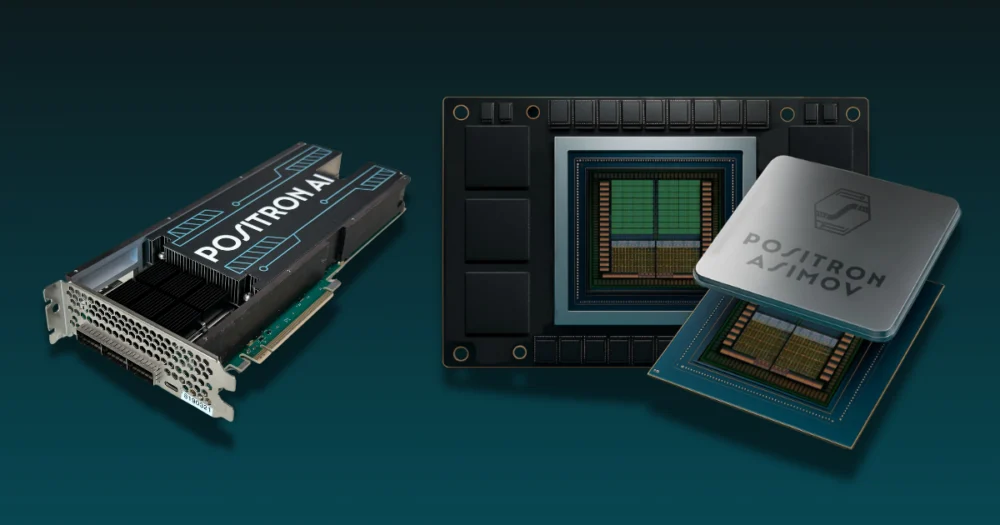
The escalating global arms race for artificial intelligence infrastructure has delivered a significant financial validation to the nascent chip ecosystem, with semiconductor startup Positron successfully closing a substantial $230 million Series B funding round. This massive capital infusion, exclusively learned from sources close to the transaction, is earmarked for the accelerated deployment and scaling of the company’s specialized high-speed memory components and integrated chips—technology deemed essential for managing demanding AI workloads.
The funding round carries significant strategic weight, notably due to the participation of the Qatar Investment Authority (QIA), the Gulf nation’s powerful sovereign wealth fund. QIA’s involvement underscores a rapidly accelerating geopolitical trend: the direct investment by nation-states into foundational AI compute capacity, viewing control over advanced silicon as a critical element of economic competitiveness and national security in the 21st century.
Positron, based in Reno, Nevada, has now raised total capital exceeding $300 million since its inception three years ago. Previous investors in the startup, who participated in a $75 million raise last year, include prominent names such as Valor Equity Partners, Atreides Management, DFJ Growth, Flume Ventures, and Resilience Reserve. This level of rapid capitalization positions Positron not merely as a hopeful contender but as a serious, well-funded challenger in the highly concentrated market currently dominated by Nvidia’s Graphics Processing Units (GPUs).
The Strategic Shift: Targeting the Inference Bottleneck
The timing of Positron’s significant raise is crucial, coinciding with a period of intense dissatisfaction among major hyperscalers and leading AI development firms regarding their dependency on the incumbent market leader. While Nvidia’s GPUs remain the undisputed gold standard for large-scale AI model training—the process of teaching large language models (LLMs) and deep neural networks—the performance economics for inference are beginning to favor specialized alternatives.
Inference refers to the computation required to run trained AI models in real-world applications, such as powering generative AI chatbots, processing real-time video feeds, or running complex recommendation engines. As businesses pivot from the costly, time-intensive process of building massive foundational models to the deployment and scaling of these models for commercial use, the demand for highly efficient inference hardware has skyrocketed. Positron has strategically positioned itself squarely within this rapidly expanding inference market.
Positron’s flagship product, the Atlas chip, manufactured in Arizona, has garnered attention due to audacious performance claims. The company asserts that Atlas can match the performance metrics of Nvidia’s current-generation H100 GPUs for inference workloads while consuming less than one-third of the power. If validated at scale in real-world data center environments, this efficiency advantage represents a profound shift in the total cost of ownership (TCO) for massive AI deployments, addressing one of the most pressing concerns for data center operators: cooling and energy consumption.
Beyond raw computational throughput, sources indicate that Positron’s architecture is particularly adept at high-frequency data processing and intensive video-processing workloads—areas where traditional GPGPUs often face latency and power bottlenecks when deployed at edge or high-transaction volumes. The core technological differentiator appears to reside in the specialized design of its high-speed memory architecture, which facilitates faster data movement, a critical requirement for low-latency inference.
The Compute Crisis and the Drive for Decoupling
The financial momentum behind companies like Positron is directly linked to the acute compute crisis facing the global technology sector. Nvidia currently controls an estimated 90% of the market for AI accelerator chips, creating a supply chain bottleneck that has driven prices for flagship GPUs into the tens of thousands of dollars and created significant lead times for deployment.
The need for decoupling from this reliance is a major motivation for companies across the industry spectrum. Even OpenAI, perhaps Nvidia’s most high-profile customer and early adopter, has reportedly expressed dissatisfaction with certain aspects of the latest Nvidia chips and has been actively seeking viable alternatives for its scaling needs. For large-scale operators, the strategic risk of having one sole, expensive supplier is unsustainable, leading to significant investments in internal chip development (like Google’s TPUs or Amazon’s Inferentia) and external collaborations with startups focused on domain-specific architectures (DSAs).
The architectural limitations of general-purpose GPUs (GPGPUs), designed primarily for massively parallel calculations typical of training, become apparent when tackling inference. Inference often requires rapid memory access and low-latency response times rather than sheer floating-point muscle. Specialized inference accelerators, such as the Atlas chip, can be engineered to optimize for these specific parameters, offering compelling performance-per-watt metrics that traditional GPGPUs cannot easily match without significant redesign.
Geopolitical Strategy: The Rise of Sovereign AI
The participation of the Qatar Investment Authority elevates Positron’s funding round beyond a simple venture capital success story; it places the startup at the intersection of technological advancement and strategic geopolitical infrastructure development.
Qatar, along with several other Gulf nations, is aggressively pursuing a "sovereign AI" strategy. This initiative, which has been a recurring priority highlighted at major regional technology forums, including recent Web Summit events in Doha, emphasizes the necessity of owning and controlling domestic compute capacity. The country views securing access to high-performance computing as indispensable for diversifying its economy, moving away from hydrocarbon reliance, and establishing itself as a premier global hub for advanced AI services, particularly within the Middle East and North Africa (MENA) region.
Sources indicate that QIA’s investment in Positron is part of a calculated move to secure early access to next-generation silicon that promises energy efficiency and competitive performance. This access is crucial for powering the massive data centers required for national AI initiatives. The strategy is already materialized through significant commitments, including a $20 billion AI infrastructure joint venture announced last September with Brookfield Asset Management, aimed at building and operating high-capacity data centers globally.
By backing Positron, Qatar is not merely making a financial bet; it is securing a stake in the supply chain of critical technology, ensuring that its future national AI clouds are not solely reliant on chips subject to the supply constraints and pricing dictated by a single U.S. corporation. This approach mirrors a growing trend worldwide where national investment funds are viewing compute capacity as a strategic commodity, similar to energy resources or telecommunications infrastructure.
Industry Implications and Expert Analysis
The trajectory of the AI silicon market suggests that the era of monolithic GPU dominance may be transitioning into an era of specialization. Expert analysis indicates that the future of AI acceleration will likely be characterized by a heterogeneous compute landscape, where different workloads are routed to the most efficient underlying hardware.
The primary hurdle for any new entrant, regardless of raw hardware performance, remains the software ecosystem. Nvidia’s nearly two-decade investment in its CUDA platform provides a powerful, sticky moat. Developers are deeply embedded in the CUDA environment, making migration to new architectures, which often require proprietary software stacks or complex porting efforts, a major barrier to adoption.
For Positron to truly succeed in challenging Nvidia’s position, it must offer more than just impressive benchmarks; it must provide a seamless, developer-friendly software layer that minimizes friction for hyperscalers seeking to integrate Atlas into their existing infrastructure. The focus on high-speed memory hints at an architectural design optimized for the massive data movement required by modern LLMs during inference, potentially alleviating the memory bandwidth bottlenecks that plague standard GPU configurations.
Industry analysts suggest that the success of inference-focused startups like Positron hinges on two factors: sustained performance claims under continuous load, and the ability to demonstrate substantial TCO savings. The claim of matching H100 performance at one-third the power consumption addresses the TCO equation directly, offering a compelling economic incentive that could overcome the inertia of the CUDA ecosystem, especially for companies prioritizing operational efficiency and sustainability.
Furthermore, the emphasis on manufacturing the Atlas chip in Arizona is a strategic choice, capitalizing on the increasing political and economic pressure for resilient, geographically diversified semiconductor supply chains, reducing reliance on East Asian fabrication facilities. This domestic manufacturing capability adds another layer of security and appeal for U.S. government agencies and enterprises concerned with supply chain resilience.
Future Impact and Market Trends
The global market for AI inference chips is forecast to expand exponentially, potentially reaching hundreds of billions of dollars annually as every sector—from finance and healthcare to manufacturing and retail—integrates generative AI capabilities. Positron’s $230 million war chest gives it the runway necessary to execute its deployment strategy and secure crucial design wins with early adopter hyperscalers who are desperate to diversify their chip supply.
The long-term impact of this funding round extends beyond Positron itself, signaling robust investor confidence in the broader trend of domain-specific acceleration. As AI models continue to grow in size, the energy required for both training and, critically, inference, will become the limiting factor for global deployment. Startups that can solve the power-efficiency puzzle, particularly for latency-sensitive inference tasks, are poised to capture significant market share.
The strategic alignment with sovereign wealth funds, exemplified by QIA’s participation, highlights a future trend where technology access is increasingly viewed through a geopolitical lens. Nations are becoming direct patrons of key foundational technologies, ensuring not only financial returns but also strategic influence and guaranteed access to the infrastructure defining the next industrial revolution.
Positron’s challenge is substantial—it is competing against a near-monopoly that possesses deep integration across hardware and software. However, the confluence of rising energy costs, insatiable demand for efficiency, and the active search by major customers for viable alternatives creates a unique window of opportunity. With over $300 million in backing and a chip boasting exceptional power-to-performance ratios for inference, Positron is now officially armed to enter the competitive fray and potentially redefine the economics of large-scale AI deployment globally. The Atlas chip, if it delivers on its promise, represents a critical component in the unfolding narrative of AI compute democratization.
