

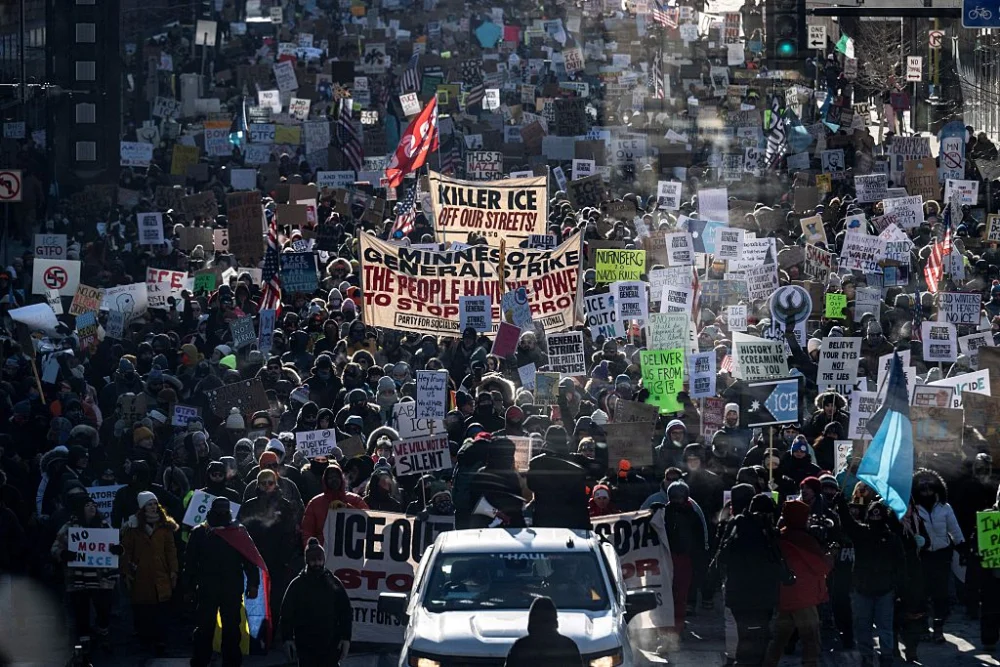
The Minneapolis-St. Paul metropolitan area, often lauded as a quiet but robust hub for healthcare technology, financial services, and burgeoning startup activity, has been thrust into a state of profound operational paralysis following an intense surge in federal immigration enforcement. The deployment of U.S. Immigration and Customs Enforcement (ICE) and Border Patrol agents, operating under the highly publicized “Operation Metro Surge,” has transformed the city’s economic landscape into a zone of tension and unpredictable conflict. This unprecedented federal presence—which has included agents equipped with military-grade weaponry and acting in plainclothes—has resulted in multiple civilian fatalities, including documented cases of U.S. citizens being killed, plunging the entire community, including its tightly-knit technology ecosystem, into a state of crisis.
For the founders, venture capitalists, and engineers who power the Twin Cities’ innovation economy, the focus has fundamentally shifted from scaling startups to ensuring basic community survival. Interviews with eight Minneapolis-based founders and investors reveal a tech sector reeling from exhaustion and fear, where core business activities have been largely supplanted by emergency grassroots organization. Scott Burns, a prominent local investor, described the environment as akin to the aftermath of a natural disaster, noting the shared sense of urgency across all professions. “There’s a lot of commonality between how a teacher is reacting right now and how a tech professional is reacting,” Burns stated, highlighting the pervasive sense of fatigue that has settled over the populace. He, like many others, has redirected his time toward direct community aid, volunteering to pack and deliver food to residents too fearful to leave their homes, a necessity born from a city under de facto siege.
Operational Disruption and the Pervasive Threat Matrix
The omnipresent nature of the federal operation presents unique and acute operational challenges for technology companies. The Twin Cities’ streets, public transit systems, and even private parking lots have become unpredictable enforcement zones. Agents have been documented circling schools and conducting aggressive “citizen checks,” demanding proof of immigration status based on highly subjective criteria like perceived race or accent—a practice legally validated by recent judicial interpretations.
Efraín Torres, a Latino founder, described the psychological burden of attempting to work remotely while constantly monitoring his neighborhood for signs of enforcement activity—the blaring of car horns, the protestors’ alert whistles, or the sight of hastily posted signs confirming a neighbor’s detention. This ambient, high-stress environment is toxic to the high-concentration work required for software development and strategic planning.
The fear is not confined to undocumented residents or those with tenuous legal status. U.S. citizens of color within the tech sector are also adopting extreme cautionary measures. One Black founder, who requested anonymity to safeguard his employees, now carries his passport at all times, a necessity driven by observing racial profiling across the city. He recounted a chilling interruption during a routine operational call: a colleague fell silent, only to report witnessing an ICE detention occurring right outside her window, near where his mother resides. “I had to get off the phone and call my mom to make sure she had her passport on her,” he recalled.
This psychological trauma has translated directly into diminished corporate focus and productivity. “It’s hard to focus; it’s been a challenge just navigating even my team through it,” the anonymous founder explained. Companies are implementing radical safety protocols, such as Torres’s firm adopting a strict no-ride-sharing policy, driven by reports of H-1B visa-holding engineers being followed by federal agents. The visible presence of “three to four armed men in tactical outfits” during enforcement encounters inflicts widespread trauma, forcing some professionals to consider the drastic measure of fleeing the state entirely to ensure their families’ safety.

Industry Implications: Talent, Capital, and the Future of Minnesota Tech
Minnesota’s technology sector, though smaller than coastal behemoths, has carved out a respectable niche, attracting over $1 billion in venture capital in recent years and fostering successful firms like the fintech company Sezzle, the clean water innovator Rorra, and the medtech firm Reema. This ecosystem relies heavily on diverse, highly skilled international talent, many of whom are H-1B visa holders—a group already facing regulatory pressure from the current administration.
The deployment of over 3,000 federal agents in Minnesota—a force that Senator Amy Klobuchar noted outnumbers the local police almost three-to-one—creates an untenable atmosphere for attracting and retaining this critical talent pool. Venture capital thrives on stability, predictability, and a robust talent pipeline. When the core workforce lives in fear of arbitrary detention or violence, the foundational pillars of the investment thesis crumble.
Expert-Level Analysis: The Cost of Instability
From an economic perspective, the escalating enforcement acts as an invisible but devastating "talent tariff." The perceived risk of living and working in Minneapolis now far outweighs the comparative advantages (lower cost of living, quality of life) that typically draw talent away from the established coastal hubs. For early-stage startups, where every employee is mission-critical, the potential loss of skilled engineers or leaders due to politically motivated enforcement poses an existential threat.
Venture capitalists assess risk based on market dynamics, technological hurdles, and team strength. Introducing systemic, state-sponsored security risk fundamentally alters the calculus. Why would a national fund deploy capital into a region where the continuity of operations is compromised by federal actions that target the workforce?
Mary Grove, a local investor, articulated the tension plainly: “It’s a tense and difficult time on the ground.” This tension manifests not only in missed deadlines but in a broader erosion of confidence. Reed Robinson, another investor, noted that while the history of innovation in the state is strong and resilient—"It’s not going to stop"—the current situation forces founders to divert invaluable time and resources toward non-business protective measures, such as organizing complex, rotating childcare networks because of the risk of daycare staff being detained. This energy drain represents a massive, unquantifiable loss of intellectual capital.
Furthermore, the targeting of communities, particularly the large Somali immigrant population in Minnesota, underscores a political motivation behind "Operation Metro Surge." This perception, coupled with the administration’s public sparring with local Democratic leaders like Governor Tim Walz and Mayor Jacob Frey, fuels the belief that the city is being deliberately destabilized as a form of political retribution. This politicization of law enforcement creates an additional layer of instability that savvy investors typically shun.

A Failure of Corporate Leadership and the Rise of Grassroots Resilience
Amidst the chaos, the response from the Twin Cities’ massive corporate infrastructure has been widely criticized as inadequate. Minneapolis and St. Paul host the headquarters of Fortune 500 giants like Target, Best Buy, UnitedHealth Group, and General Mills—companies that rely heavily on the region’s stability and employ thousands of people potentially impacted by the raids.
While sixty senior executives did issue a statement calling for an "immediate de-escalation of tensions" following the killing of ICU nurse Alex Pretti by ICE agents, and corporate entities contributed millions in grants through the Minneapolis Foundation to support affected small businesses, many founders and smaller investors found this institutional response wanting.
Startup investors voiced disappointment over the lack of moral clarity and robust defense of employees. One investor noted, “We haven’t had an adequate response.” This hesitancy among established corporate leaders is, in part, explained by risk aversion; a CNBC poll indicated that executives stayed silent either because they didn’t see the issue as relevant to business (a questionable claim given the direct impact on their workforce) or because they feared political retaliation from the federal government.
Tim Herby, a local investor, characterized this institutional failure as "most disappointing," calling the past two months "heart-wrenching."
In the vacuum left by corporate ambivalence, the tech community has activated a powerful grassroots network, showcasing profound community cohesion. This network transcends typical professional silos. Investors are funding emergency aid, buying groceries for college founders who are immigrants, and establishing protective social infrastructure. The work is deeply personal and often involves high risk. One U.S. citizen investor, who traces his family roots in the country back a century, still carries his passport, noting that federal agents are operating not just in the urban core but in rural Minnesota where he goes to the gym. He and others are prioritizing the immediate needs of their networks, providing food and safe transport.
The scene demonstrates a poignant irony, noted by one Black investor: local police, historically subjects of protest (particularly after the murder of George Floyd just years prior), now find themselves aligned with the community in speaking out against the aggressive federal presence.
The reliance on informal networks for security highlights the depth of the crisis. A Black founder shared that his white friends now routinely drive him around the city, acting as escorts to mitigate the risk of racial profiling by federal agents. These daily acts of solidarity underscore how thoroughly the enforcement operations have permeated and consumed everyday life.

Future Impact and Long-Term Trends
The long-term repercussions of "Operation Metro Surge" extend far beyond immediate productivity losses. This crisis sets a dangerous precedent for how federal power can be deployed to destabilize regional economies and political opposition.
1. Capital Flight and De-urbanization of Talent: If the environment of fear persists, Minneapolis risks capital flight and, critically, talent emigration. Technology professionals, particularly those with international backgrounds or those who feel racially targeted, may opt for more politically stable, welcoming urban centers. This is particularly concerning for the Twin Cities’ burgeoning medtech and fintech sectors, which depend on a highly mobile and specialized global workforce.
2. Redefining Corporate Social Responsibility (CSR): The crisis is forcing a painful re-evaluation of corporate leadership roles during moments of social and political upheaval. The perceived timidity of large local corporations will likely fuel demands from employees, consumers, and younger founders for stronger, more explicit commitments to social justice and the protection of their workforce. Future investors and founders may prioritize locating their businesses in areas where institutional defenses against federal overreach are demonstrably robust.
3. The Psychological Scar: The pervasive fear and trauma—manifested in founders considering relocating, engineers being followed, and the constant awareness of violence—will leave a lasting psychological scar on the ecosystem. Rebuilding trust in civil institutions and restoring a sense of safety will require years, regardless of future political shifts.
As Efraín Torres summarized, the presence of armed, tactical agents “inflicting trauma everywhere they go” creates an environment where entrepreneurship becomes an act of defiant resilience rather than innovation. The community’s capacity to support one another—through shared meals, emergency funding, and protective networks—proves the spirit of the Minneapolis tech scene remains intact. However, sustained innovation requires more than spirit; it demands stability. The city’s ability to reclaim its status as a viable tech hub hinges on its success in navigating and ultimately overcoming this politically charged era of systemic suppression. The ongoing effort, symbolized by community organizations like Minnestar planning events to discuss next steps, is not merely about staying afloat; it is about defining a new model of decentralized, socially engaged innovation in the face of profound adversity.
