


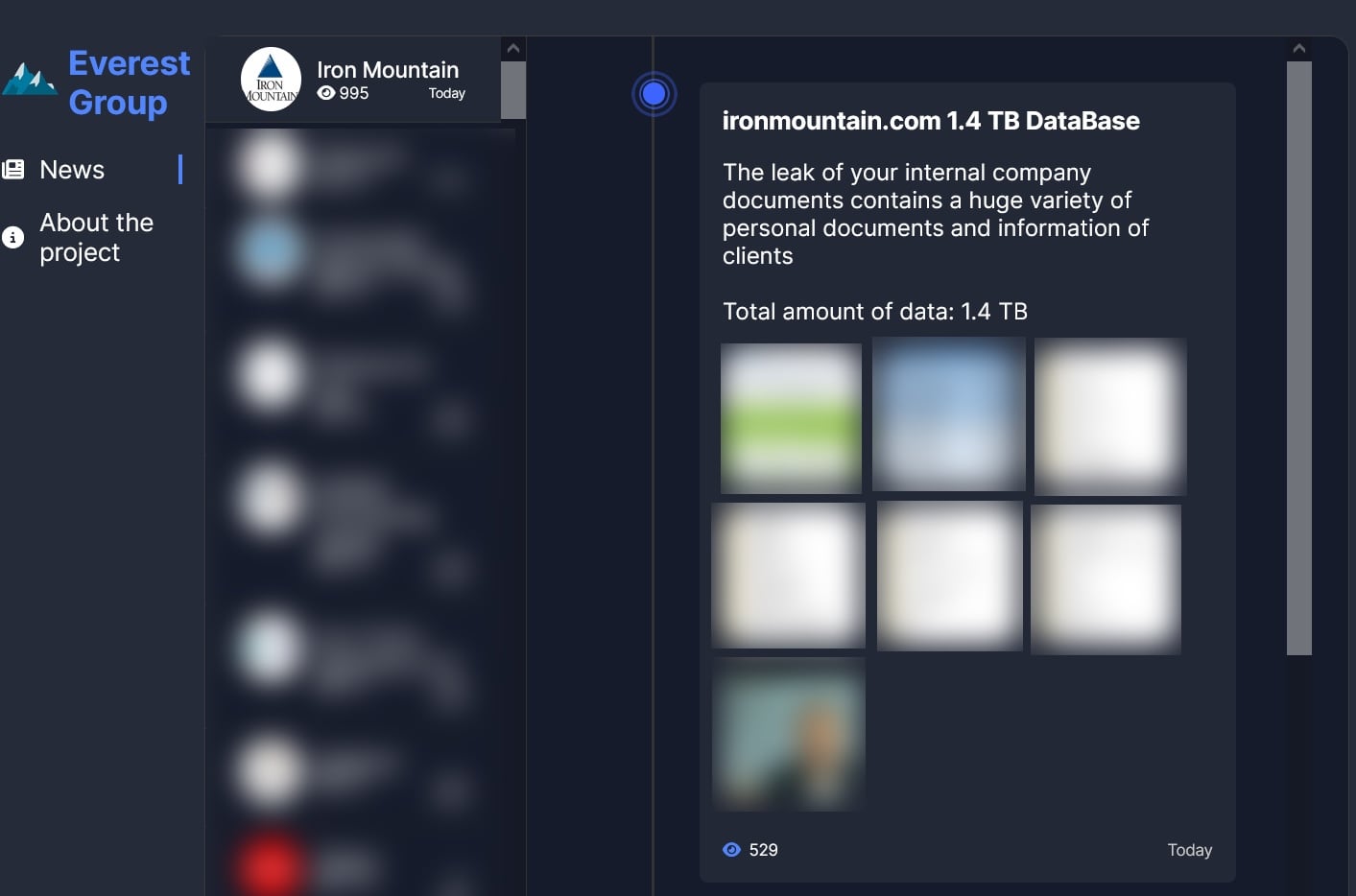
Iron Mountain, a globally recognized titan in data management, secure storage, and digital infrastructure services, has publicly addressed a data security incident initially publicized by the notorious Everest extortion syndicate. The company’s preliminary assessment, conveyed to security reporters, strongly suggests the breach was narrowly confined, primarily impacting non-sensitive corporate marketing documentation rather than core client data or operational systems. This clarification is crucial given Iron Mountain’s foundational role in safeguarding the critical records for an immense global clientele, which famously includes 95% of the Fortune 1000 companies spanning over 61 nations.
Established in 1951 and headquartered in Portsmouth, New Hampshire, Iron Mountain’s business model is predicated on trust and the impenetrable security of physical and digital assets. When a threat actor like Everest claims to have exfiltrated 1.4 terabytes (TB) of "internal company documents," including assertions of "personal documents and information on clients," the immediate industry reaction is one of heightened alert. The sheer scale implied by the claimed data volume suggests a potentially catastrophic compromise for an organization whose reputation hinges on absolute data integrity.
However, the official narrative provided by Iron Mountain paints a significantly different, far less severe picture. The firm asserts that the unauthorized access was facilitated through the exploitation of a single, compromised login credential. This credential granted the threat actors entry into a specific, isolated folder located on a file-sharing server. Crucially, this specific repository was designated for storing and distributing marketing collateral, often shared externally with vendors and partners, and was, by its nature, publicly accessible or semi-publicly exposed.
The company’s subsequent forensic investigation confirmed that the Everest operatives, known for their adaptability in the cybercrime landscape, did not escalate the intrusion. There was no deployment of ransomware payloads onto the affected server, nor did the attackers manage to pivot or traverse into other segments of Iron Mountain’s extensive internal network infrastructure. This containment suggests either a limited scope of the initial compromise or a swift, effective isolation protocol executed post-discovery. Iron Mountain explicitly stated: "No customer confidential or sensitive information has been involved. A single compromised login credential was used to gain access to one folder, consisting primarily of marketing materials shared with third-party vendors on a public-facing file-sharing site." Furthermore, they affirmed the integrity of their broader systems: "At this time, we also confirm that no Iron Mountain systems have been breached, and there is no ransomware or malware involvement, or any other cyber activity, beyond the compromised folder credential, which has since been deactivated."

Contextualizing the Threat Actor: The Evolution of Everest
To fully appreciate the context of this incident, one must analyze the threat actor itself. The Everest group, which has been active since approximately 2020, represents a significant evolution within the ransomware ecosystem. Initially deploying traditional encryption methods, Everest has strategically pivoted its core business model towards data exfiltration and corporate extortion, aligning with the broader industry trend of ‘double extortion.’ This tactic involves stealing sensitive data and then threatening public release if a ransom is not paid, even if the target organization has robust backups to restore from encryption events.
Everest has also developed a reputation as a proficient Initial Access Broker (IAB). This secondary, yet highly lucrative, revenue stream involves compromising corporate environments and then selling authenticated network access—often via stolen credentials or established backdoors—to other specialized cybercrime syndicates. This dual functionality makes them a multifaceted threat, capable of causing direct harm or acting as a gateway for more destructive actors.
Over the past five years, the group has aggressively expanded its target roster, adding hundreds of victims to its dedicated dark web leak portal. This portal serves as the primary leverage point in their double-extortion strategy. The targeting profile of Everest is not static; regulatory bodies have taken notice. In August 2024, for example, the U.S. Department of Health and Human Services (HHS) issued specific advisories warning that Everest was increasing its focus on the highly sensitive healthcare sector within the United States, underscoring their operational reach across diverse, high-value industries.
The operational history of Everest has also seen moments of internal disruption. Most recently, in April 2025, their dark web infrastructure suffered a significant public setback when their leak site was defaced. The attackers replaced the site’s contents with a message reading, "Don’t do crime CRIME IS BAD xoxo from Prague," temporarily disrupting their public extortion mechanism. While such defacements rarely halt operations permanently, they introduce periods of chaos and force the group to rebuild or migrate infrastructure, which can occasionally reveal operational security flaws.
Industry Implications: The Fragility of Access Controls
While Iron Mountain has successfully contained the immediate damage, the incident serves as a potent case study in modern cyber risk, specifically highlighting the inherent dangers associated with externally facing, poorly segmented data repositories. For an industry as sensitive as data storage and records management, the mere suggestion of a client data compromise sends shockwaves through the sector.

The core implication here revolves around Identity and Access Management (IAM) and data segmentation hygiene. The fact that a single compromised credential led to the exfiltration of 1.4 TB of any data underscores the principle that even marketing materials can be stored in environments that lack the strict access controls applied to core operational or client databases.
In enterprise environments, especially those handling the crown jewels of global corporations, network segregation should isolate marketing assets from repositories containing even tangential client information. The use of a "public-facing file-sharing site," even if access required a credential, represents a potential weak link. Security architects often refer to this as the "lateral movement risk." If an attacker gains entry through the lowest-security door—in this case, a marketing folder—the subsequent step is always to probe for adjacent, higher-value systems. Iron Mountain’s containment suggests they either detected the breach quickly enough to prevent lateral movement or the folder was sufficiently firewalled from the rest of the infrastructure.
For Iron Mountain’s 240,000 global clients, the immediate concern shifts from data loss to process assurance. They need confirmation that the method of access—the compromised credential—was not reused elsewhere and that the file-sharing platform itself does not harbor vulnerabilities that could be exploited for deeper access. The swift deactivation of the credential is a necessary but minimal response; a full audit of all credentials associated with third-party vendor access points is mandatory to prevent repeat exploitation.
Expert Analysis: The Nuance of "Limited Breach"
From a cybersecurity perspective, classifying a breach as "limited" requires stringent forensic validation. Security professionals understand that threat actors often conduct reconnaissance and data staging before announcing a successful attack. The Everest claim of 1.4 TB suggests they had ample time to browse and selectively download data.
The key differentiating factor in Iron Mountain’s statement is the focus on data classification. If the data truly consisted only of marketing collateral—press releases, campaign assets, non-public product roadmaps, or vendor agreements related solely to marketing—the immediate financial and regulatory liability is significantly lower than if PII (Personally Identifiable Information) or proprietary client intellectual property had been involved.
However, even marketing materials can contain embedded metadata or strategic documents that, if leaked, could offer competitors or threat actors strategic insights into Iron Mountain’s go-to-market strategies, pricing structures, or planned service expansions. This constitutes a competitive intelligence loss, even if it doesn’t trigger GDPR or CCPA notification requirements.
Furthermore, the attacker’s intent is revealing. By immediately claiming client information was stolen but then only having access to a marketing folder, Everest might be engaging in false flag signaling or exaggerated claims designed to maximize panic and pressure on the victim organization. This tactic inflates the perceived severity of the incident, hoping the target company will pay simply to disprove the broader claims publicly, even if internal forensics suggest otherwise. Iron Mountain’s measured response—providing specific technical details about the access point—is an attempt to control the narrative by grounding the incident in verifiable technical facts rather than threat actor rhetoric.
Future Impact and Strategic Trends
This incident reinforces several critical trends shaping the future of enterprise cybersecurity, particularly for data custodians:
- The Ascendancy of Credential Theft: The reliance on compromised credentials remains the single most common initial vector for sophisticated attacks. This underscores the necessity of moving beyond traditional perimeter defenses toward a Zero Trust architecture where every access request, internal or external, is verified based on context, device health, and least-privilege principles. Multi-Factor Authentication (MFA) must be enforced universally, especially for access to shared environments, irrespective of how "public-facing" the server might be perceived.
- Data Governance in Shared Spaces: The breach highlights the danger of using unified file-sharing platforms for disparate levels of data sensitivity. Best practice dictates that data classification should dictate storage location and access controls. Highly sensitive data must reside in highly secured enclaves, separate from even moderately sensitive materials like vendor-shared marketing drafts. The practice of mixing data types in a single, accessible location is a recipe for security incidents.
- The Endurance of Non-Ransom Extortion: The shift by groups like Everest away from system encryption towards pure data theft confirms that the threat landscape is prioritizing data leverage over system downtime. Organizations must prepare not just for restoration (backups) but for data leakage scenarios, which require robust communications plans, legal counsel, and specialized digital forensics capabilities to accurately assess the scope of the exfiltrated material.
- Evolving Threat Actor Tactics: Everest’s history as an IAB suggests that even if Iron Mountain successfully neutralized this specific intrusion, the access gained might have been sold. Cybersecurity teams must now investigate whether any of their network access points, even those seemingly closed off, have been provisioned to other threat actors operating in different niches (e.g., espionage, financial fraud).
In summary, Iron Mountain’s confirmation that the Everest intrusion was confined to a file-sharing repository containing marketing materials mitigates immediate catastrophic fallout for their clientele. However, the event serves as a sharp reminder to the entire data management sector: in the eyes of a sophisticated threat actor, the distinction between a critical database and a shared marketing folder can vanish instantly if a single credential grants the key to the kingdom. For Iron Mountain, the immediate focus shifts from damage control to demonstrating the resilience of their segregation policies and the robustness of their credential management framework to their world-class customer base.
