

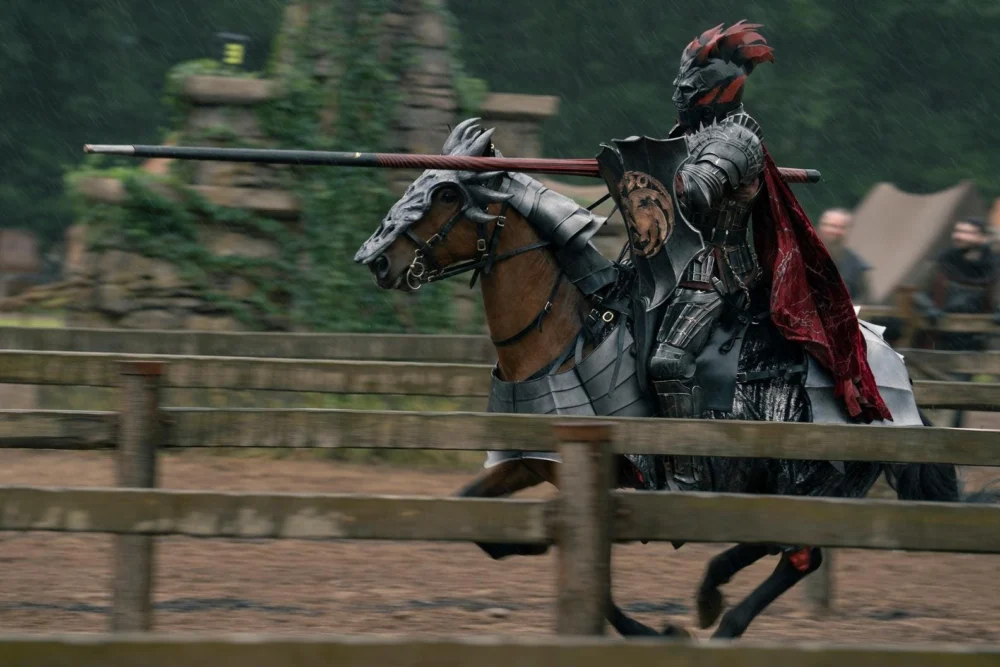
The third installment of HBO’s A Knight of the Seven Kingdoms, titled "The Squire," represents a pivotal shift in the narrative architecture of the Game of Thrones prequel. While the preceding episodes established the foundational bond between the towering, earnest Ser Duncan the Tall and his precocious squire, Egg, this chapter plunges the duo into the complex sociopolitical mire of the Targaryen dynasty. It is a masterclass in cinematic economy, utilizing its compact runtime to balance whimsical character beats with the visceral, high-stakes dread that has become the hallmark of George R.R. Martin’s televised universe.
Set against the verdant backdrop of the Ashford Tourney, the episode opens with a deceptive sense of bucolic tranquility. The cinematography captures a misty, dawn-lit valley that feels world-removed from the scorched-earth politics of House of the Dragon. Here, the stakes initially appear localized: a hedge knight seeking glory and a boy dreaming of a stationary life. The dialogue between Dunk (Peter Claffey) and Egg (Dexter Sol Ansell) as they overlook the tourney grounds serves as more than mere exposition; it establishes a rare, wholesome chemistry. When Egg muses about raising crops and animals—specifically avoiding sheep—it highlights the innocence that the series seeks to protect, even as it prepares to dismantle it.

The Craft of Character: Dunk, Egg, and the Archetype of the True Knight
Peter Claffey’s portrayal of Ser Duncan continues to be a revelation. In a franchise often populated by Machiavellian schemers, Dunk’s literal and figurative transparency is refreshing. He is a man of simple needs and rigid, if unrefined, honor. This is most evident in the domesticity of the opening scenes, where the act of crafting an "epic" breakfast sandwich or teaching Egg the rudimentary skill of sewing provides a grounded contrast to the lofty titles and polished armor of the assembled lords.
Dexter Sol Ansell, meanwhile, navigates the complexities of Egg with a maturity that belies his age. In "The Squire," we see the first true glimpses of the future King Aegon V. His ability to pivot from boyish mischief—such as his spirited training sessions with the horse, Thunder—to a commanding, somber authority is the episode’s narrative engine. The scene where Egg interacts with Thunder, asserting that a horse "doesn’t want to be ordered about any more than a man does," is a subtle piece of foreshadowing. It suggests a philosophy of governance that will eventually define his reign: a king who remembers the dignity of the common man.
The introduction of Ser Robyn Rhysling, the "Maddest Knight in the Seven Kingdoms," adds a layer of eccentric world-building. His brief interaction with Egg, marked by the gruesome detail of a lost eye hanging from its socket, serves as a reminder that the chivalric world is often one of senseless violence and physical ruin. It is the "gross-out" realism that anchors the show’s more whimsical elements, ensuring the audience never forgets the proximity of death in this tourney setting.

The Revelation: A Prince Among Hedge Knights
The narrative climax of the episode—the unmasking of Egg’s true identity—is handled with a frantic, operatic intensity. For viewers familiar with the source material, the reveal was inevitable, yet the execution remains striking. Egg is not merely an orphan; he is Aegon Targaryen, son of Prince Maekar and grandson of King Daeron II. This revelation retroactively colors every previous interaction, from his disdain for his brother Aerion’s cruelty to his quiet observations of the smallfolk.
The connection to Game of Thrones is made poignant through the shadow of Maester Aemon. In the original series, a dying Aemon Targaryen famously hallucinated his younger brother, whispering, "Egg, I dreamed that I was old." Seeing the vibrant, defiant boy in this prequel adds a layer of tragic weight to the Targaryen lineage. It reminds the audience that the "Game of Thrones" is a cycle of generational trauma, where even the most promising princes are eventually worn down by time, duty, and the Wall.
The Antagonist: Aerion Brightflame and the Perversion of Royalty
Finn Bennett’s Aerion "Brightflame" Targaryen provides the perfect foil to Dunk’s humility. Aerion represents the worst impulses of the dragon-blooded: entitlement, sadism, and a fragile ego. The incident at the puppet show, where Aerion brutally assaults the Dornish puppeteer Tanselle (Tanzyn Crawford) for the perceived slight of a dragon being slain in her play, is the episode’s moral turning point.

Aerion’s logic—that "the dragon will never lose"—is a chilling echo of the Targaryen supremacy that would eventually lead to the family’s downfall. When Dunk intervenes, striking a prince of the blood to save a common woman, he commits a capital offense in the eyes of Westerosi law. The tension in the tent, amplified by a score of frenetic strings and operatic vocals, captures the terrifying reality of life under an absolute monarchy. A single moment of chivalry has placed Dunk on the path to execution, proving that in this world, no good deed goes unpunished by the powerful.
Industry Implications: HBO’s Strategic Pivot in the Fantasy Landscape
The production of A Knight of the Seven Kingdoms signals a significant strategic shift for HBO. Following the massive scale and budget of House of the Dragon, "The Squire" demonstrates that the network is willing to experiment with "prestige-lite" formats—shorter episodes, smaller casts, and a more focused narrative scope. This move is likely a response to the current streaming climate, where audiences are increasingly suffering from "spectacle fatigue."
By focusing on the "Dunk and Egg" novellas, HBO is tapping into a more episodic, character-driven form of storytelling that resembles classic Westerns or picaresque novels. This approach allows for a more faithful adaptation of George R.R. Martin’s prose, which often thrives in the "little moments" of world-building. The success of this episode suggests that there is a significant appetite for fantasy that prioritizes heart and humor over massive CGI battles.

Furthermore, the show’s emphasis on the Blackfyre Rebellion—referenced in Egg’s bawdy songs—provides a rich historical context that rewards long-time fans without alienating newcomers. It establishes a "connected universe" feel that is more organic than the forced cameos often seen in other franchises.
Analysis: The Steward’s Gambit and the Rigged Game
One of the more intellectually stimulating segments of the episode involves the Ashford steward, Plummer. His proposal to Dunk—to rig a joust against Ser Androw Ashford—introduces a theme that will surely dominate the remainder of the season: the corruption of the "Fair Play" ideal.
Plummer’s pragmatic outlook, noting that Lord Ashford has "richly overspent" and that hard times are coming, grounds the fantasy in economic reality. The tourney is not just a sporting event; it is a financial venture and a political pageant. Dunk’s internal struggle between the promise of wealth (being "richer than a Lannister") and his inherent honor is the classic hero’s journey. However, in the context of Westeros, honor is often a luxury that the poor cannot afford. Dunk’s choice will define not only his future but also the lessons he imparts to the young Aegon.

Future Impact and Trends: The Evolution of Westerosi Television
As the season progresses, A Knight of the Seven Kingdoms is poised to influence the future of the Thrones brand. If this series continues to garner critical and commercial acclaim, it may pave the way for other "smaller" stories within the lore, such as a series focused on the voyages of Corlys Velaryon or the early days of the Night’s Watch.
The trend toward "wholesome" or "cozy" fantasy, even when punctuated by violence, is a notable shift in the genre. It suggests that modern audiences are looking for characters they can genuinely root for—characters whose moral compasses are not entirely obscured by shades of grey. Dunk and Egg represent a beacon of hope in a world that is often relentlessly grim.
Conclusion: The Stakes of Ashford Meadows
Episode 3, "The Squire," succeeds because it understands that the most compelling conflicts are not fought with dragons, but with conscience. By unmasking Aegon Targaryen and pitting Ser Duncan against the cruelty of the royal family, the show has raised the stakes from a simple tourney to a battle for the soul of the Seven Kingdoms.

As Dunk stands bloodied before a prince, he is no longer just a hedge knight; he is a symbol of the "sovereignty of the small." The episode leaves us with a profound question: Can a man remain "true" in a system built on lies and rigged games? With only three episodes remaining, the consequences of Dunk’s chivalry—and the fallout of Egg’s revealed identity—promise a conclusion that is as emotionally resonant as it is historically significant within the annals of Westeros. The boy who would be king has found his mentor, but the fire and worms of prophecy still loom in the distance.
