

For decades, the marine biology community and the public alike have viewed the manta ray through a lens of majestic isolation. These "gentle giants" of the ocean, known for their sweeping pectoral fins and somersaulting filter-feeding displays, are frequently categorized as charismatic megafauna—individual icons of conservation that draw thousands of divers to tropical reefs annually. However, groundbreaking long-term research emerging from the coastal waters of South Florida is fundamentally challenging this individualistic perspective. New data suggests that the Atlantic manta ray is not merely a single organism navigating the current, but rather a complex, mobile ecosystem—a biological "mothership" that hosts, protects, and transports a remarkably stable community of diverse marine life.
This shift in understanding comes via a comprehensive nine-year study led by Emily Yeager, a doctoral researcher at the University of Miami’s Rosenstiel School of Marine, Atmospheric, and Earth Science. By utilizing a combination of high-resolution drone cinematography and thousands of hours of visual surveys conducted by freedivers, the research team has unveiled a hidden world of social and biological complexity. The study focused specifically on the Atlantic manta ray (Mobula yarae), a species only recently recognized as taxonomically distinct from its larger oceanic cousins. While the broader scientific world has spent decades studying manta populations in the Indo-Pacific, Mobula yarae has remained something of an enigma, making these new findings essential for both regional conservation and global marine ecology.
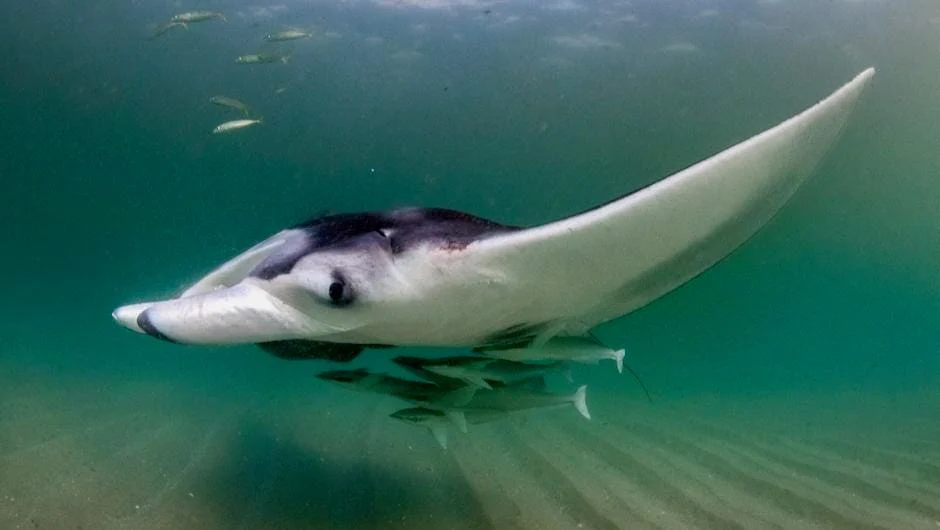
The most startling revelation of the study is the ubiquity of these hitchhiking communities. Across 465 separate recorded encounters with juvenile Atlantic manta rays, researchers found that 100% of the rays were accompanied by other fish species. This is not a casual or occasional association; it is a constant state of being. The research suggests that for a manta ray, being "alone" is a biological anomaly. These rays serve as the foundation for a consistent assembly of residents, primarily comprised of four distinct groups: remoras (and their relatives, the sharksuckers), cobia, scads, and various species of jacks. While a typical juvenile manta might host half a dozen companions, some individuals were observed acting as a moving habitat for hundreds of smaller fish at once.
The implications of this "mobile ecosystem" model extend far beyond simple hitchhiking. In traditional ecology, these relationships are often shoehorned into rigid categories like commensalism (where one benefits and the other is unaffected) or mutualism (where both benefit). However, the South Florida data suggests these labels are far too simplistic to describe the nuanced reality of life on a manta ray. The spatial distribution of the fish on the manta’s body provides a significant clue to the underlying mechanics of this relationship. The "residents" do not cluster randomly; they show a marked preference for the ventral (underside) of the ray, often congregating near sensitive areas such as the eyes and gills.

From a fluid dynamics perspective, these positions are strategic. The ventral side of a moving manta ray creates a boundary layer of water where drag is significantly reduced. By positioning themselves here, smaller fish can "draft" off the manta, conserving immense amounts of energy that would otherwise be spent battling the current. This hydrodynamic advantage allows juvenile fish to travel vast distances across the relatively featureless sand flats of South Florida—areas that offer little to no natural cover from predators. For a young jack or cobia, a manta ray is a moving fortress, providing both a physical shield and an energetic "free ride."
Furthermore, the stability of these communities over time suggests a level of fidelity previously unrecorded in such associations. The research team observed the same individual manta rays dozens of times over several years, finding that their specific communities of fish remained remarkably consistent in composition and size. While individual fish were not tagged, the consistency of the cohorts suggests that many of these symbionts may stay with a single host for months or even years. This turns the manta ray into a "mobile nursery," particularly for species like the cobia and various jacks, which are often observed in their juvenile stages while attached to a ray.
This discovery carries profound weight for the fishing and tourism industries in Florida. South Florida’s nearshore waters are a high-traffic zone for recreational anglers and commercial shipping. One of the most sought-after game fish in the region is the cobia (Rachycentron canadum). Because cobia are so frequently found in the company of manta rays, anglers often target rays as a way to find their prize. This leads to a dangerous overlap where manta rays are frequently hooked or entangled in fishing gear by accident. Understanding that the manta is the literal life-support system for these fish populations could lead to more stringent "no-cast" zones or seasonal protections aimed at preserving the host to ensure the survival of the associated fisheries.
The concept of a large marine animal acting as a transitory ecosystem is not entirely without precedent—whale sharks have long been known to host schools of golden trevally—but the discovery of this dynamic in a nearshore, juvenile manta population adds a layer of ecological urgency. Manta rays in South Florida inhabit a "nursery" environment, a shallow-water sanctuary where they grow before heading into the deeper Atlantic. If these rays are indeed providing essential nursery services for other commercially and ecologically important fish, the decline of the manta ray would trigger a domino effect across the coastal food web.
When a manta ray population declines, the ocean doesn’t just lose a single species; it loses a vital piece of infrastructure. In the barren, sandy environments typical of the Florida coastline, topography is scarce. There are few reefs or rock outcroppings to provide shelter. In this context, the manta ray becomes the topography. It is a living reef that moves. For the juvenile fish that rely on them, the manta is the difference between life and death in a landscape of open-water vulnerability.

Looking toward the future, the technology used to study these interactions is evolving. While visual surveys and drones provided the foundation for this nine-year study, the next frontier involves bio-logging and miniaturized telemetry. Researchers are hopeful that future iterations of acoustic or satellite tags will be small enough to be placed on both the manta host and its remora symbionts simultaneously. Such data would allow scientists to track the "divorce rate" of these communities—determining exactly how long a remora stays with its host and whether they transition between different rays like passengers changing trains at a station.
The work of the Florida Manta Project, which contributed significantly to this data pool, emphasizes that marine conservation must move away from the "single-species" silo. To protect the Atlantic manta ray, we must protect the entire biological suite that travels with it. This requires an integrated management approach that considers the health of the remoras, the jacks, and the cobia as intrinsic to the health of the ray itself.
As we continue to peer into the blue through the eyes of advanced technology, the image of the solitary manta ray is fading, replaced by a more complex portrait of a communal traveler. These hidden communities, living in the slipstream of a giant, remind us that the ocean is a web of dependencies that we are only beginning to map. The Atlantic manta ray is a reminder that in the wild, no one truly travels alone, and the survival of the many is often hitched to the wings of the one. The challenge for 21st-century science is to recognize these mobile oases before they vanish, ensuring that these living architectures continue to cruise the Atlantic for generations to come.
