

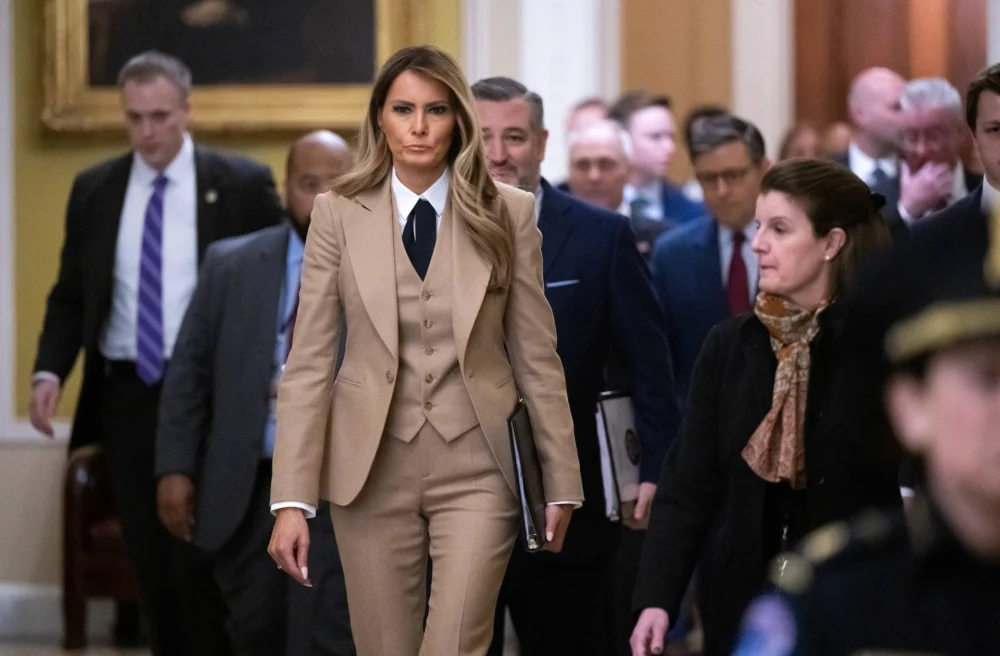
The opening weekend performance of the documentary centered on former First Lady Melania Trump, titled Melania, has immediately become a flashpoint in the ongoing debate concerning the financial rationale behind streaming giant acquisitions and the blurring lines between corporate media and political influence. While initial Sunday estimates placed the film’s domestic box office gross at $7.04 million, significantly surpassing pre-release projections that hovered between $3 million and $5 million, this theatrical success is utterly dwarfed by the astonishing capital expenditure undertaken by Amazon to secure the rights and promote the feature.
Amazon, through its studio arm, committed a staggering $40 million just for the acquisition of Melania, followed by an estimated $35 million allocated for promotion and marketing. This combined investment of at least $75 million means that, despite exceeding box office forecasts, the documentary is projected to incur substantial losses in its theatrical window. In the context of the current market, the film secured the third position overall for the weekend, trailing the Sam Raimi-directed suspense thriller Send Help, which pulled in $20 million, and Iron Lung, a film adaptation of a video game sensation spearheaded by influential YouTuber Mark Fischbach (Markiplier), which earned $17.8 million. The mere fact that a political documentary could land among these massive IP-driven projects underscores the volatile yet powerful niche appeal of highly polarized biographical content.
The true corporate calculus behind the Melania acquisition, however, demands scrutiny far beyond conventional box office metrics. The bidding war for the rights revealed that Amazon’s $40 million offer was a formidable $26 million higher than the nearest competitor, reportedly The Walt Disney Company. This extreme disparity immediately raised red flags among industry veterans, who questioned the feasibility of recouping such an investment through traditional cinematic distribution.
Ted Hope, a seasoned film executive who previously held a position at Amazon Studios between 2015 and 2020, articulated the skepticism publicly, labeling the deal as potentially the most expensive documentary ever produced outside of projects requiring exorbitant music licensing fees. Hope’s pointed critique—asking how the deal could not be interpreted as an attempt to "curry favor" or an "outright bribe"—strikes at the heart of Amazon’s broader corporate strategy in an era of intense regulatory pressure.
The Regulatory Hedge: Big Tech’s Soft Power Play
For a behemoth like Amazon, which controls critical segments of global e-commerce, cloud computing (via Amazon Web Services), and logistics, the greatest financial threats are not poor box office returns, but regulatory intervention, antitrust litigation, and unfavorable government policy. In this high-stakes environment, content acquisitions, particularly those involving politically sensitive subjects, can function as strategic non-monetary assets—a form of corporate realpolitik.
The $75 million spent on Melania must be viewed less as an investment in cinematic content and more as a high-visibility, high-cost regulatory hedge. Acquiring and aggressively promoting a sympathetic portrayal of a former First Lady, especially one tied to an administration known for its scrutiny of Big Tech firms, offers Amazon a unique pathway to demonstrating cultural investment and potentially securing goodwill in powerful political circles. The expense is negligible compared to the billions Amazon stands to lose if federal regulators successfully enforce structural separation or impose punitive fines related to antitrust violations.
This strategy signals a significant shift in how tech conglomerates approach media production. They are no longer simply content providers competing for subscribers; they are increasingly becoming powerful political actors utilizing their media arms to influence the geopolitical and regulatory environment in which they operate. The theatrical release, irrespective of profitability, serves as a high-profile, highly publicized announcement of this corporate priority.
Production Ethics and the Critical Abyss
The acquisition’s questionable financial logic is compounded by the significant ethical and critical controversies surrounding the production itself. The documentary marks the first directorial effort by Brett Ratner since 2017, when his career was sidelined following multiple allegations of sexual harassment and misconduct—accusations Ratner has consistently denied. Amazon’s decision to elevate a director carrying such significant reputational baggage further emphasizes that the project’s political utility outweighed conventional concerns about creative pedigree or ethical standing within the Hollywood community.
The internal discomfort with the project’s political nature and the director’s involvement was palpable. Reports indicated that a substantial two-thirds of the New York-based production crew for Melania requested to remain uncredited, a highly unusual protest reflecting a desire to distance themselves professionally from the finished product.
When the documentary finally arrived, the critical consensus was devastating. The film was not made available for advance screening by mainstream critics, a tactic often employed to shield controversial projects from early negative reviews. However, once released, the feedback confirmed industry fears. On review aggregation site Metacritic, the documentary currently holds a dismal 7%, signifying "overwhelming dislike," and fares only slightly better on Rotten Tomatoes at 10%.
The New York Times film critic Manohla Dargis characterized the feature as a "very circumscribed and carefully stage-managed chronicle" of Mrs. Trump’s life in the 20 days leading up to the 2025 inauguration. This assessment suggests the film functions less as an investigative documentary and more as authorized hagiography—precisely the kind of content that provides maximum political benefit while sacrificing journalistic independence.
Adding to the spectacle of the film’s political currency, Apple CEO Tim Cook was noted among the high-profile attendees at a special preview screening held at the White House the preceding weekend. This detail underscores that the film served as a social and political event for the leaders of rival Big Tech firms, solidifying its status as a piece of influential, access-driven media, rather than merely entertainment.
Streaming Economics: The Long-Tail Lifecycle
Despite the theatrical bloodbath, Amazon MGM’s distribution strategy centers on framing the opening weekend as merely the first phase of a much larger, more valuable corporate asset. Kevin Wilson, Amazon MGM’s head of domestic theatrical distribution, described the box office run as "an important first step in what we see as a long-tail lifecycle for both the film and the forthcoming docu-series." Wilson explicitly predicted the content would enjoy a "significant life" on Amazon’s Prime streaming service.
This perspective reveals the true economic model at play: the documentary is a loss leader designed to maximize subscriber acquisition and, more importantly, retention on Prime Video. For streaming platforms, highly exclusive, emotionally charged, and polarizing content is crucial for maintaining subscriber engagement, particularly among specific, highly engaged political demographics. The theatrical release, costing $75 million, functions as the most expensive, yet most effective, form of marketing, generating maximum media buzz and controversy before the title transitions to its permanent home on Prime.
In the streaming economy, the metric for success is not the recouping of the production budget through ticket sales, but the Lifetime Value (LTV) of the subscribers it attracts or retains. If Melania and its planned accompanying docu-series can prevent even a fraction of Prime subscribers from churning, or if they draw in a new, politically aligned cohort of customers, the initial $75 million expenditure quickly becomes justifiable, especially when factoring in the increased propensity for those subscribers to also utilize Amazon’s e-commerce ecosystem.
Future Impact and the Prestige Political Content Arms Race
The Melania acquisition sets a worrying precedent for the future of media production within Big Tech ecosystems. It formalizes the strategy of using vast corporate resources to fund content primarily valued for its political access and influence, regardless of critical merit or standard financial returns. This establishes a new category of "Prestige Political Content," where the goal is not to win awards or audiences universally, but to successfully navigate complex regulatory waters and generate strategic political capital.
Looking ahead, we are likely to see an acceleration of this trend. As antitrust enforcement remains a critical threat to the largest tech monopolies, these companies will continue to leverage their media studios—Amazon MGM, Apple TV+, and others—as vehicles for soft diplomacy. This means that politically favorable narratives, documentaries on influential figures, and content that aligns with the ideological preferences of those in power may command increasingly inflated acquisition prices.
The implication for journalistic integrity and objective documentary filmmaking is profound. When the price of access is $40 million, true independence becomes functionally impossible. Filmmakers and documentarians may find themselves increasingly catering to the political objectives of their deep-pocketed tech financiers, rather than the pursuit of truth.
The theatrical run of Melania was a financial failure by traditional metrics, securing only a fraction of its total investment. Yet, viewed through the lens of corporate strategy, political influence, and streaming optimization, the $7.04 million opening weekend was an astonishingly successful public relations event—a clear declaration by Amazon that when the stakes involve regulatory survival, content is merely a vehicle for influence, and the cost is no object. This pivot marks a definitive and perhaps troubling moment in the convergence of global technology, media distribution, and political power.
