

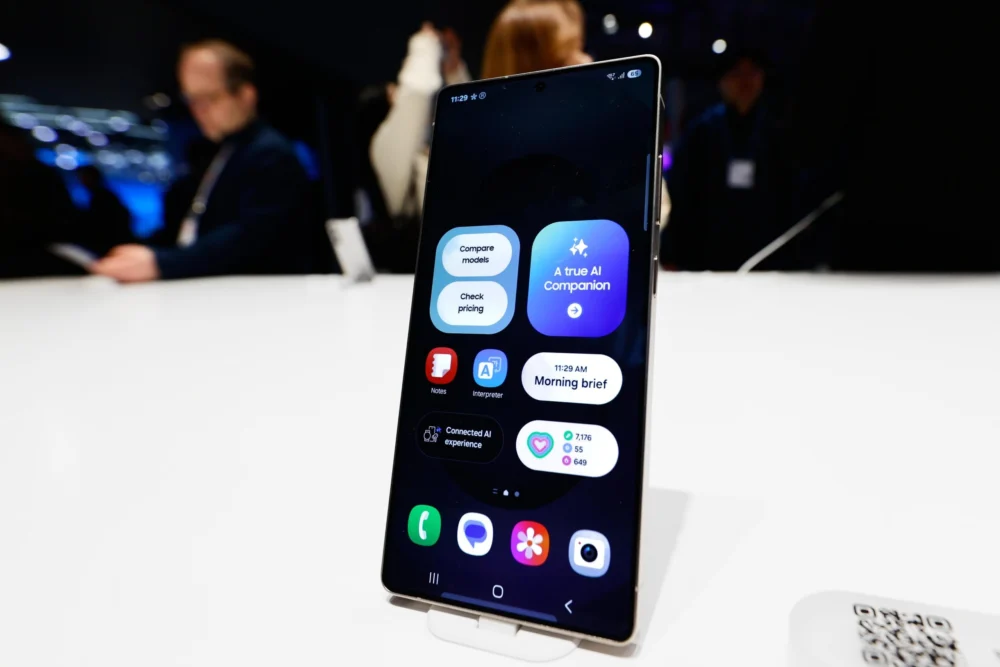
As the mobile industry prepares for the 2026 flagship cycle, the focus has shifted from mere incremental gains in processing power and camera megapixels to a more fundamental concern: the physical security of digital information. Samsung has signaled a major shift in this direction by unveiling a sophisticated new privacy feature slated for its upcoming Galaxy S26 series, most notably the high-end Ultra model. This technology, which the company describes as a revolutionary "privacy layer," seeks to solve the perennial problem of "shoulder surfing"—the act of unauthorized individuals peering at a user’s screen in public spaces. While privacy filters have existed for years as aftermarket accessories, Samsung’s integrated solution represents a significant leap forward by merging hardware innovation with deep software integration.
The timing of this announcement is particularly pertinent. In recent years, law enforcement agencies and cybersecurity experts have noted a change in the tactics used by smartphone thieves. While the hardware itself remains valuable, the real prize is now the data contained within the device. By observing a user enter their passcode in a crowded area—such as a train, a cafe, or a bus—thieves can gain full access to banking apps, private messages, and cloud storage before the victim even realizes their phone is gone. This "human-centric" vulnerability has become a glaring hole in the otherwise robust encryption of modern smartphones. Samsung’s new display technology is designed to close this gap by ensuring that sensitive information is only visible to the person holding the device.
To understand why this is a breakthrough, one must look at the limitations of current privacy solutions. Traditional privacy screen protectors rely on micro-louver technology—essentially tiny vertical slats that block light when viewed from an angle. While effective at obscuring the screen from neighbors, these physical filters come with significant drawbacks. They often reduce overall screen brightness, distort color accuracy, and interfere with the clarity of the display. Furthermore, they are permanent; if a user wants to show a photo or a video to a friend sitting next to them, they must physically tilt the phone or remove the protector. Samsung’s approach moves away from these static limitations by making the privacy effect dynamic and controllable.
The upcoming Galaxy S26 Ultra’s "privacy layer" is an electronic solution that utilizes a fusion of specialized display hardware and advanced software algorithms. Unlike a piece of plastic glued to the front of the phone, this system can be toggled on and off at will. This granular control allows for a level of flexibility previously unseen in the mobile market. Users will be able to set specific triggers for the privacy mode. For instance, the phone could be configured to automatically activate the privacy shield when a banking application is opened or when the keyboard appears for password entry. Once the sensitive task is completed, the display can return to its full, wide-viewing-angle glory, allowing for the vibrant visual experience that Samsung’s AMOLED panels are known for.
Industry analysts suggest that this technology likely leverages a secondary layer within the OLED stack or a sophisticated manipulation of the sub-pixel light emission. By controlling the directionality of the light at a hardware level, Samsung can effectively narrow the viewing cone on demand. When the privacy mode is engaged, the light is directed primarily forward toward the user. To anyone standing even a few degrees to the side, the screen would appear black, blurred, or heavily distorted. This hardware-software synergy ensures that the privacy effect is not just a software overlay—which could be easily bypassed or mimicked—but a fundamental property of the display itself.
The implications for user experience are profound. One of the most intriguing aspects of the new system is its "timing" and "app-aware" capabilities. Samsung has hinted that users will be able to schedule privacy modes or link them to specific locations. For example, a user could set the privacy layer to be active only during their morning commute or while they are at a specific airport terminal. Furthermore, the technology extends to notifications. For years, users have had to choose between the convenience of lock-screen notifications and the risk of those notifications being read by strangers. With the new adaptive display, notifications could remain visible to the user but remain obscured to everyone else, allowing for a seamless blend of utility and discretion.

This move by Samsung also places pressure on its primary competitors, most notably Apple and Google. While Apple has long marketed the iPhone as the gold standard for privacy, its efforts have largely been focused on software permissions and data tracking. By introducing a physical, hardware-based privacy solution, Samsung is carving out a new niche in the "Privacy-First" hardware category. If successful, it is highly likely that we will see a "privacy arms race" in the display industry, with other manufacturers scrambling to implement similar directional light technologies.
From a technical standpoint, the challenges of implementing such a feature are non-trivial. Engineers must ensure that the privacy layer does not add significant thickness to the device or compromise the touch sensitivity of the screen. There is also the question of power consumption; driving a display to maintain high brightness while restricting its viewing angle requires precise voltage control. However, given Samsung’s position as a global leader in display manufacturing—supplying panels to many of its own rivals—it is uniquely positioned to overcome these hurdles. The Galaxy S26 Ultra is expected to serve as the showcase for this technology, acting as a "halo" product that demonstrates the future of secure mobile computing.
Beyond the immediate benefit of preventing data theft, the privacy layer addresses a growing social discomfort. In an era where digital lives are increasingly public, the desire for "digital personal space" is at an all-time high. Whether it is a business professional reviewing a confidential contract on a flight or a teenager sending private messages in a classroom, the ability to control who sees what on a screen is a powerful tool for personal agency. It shifts the burden of privacy from the user’s behavior—having to hide the phone or hunch over it—to the device itself.
As we look toward the official launch of the Galaxy S26 series, the inclusion of this feature suggests that Samsung is thinking deeply about the "real-world" environment in which its devices are used. The modern smartphone is no longer just a communication tool; it is a digital wallet, a master key to one’s identity, and a repository of a lifetime of memories. Protecting that asset requires more than just a strong password; it requires a screen that knows who is looking at it.
The broader industry impact could also see this technology trickling down to other form factors. If Samsung can successfully miniaturize and optimize this electronic privacy layer for smartphones, it is only a matter of time before we see it appearing in tablets and laptops, where the need for privacy in public workspaces is even more acute. We may be entering an era where the "viewing angle" of a screen is no longer a fixed specification, but a dynamic setting that the user adjusts as easily as volume or brightness.
In conclusion, Samsung’s confirmation of this ground-breaking feature for the Galaxy S26 Ultra marks a turning point in mobile design. By addressing the physical vulnerability of the display, the company is tackling a sophisticated threat with an even more sophisticated solution. As more details emerge regarding the hardware specifications and the software interface of this "privacy layer," it is becoming clear that the S26 series will be defined not just by how it looks to the user, but by how it looks—or doesn’t look—to everyone else. This is a bold step toward a future where our devices are not just smart, but truly private, providing a sanctuary of information in an increasingly crowded and watchful world.
