

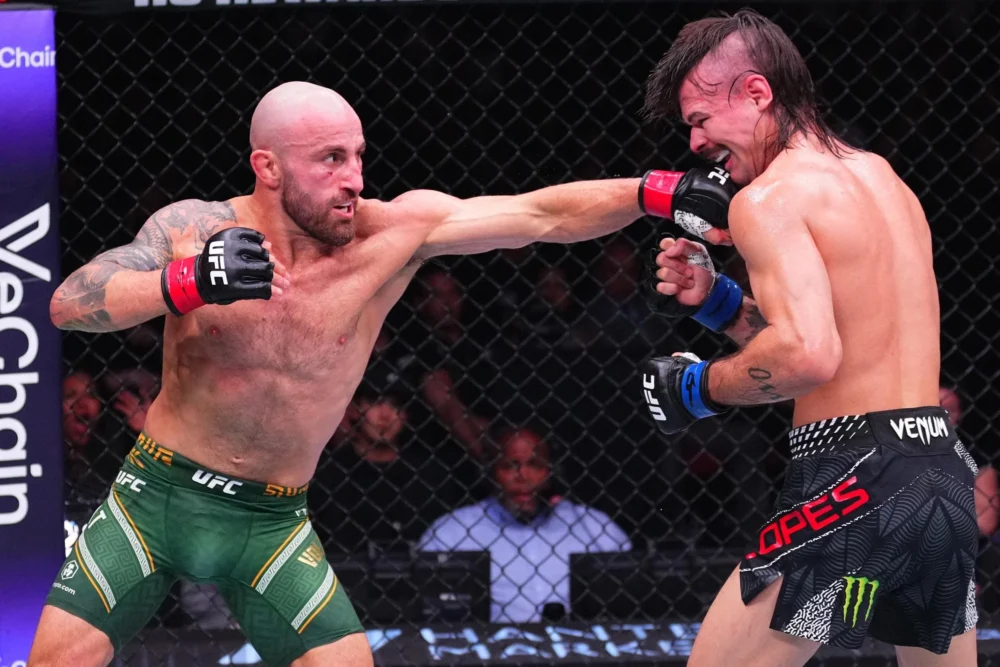
The landscape of the Ultimate Fighting Championship’s featherweight division was reaffirmed on Saturday night at the Qudos Bank Arena in Sydney, Australia, as Alexander Volkanovski delivered a masterclass performance to retain his title against Diego Lopes. In a high-stakes rematch that served as the centerpiece of UFC 325, the local hero proved that age is merely a statistic, utilizing a sophisticated striking arsenal and veteran composure to stifle one of the division’s most dangerous rising stars. While the main event provided a familiar sense of dominance, the broader card signaled a seismic shift in the promotion’s hierarchy, characterized by the brutal efficiency of Benoit Saint-Denis and the emergence of a new generation of talent ready to challenge the established order.
The headlining bout between Volkanovski and Lopes was more than just a title defense; it was a psychological and technical chess match. Coming into the contest, many analysts questioned whether the 37-year-old champion could replicate the success of his April 2025 victory over the Brazilian. Lopes, known for his chaotic grappling and explosive power, had spent the intervening months refining his approach, yet he found himself once again trapped in the "Volkanovski Vortex." From the opening bell, Volkanovski established a rhythm that Lopes struggled to disrupt. The champion’s use of the jab-cross combination was not merely a scoring tool but a defensive barrier, keeping the challenger at the end of his reach and preventing the pocket-fighting exchanges where Lopes thrives.
Despite the lopsided nature of the scorecards—which read 50-45 and 49-46 twice—the fight was not without its moments of high drama. In the third round, Lopes briefly silenced the Sydney crowd when he connected with a crisp counter that sent Volkanovski to the canvas. It was a flash knockdown that tested the champion’s championship mettle. However, Volkanovski’s recovery was a testament to his elite conditioning and tactical awareness. Instead of panicking, he immediately initiated a clinch, neutralized the follow-up flurry, and within sixty seconds, had returned to the center of the cage to resume his striking clinic. This ability to weather the storm and immediately regain control is what separates Volkanovski from his peers, further cementing his status as arguably the greatest featherweight to ever grace the Octagon.
The implications of this victory for the 145-pound division are profound. With Volkanovski remaining at the summit, the UFC faces a "gatekeeper" dilemma. Diego Lopes, despite his undeniable talent, has now lost twice to the champion in less than a year. This creates a bottleneck at the top of the rankings, where new contenders must not only win but do so in a fashion that justifies a leapfrog over established names. For Volkanovski, the path forward likely involves a late-2026 defense against the winner of the upcoming top-contender bouts, or perhaps a final foray into the lightweight division to chase a "double-champ" legacy that has narrowly eluded him in the past.

While Volkanovski celebrated his homecoming, the co-main event served as a somber reminder of the sport’s unforgiving nature. Dan Hooker, a staple of the Oceanic MMA scene, saw his homecoming spoiled by the relentless aggression of France’s Benoit Saint-Denis. Known as "God of War," Saint-Denis brought a level of physicality that Hooker struggled to match. The fight, which began as a high-paced "sprawl-and-brawl" affair, turned decisively in the second round. A tactical miscalculation by Hooker during a grappling transition allowed Saint-Denis to secure a dominant top position. From there, the Frenchman unleashed a barrage of elbows and ground-and-pound that left the referee with no choice but to intervene.
Saint-Denis’s TKO victory is a significant marker for the lightweight division. It signals the arrival of a new archetype of fighter: the high-output, "total MMA" specialist who can transition seamlessly between elite-level wrestling and devastating Muay Thai. For Hooker, the loss raises difficult questions about his trajectory in a division that is increasingly dominated by younger, more explosive athletes. The $25,000 finish bonus awarded to Saint-Denis was a mere formality for a performance that likely catapulted him into the top five of the 155-pound rankings.
The undercard of UFC 325 was equally revealing, highlighting a trend of international recruitment that is paying dividends for the promotion. Mauricio Ruffy’s second-round TKO of the perennial contender Rafael Fiziev was perhaps the biggest "upset" of the night in terms of betting lines, but for those watching Ruffy’s ascent, it felt like an inevitability. Ruffy’s striking was surgical, exposing gaps in Fiziev’s defense that few had managed to exploit previously. Similarly, Tallison Teixeira’s unanimous decision victory over Tai Tuivasa signaled a potential changing of the guard in the heavyweight division. Tuivasa, a fan favorite known for his "shoey" celebrations and knockout power, was unable to overcome the reach and disciplined movement of Teixeira. The loss marks a difficult stretch for Tuivasa and suggests that the heavyweight division is moving away from the "brawler" era toward a more technical, athletic paradigm.
One of the most discussed aspects of the event was the UFC’s strategic implementation of its bonus structure. In a move that has been praised by fighters and pundits alike, the promotion ensured that every athlete who secured a finish—and did not already receive a traditional "Fight of the Night" or "Performance of the Night" award—was granted a $25,000 bonus. This policy is designed to incentivize aggressive, finish-oriented fighting styles, and it clearly worked in Sydney. From Quillan Salkilld’s first-round rear-naked choke of Jamie Mullarkey to Keiichiro Nakamura’s third-round knee TKO of Sebastian Szalay, the card was punctuated by decisive endings.
This "finish-first" mentality is part of a larger industry trend where the UFC is competing not just with other MMA promotions, but with the broader attention economy. By rewarding fighters for ending bouts early, the UFC ensures a high-light-reel-friendly product that performs well on social media platforms and digital streaming services. The $100,000 "Fight of the Night" bonuses awarded to Volkanovski and Lopes further underscore the promotion’s willingness to invest in its marquee stars when they deliver the kind of high-level drama that justifies a pay-per-view price tag.

Beyond the individual results, UFC 325 showcased the technical evolution of the sport. We saw a high prevalence of "technical submissions," such as Jonathan Micallef’s rear-naked choke over Oban Elliott, where the fighter chooses to put the opponent to sleep rather than waiting for a tap. This reflects a growing sophistication in Brazilian Jiu-Jitsu application within the context of MMA, where fighters are becoming more adept at bypassing defensive hand-fighting. Additionally, the success of fighters like Kaan Ofli and Dom Mar Fan, who secured disciplined unanimous and majority decisions, highlights the importance of "effective aggression" and cage control in the modern scoring criteria.
As the UFC looks toward the remainder of 2026, the Sydney event will be remembered as a turning point. It proved that the Australian market remains one of the most vibrant and profitable territories for the organization, capable of selling out arenas and producing world-class talent. It also served as a showcase for the "Volkanovski Standard"—a level of excellence that remains the benchmark for anyone aspiring to greatness in the lower weight classes.
However, the shadow of retirement looms over several of the night’s veterans. At 37, Volkanovski is entering the twilight of his career, and while he looks as sharp as ever, the physical toll of five-round championship battles cannot be ignored. The promotion must now balance its reliance on established legends with the need to build the stars of tomorrow. Fighters like Mauricio Ruffy and Benoit Saint-Denis are the answer to that challenge, providing the "new blood" necessary to keep the championship narratives fresh and engaging.
In conclusion, UFC 325 was a masterclass in event curation and athletic execution. It offered a perfect blend of nostalgic dominance and future-facing potential. Volkanovski remains the king, but the sharks are circling, and the water is getting colder. As the UFC continues its global expansion, the lessons learned in Sydney—about the value of finishing bonuses, the importance of regional stars, and the relentless evolution of fighting techniques—will undoubtedly shape the future of the sport for years to come. The Qudos Bank Arena may have fallen silent as the fans departed into the Sydney night, but the echoes of the evening’s battles will resonate throughout the MMA world as the rankings are recalibrated and the next generation of challengers prepares for their shot at immortality.
