

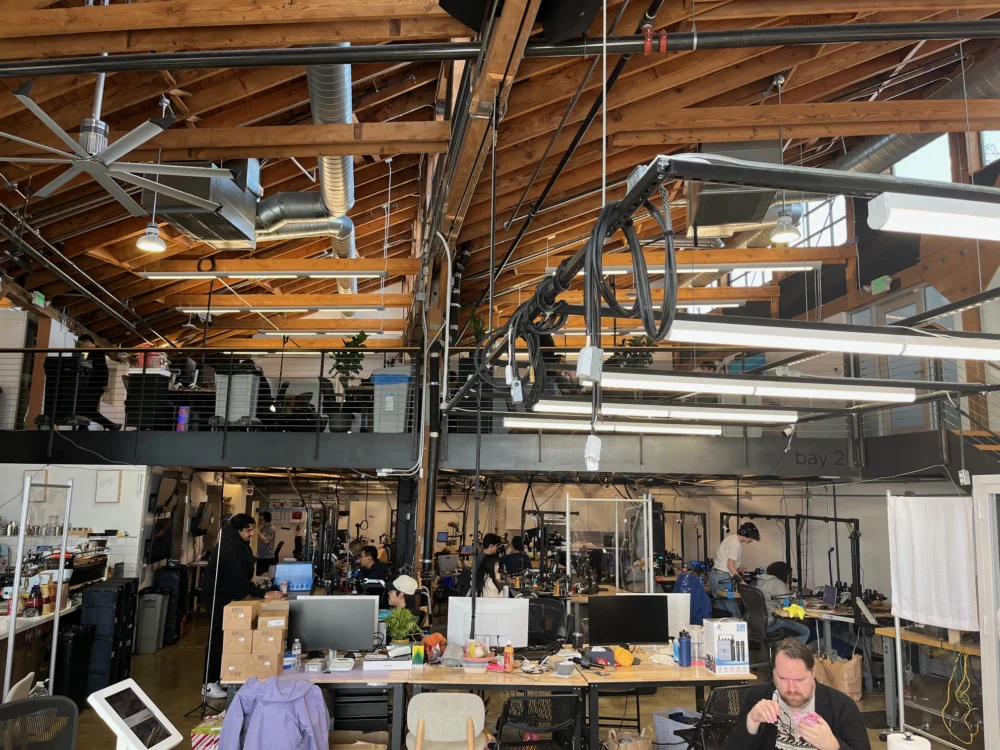
The headquarters of Physical Intelligence (PI) in San Francisco offers no grand architectural statement or polished corporate façade. A single, subtly distinct Greek letter pi on the exterior door is the only sign of the venture-backed powerhouse within. Stepping inside, one is immediately immersed in the dynamic, almost chaotic energy of a high-stakes research laboratory. The sprawling interior is a vast, unadorned concrete shell, mitigated only by long, haphazardly arranged wooden tables. These tables serve dual purposes: some are scattered with the detritus of communal life—cookie boxes and the tell-tale jar of Vegemite, confirming the Australian roots of key personnel—while others function as dense, low-tech workstations, burdened by monitors, intricate tangles of black wiring, and a rotating array of robotic arms.
This environment is less Silicon Valley unicorn and more graduate school robotics lab, an aesthetic choice that underscores the company’s core philosophy: the value resides entirely in the intelligence, not the hardware.
Across the workspace, the mechanical ballet of nascent autonomy unfolds. Here, the challenge is not high-precision industrial work, but mastering the messy, unpredictable domain of human tasks. One robotic arm struggles visibly to fold a pair of black trousers, its attempts jerky and imprecise, demonstrating the difficulty of manipulating deformable objects—a notorious hurdle in robotics. Nearby, another arm is dedicated to the frustrating task of inverting a simple shirt, a movement that requires complex tactile feedback and spatial reasoning. In contrast, a third arm performs a more successful, if mundane, operation: efficiently peeling a zucchini, depositing the ribbons into a dedicated container.
These demonstrations, seemingly trivial, are in fact pivotal data collection points for the ambitious goal driving PI. As Sergey Levine, UC Berkeley associate professor and a co-founder of PI, explains the scene, he encapsulates the vision: "Think of it like ChatGPT, but for robots." Levine, known for his seminal work in reinforcement learning, possesses the calm, intellectual clarity of someone accustomed to distilling groundbreaking concepts for non-specialists.
What visitors observe is the physical manifestation of a continuous, globally distributed data loop. Data is harvested not just from the San Francisco HQ, but from decentralized robotic stations set up in diverse real-world environments—warehouses, specialized kitchens, or even temporary installations in homes. This expansive, heterogeneous dataset fuels the training of what PI calls general-purpose robotic foundation models. Once new models are trained, they are immediately deployed back into these physical testing stations for rigorous evaluation. The struggling pants-folder and the adept zucchini-peeler are merely proxies, testing the model’s ability to generalize physical skills. The zucchini exercise, for instance, seeks to confirm if the model can abstract the fundamental motion of ‘peeling’ well enough to tackle an unfamiliar object, like an apple or a potato, without specific retraining.
Further emphasizing this research-first mentality, the facility includes a specialized test kitchen. Here, a sophisticated espresso machine sits, not as an amenity for the dozens of focused engineers, but as a teaching tool for the robots. Every foamed latte produced, every failed pour, generates crucial data points for complex manipulation and object interaction.

Levine stresses the deliberate unglamorous nature of the hardware. The off-the-shelf robotic arms currently in use are commercially priced around $3,500—a figure Levine notes includes "an enormous markup." He estimates that if PI were to manufacture these simple actuators in-house, the material cost would drop below $1,000. This low-cost hardware strategy is central to their belief system: superior, generalized intelligence is the ultimate compensator for mechanical imperfections. Just a few years ago, the very idea that such inexpensive, commodity hardware could perform even these clumsy tasks would have astonished seasoned roboticists. The goal is to decouple performance from bespoke, million-dollar machinery.
The Capital and the Cult of Pure Research
The operational framework of Physical Intelligence is as unusual as its technological focus. Following Levine’s departure, the conversation shifts to Lachy Groom, a co-founder whose palpable sense of urgency permeates the workspace. Groom, 31, is an archetype of Silicon Valley success, having sold his first venture at 13 in Australia—a history that neatly explains the Vegemite jar. After a highly influential tenure as an early employee at Stripe, Groom spent five years as a prodigious angel investor, backing major successes like Figma, Notion, and Ramp. Yet, he viewed investing as merely a necessary interim activity, not the culmination of his career.
Groom’s return to operational roles was triggered by the academic breakthroughs emanating from the labs of Levine and Chelsea Finn (a former Berkeley student of Levine’s, now running her own lab at Stanford). Recognizing the emerging paradigm shift in robotic learning, Groom sought out Karol Hausman, a respected Google DeepMind researcher and Stanford educator, who was also involved in the budding venture. Groom describes the initial meeting with the founding team—which also includes Quan Vuong from Google DeepMind—with near-religious fervor: "It was just one of those meetings where you walk out and it’s like, This is it."
This conviction has translated into unprecedented financial backing. In just two years, PI has secured over $1 billion in funding, reaching a formidable valuation of $5.6 billion from top-tier firms including Khosla Ventures, Sequoia Capital, and Thrive Capital.
What sets PI apart in the capital markets is Groom’s unapologetic stance on commercialization. He openly admits to offering investors no clear roadmap or timeline for generating revenue. "I don’t give investors answers on commercialization," Groom states, acknowledging the rarity of this tolerance among venture capitalists. This deliberate resistance to the pressures of near-term monetization is fundamental to the company’s strategic purity. PI’s high capitalization is a buffer, ensuring the researchers have the runway needed to pursue foundational discoveries without the distraction of quarterly sales targets.
The vast majority of PI’s expenditure is dedicated to compute resources—the critical fuel for training massive, data-hungry foundation models. Groom notes that there is effectively "no limit to how much money we can really put to work," as there is "always more compute you can throw at the problem." This is a classic "winner-take-all" strategy: the first entity to achieve true, general-purpose robotic autonomy will capture a market whose size is currently incalculable, rendering the initial investment costs trivial.
The Technical Gambit: Cross-Embodiment Learning
If the investment strategy is radical, the technical strategy is equally ambitious. Co-founder Quan Vuong explains that PI’s focus is on cross-embodiment learning and the leveraging of diverse data sources. This concept posits that the knowledge acquired by the model on one physical platform—say, a stationary arm peeling vegetables—can be seamlessly and instantly transferred to a completely different platform, such as a mobile humanoid robot, or even a novel piece of industrial machinery built tomorrow.

"The marginal cost of onboarding autonomy to a new robot platform, whatever that platform might be, it’s just a lot lower," Vuong explains. This is the holy grail of universal robotics: eliminating the need for expensive, time-consuming retraining whenever hardware is updated or a task environment changes. This shift is analogous to how Large Language Models (LLMs) allow a single foundational intelligence to power thousands of distinct applications without needing to rebuild the core model.
PI is already validating this capability by engaging with a select group of partners across various industries, including logistics, grocery operations, and even a local chocolate manufacturer. These collaborations serve not as revenue streams, but as real-world testing grounds to evaluate whether the systems have achieved the requisite robustness for practical automation. Vuong asserts that for certain defined tasks, the systems are already ready for deployment. The "any platform, any task" approach ensures a large surface area for success, allowing the company to validate autonomy across a broad spectrum of physical challenges.
Industry Implications and the Philosophical Divide
Physical Intelligence is not operating in a vacuum; the race to build generalized robotic intelligence—often termed Embodied AI—is intensely competitive, mirroring the early days of the generative AI boom. This competition highlights a stark philosophical schism within the sector.
On one side is PI, betting that deep, pure research, protected by massive capital, will yield a superior, truly generalized model. On the other side stands companies like Pittsburgh-based Skild AI, which recently raised $1.4 billion at a staggering $14 billion valuation. Skild AI has taken the path of aggressive commercialization, deploying its "omni-bodied" Skild Brain immediately across verticals like security, manufacturing, and warehousing, claiming $30 million in revenue in just a few months last year.
Skild AI’s public criticism of competitors focuses on the technical substance of their models. They argue that many so-called "robotics foundation models" are simply vision-language models (VLMs) "in disguise." These VLMs, critics claim, rely too heavily on internet-scale pretraining data and lack "true physical common sense" derived from physics-based simulation and intensive, real-world robotic interaction.
This represents a classic tech industry divergence: the Data Flywheel vs. Foundational Purity debate. Skild AI is betting that commercial deployment creates a virtuous data flywheel, where every successful (or failed) real-world application generates proprietary data that continuously improves the model, leading to rapid market dominance. PI, conversely, is wagering that by insulating its research from market pressures, it can focus on building a fundamentally superior, deeper form of general intelligence that will eventually eclipse systems designed for immediate application. The resolution of this core strategic disagreement will likely define the future architecture of the robotics industry.
The Challenges Ahead
Despite the clarity of vision, PI faces formidable operational hurdles. Groom acknowledges that while the software team operates with an almost abstract purity—researchers define a need, and the company resources are mobilized to meet it—the physical world constantly intervenes.

"Hardware is just really hard," Groom concedes. Unlike software development, where iteration cycles are instantaneous, robotics is constrained by mechanical fragility, slow supply chain deliveries, and complex safety considerations. Hardware breaks frequently, delaying critical testing and complicating data collection. Furthermore, as PI looks toward consumer applications—the lingering questions about the practical utility of a zucchini-peeling robot in a real kitchen, the safety protocols required for mechanical intruders in homes, and the market readiness for such automation—loom large.
The company, currently at around 80 employees, aims to grow cautiously, preferring to expand "as slowly as possible" to maintain the internal focus and purity of its research mandate.
Yet, PI’s strategy is deeply rooted in Silicon Valley’s history of backing ambitious, high-risk, zero-revenue endeavors. The investment community has long understood that the pursuit of genuinely foundational technology—even without a defined commercialization timeline—can yield disproportionate returns. The bet is not on selling robotic arms today, but on owning the universal operating system for all physical automation tomorrow.
As Lachy Groom rushes off to his next commitment, the low hum of experimentation persists. The robot arms continue their laborious practice—the folding attempt still clumsy, the shirt still inside-out, but the zucchini shavings piling up methodically. The consensus among the founding team, composed of experts who have dedicated decades to solving these exact problems, is that the convergence of compute power, data scale, and algorithmic breakthroughs has made this moment ripe for generalized physical intelligence. For PI and its multi-billion-dollar backers, the goal is not incremental improvement, but the revolutionary leap to universal autonomy, justifying the monumental investment required to build the brain that finally brings the physical world under the control of intelligent software.
