

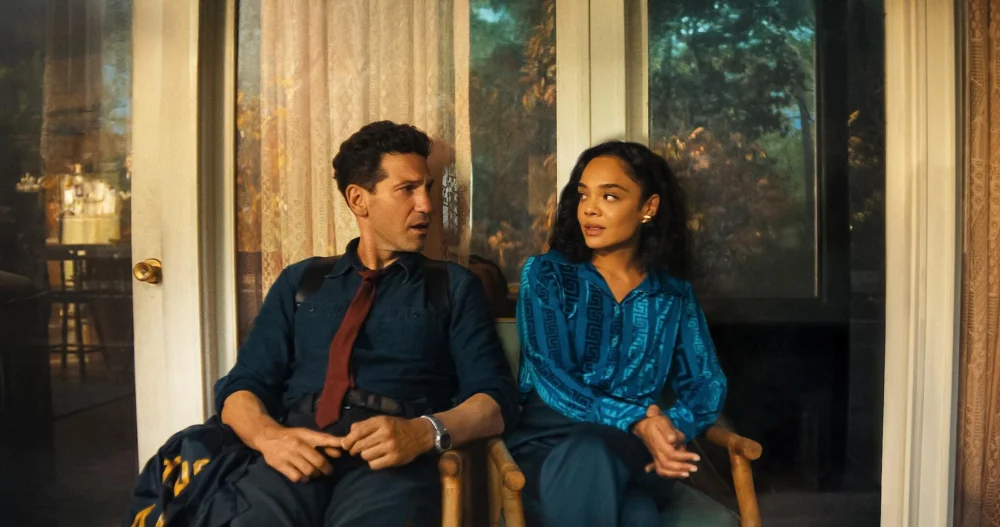
The contemporary streaming landscape is increasingly defined by a specific sub-genre often referred to as "domestic noir"—a blend of suburban anxiety, fractured marriages, and grisly secrets that bubble beneath the surface of seemingly quiet communities. When Netflix announced its adaptation of Alice Feeney’s 2020 bestseller His & Hers, the project arrived with the pedigree of a guaranteed hit. Bolstered by the casting of Jon Bernthal and Tessa Thompson—two of the most magnetic and capable actors working today—the series promised a high-stakes psychological autopsy of a marriage caught in the crosshairs of a murder investigation. However, despite a visually atmospheric opening and a premise ripe with tension, the limited series ultimately collapses under the weight of its own narrative contrivances, offering a stark reminder that even the most formidable star power cannot salvage a fundamentally flawed script.
Set against the humid, claustrophobic backdrop of Dahlonega, Georgia, His & Hers attempts to weave two parallel stories. The first is a standard procedural: a brutal murder has rocked the small town, and the local Sheriff’s department is under pressure to find the culprit. The second is a deeply personal drama involving Anna Harper (Thompson), a journalist who has returned to her hometown after a year-long disappearance following the tragic death of her child, and her estranged husband, Jack (Bernthal), a detective tasked with solving the very crime Anna is investigating. As the plot unfolds, it becomes clear that both Anna and Jack have intimate, potentially incriminating ties to the victim, turning the investigation into a psychological tug-of-war where the "truth" is a moving target.
The primary issue with His & Hers is not its premise, but its execution. For a murder mystery to succeed, it requires a delicate balance of intellectual engagement and emotional resonance. The audience needs to feel the stakes of the investigation while simultaneously caring about the internal lives of the investigators. Unfortunately, His & Hers struggles on both fronts. The "detective work" presented here is bafflingly rudimentary, often ignored in favor of melodramatic outbursts. Jack Harper, as portrayed by Bernthal, is a character defined by impulsivity and instability rather than investigative prowess. While Bernthal is known for his ability to play "men on the edge," the script gives him little to work with beyond generic tropes of the "tortured cop." His character frequently ignores glaring evidence and makes wild, unfounded accusations that serve only to move the plot toward its next scripted beat, rather than emerging from a logical deductive process.
This lack of narrative rigor is exacerbated by the show’s inevitable comparisons to HBO’s Sharp Objects. The parallels are so striking that they border on the derivative. Both series feature a female journalist with deep-seated psychological scars returning to her stifling hometown to cover a murder. Both use the "Southern Gothic" aesthetic—characterized by decaying grandeur, hidden family skeletons, and a pervasive sense of dread—to establish their tone. However, where Sharp Objects (adapted from Gillian Flynn’s novel) excelled through its surgical precision and its focus on the generational trauma of its protagonist, His & Hers feels like a diluted imitation. In Sharp Objects, the town of Wind Gap was a character in itself, breathing with a sinister, hypochondriac energy. In His & Hers, Dahlonega feels like a generic backdrop, a collection of small-town clichés that fail to evoke a genuine sense of place.
The industry implications of a project like His & Hers are significant. We are currently in an era of "algorithmic entertainment," where streaming platforms use data to greenlight projects that hit specific demographic markers: "Murder Mystery," "Book Adaptation," "A-List Lead," and "Limited Series." On paper, His & Hers is the perfect Netflix product. It is designed for the "binge-watch" model, utilizing cliffhangers and "shocking" revelations to keep the viewer clicking "Next Episode." Yet, this reliance on shock value often comes at the expense of narrative integrity. When a story prioritizes the "twist" over the journey, it risks alienating the audience. In the case of His & Hers, the twists in the final act are not only implausible but laughably nonsensical. They rely on a series of astronomical coincidences and character motivations that shift so violently they cease to be believable.

From an analytical perspective, the dual-narrative structure—the "His" and the "Hers"—should have been the show’s greatest strength. In theory, this perspective-shifting allows a creator to play with the concept of the "unreliable narrator," challenging the viewer to discern the truth from two conflicting accounts. However, the series fails to capitalize on this potential. Instead of providing nuanced, differing perspectives on the same events, the show simply splits the screen time between two characters who are both equally underdeveloped. Anna and Jack become paper-thin caricatures: the ambitious but broken reporter and the small-town cop with a temper. Because the audience never truly connects with their grief or their motivations, the central mystery loses its emotional anchor.
The failure of His & Hers also highlights a growing trend in the "Prestige TV" landscape: the "Phoned-In Performance." While Thompson and Bernthal are undeniably talented, they often feel adrift in this production. Thompson, who has shown incredible range in films like Passing and Thor: Ragnarok, is forced here to play a character whose actions are often bizarre and contradictory. Bernthal, meanwhile, is trapped in a cycle of shouting and brooding that feels like a retread of his previous roles without the necessary context to make it compelling. When the script is amateurish, even the best actors can appear to be merely going through the motions, unable to find the "soul" of the story.
Looking toward the future of the genre, His & Hers serves as a cautionary tale for streaming services. The "Domestic Noir" well is running dry, and audiences are becoming increasingly savvy to the tropes of the genre. To stand out in a saturated market, creators must move beyond the "journalist returns to small town" formula and invest in scripts that value logic and character depth over cheap thrills. There is a palpable hunger for "smart" mysteries—shows like Giri/Haji or Dept Q—that respect the viewer’s intelligence and offer a more sophisticated take on the procedural format.
For those seeking a truly gripping mystery, the recommendations remain clear. Sharp Objects remains the gold standard for this specific brand of Southern Gothic suspense. On Netflix itself, viewers would be better served by the intricate plotting of Lupin or the cross-cultural tension of Giri/Haji. These shows understand that a mystery is only as good as the characters solving it. They provide the "why" behind the "who," ensuring that the final reveal feels earned rather than manufactured.
Ultimately, His & Hers is a missed opportunity. It had the ingredients of a prestige hit but lacked the culinary skill to bring them together. The series wanders through its six-hour runtime, occasionally stumbling upon an interesting idea or a well-framed shot, only to lose its way in a thicket of bad dialogue and nonsensical plot points. By the time the final revelation occurs, the absurdity of the situation has long since drained the story of any tension. For a show titled His & Hers, it’s a shame that neither side of the story manages to offer anything truly worth watching. The result is a generic, forgettable entry in the Netflix catalog—one that suggests that if the streaming giant wants to maintain its dominance in the prestige drama space, it needs to start valuing the quality of its scripts as much as the fame of its stars.
