

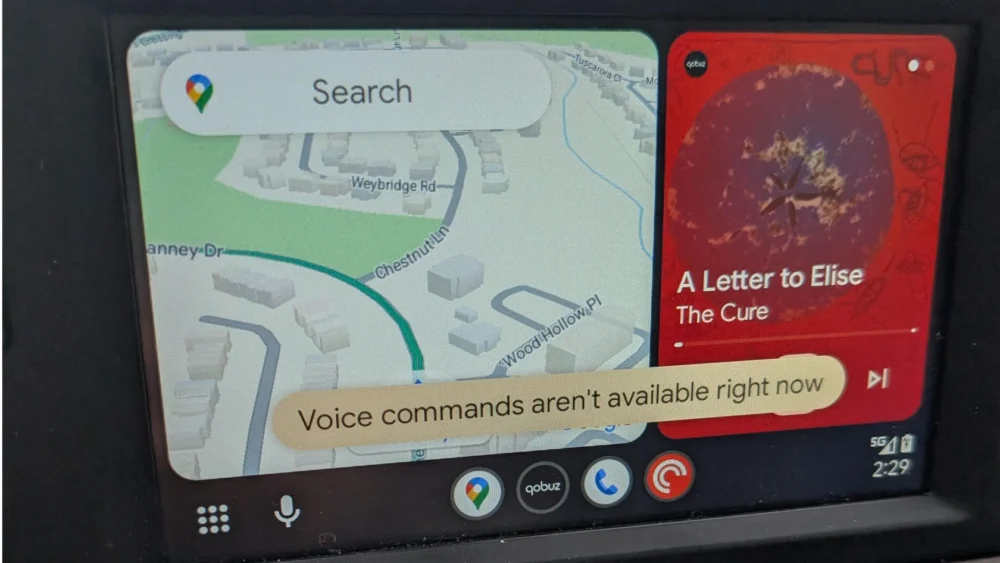
The core promise of modern in-car infotainment systems, particularly those leveraging smartphone integration like Android Auto, rests on a foundational principle: maximizing driver focus on the road ahead. This is achieved primarily through robust, reliable hands-free operation, with voice commands serving as the essential bridge between the user and navigation, communication, and media control. Recently, a significant disruption has surfaced across the Android Auto ecosystem, rendering this critical hands-free capability inert for a notable segment of the user base. Reports flooding community forums indicate the appearance of a stark, frustrating notification: "Voice commands aren’t available right now."
This specific failure mode transcends minor glitches. In the context of driving, the inability to issue voice commands—to reroute navigation in heavy traffic, initiate a hands-free call, or change a podcast mid-commute—is not merely an inconvenience; it represents a regression in vehicle safety features and user experience. Initial documentation of this issue suggests a rapid onset, coalescing over a recent weekend period, prompting immediate concern among users who rely on these features daily.
Analyzing the Scope and Affected Ecosystem
The anecdotal evidence gathered from platforms like Reddit reveals a pattern of systemic failure rather than localized hardware incompatibility. Reports detail the error message manifesting consistently across the entire Android Auto interface, impacting core functions such as Google Maps navigation prompts and media playback controls managed through voice input. The troubleshooting steps attempted by affected users—including system reboots, cable cycling, and application restarts—have proven ineffective, suggesting the root cause lies deeper within the software stack or a backend service dependency.
Crucially, the diversity of affected hardware points away from a simple device-specific bug. The reported malfunctions span a broad spectrum of vehicle manufacturers, encompassing popular models from Ford, Hyundai, Kia, Subaru, Toyota, and Nissan. Similarly, the mobile devices experiencing this issue are not confined to a single OEM or Android version, involving flagship devices from both Samsung Galaxy and Google Pixel lineups. This wide distribution strongly implies that the failure point is centralized, likely residing within a shared component accessed by the Android Auto application or a cloud service upon which the voice processing relies.
Technical Deep Dive: The Google App as a Suspect
In the absence of official communication from Google regarding the outage, the user community has naturally turned to forensic analysis of recent software changes. A leading hypothesis centers on recent updates to the base Google Application. The Google App is the overarching container for many core Google services on Android, including the foundational elements necessary for speech recognition and natural language processing that power Android Auto’s voice assistant capabilities.
Several users observed that the voice command function was restored immediately following a specific action related to the Google App. In some instances, updating the Google App to its latest iteration resolved the problem, suggesting that a dependency introduced in a previous version was corrected in the patch. Conversely, other users found relief by rolling back the Google App update or, more drastically, clearing its cache and storage. This behavior—where both updates and rollbacks offer remediation—is characteristic of an unstable API interaction or a server-side change that was either poorly deployed or inconsistently propagated across Google’s infrastructure.
The temporary fixes reported, such as force-stopping the Android Auto service itself or repeatedly reconnecting the USB cable, underscore the volatility of the current state. These actions might briefly re-establish a necessary handshake or token required for voice services, but the problem inevitably resurfaces, confirming a persistent underlying vulnerability.
The Gemini Transition and Voice Architecture Implications
A significant layer of complexity—and speculation—involves the ongoing transition of Google Assistant functionality to the more advanced Gemini AI model within the Android ecosystem. Android Auto has been a testing ground for integrating Gemini’s conversational capabilities, moving beyond the rigid command structure of the older Assistant.
If the voice command outage coincides with any backend migration or A/B testing related to Gemini integration within the Android Auto framework, this could explain the intermittent and widespread nature of the failure. Voice processing pipelines are intricate: they involve local acoustic processing, secure transmission to the cloud for transcription, interpretation by the language model (Assistant or Gemini), and then the return of a command execution signal. A failure at any point—especially in the transcription or interpretation layer tied to the Google App’s cloud connection—would result in the generic "not available" error.
For users who have already enabled Gemini within their Android Auto experience, the experience is reportedly similar to those still using the classic Assistant, suggesting the core voice engine dependency is shared or that the transition itself is triggering instability across the entire voice infrastructure, regardless of the front-end model being utilized. This points to a potential server-side bottleneck or a universal authentication failure preventing the phone from securely communicating voice data to Google’s processing centers.
Industry Perspective: Safety, Reliability, and the Connected Car
From an industry standpoint, this type of systemic failure highlights the inherent risks of relying heavily on cloud-dependent services for mission-critical, real-time in-car functions. The automotive sector has invested billions in integrating platforms like Android Auto and Apple CarPlay because they offer rapid feature deployment without the lengthy development cycles required for native OEM infotainment systems. However, this integration creates a dependency: if Google experiences a service disruption, thousands of vehicle models globally are instantly affected.
Automotive safety regulators worldwide prioritize minimizing driver distraction. Voice commands are explicitly permitted because they adhere to strict "eyes-off-road, hands-off-wheel" guidelines. An outage that forces a driver to manually interact with the screen—to navigate, to accept a call, or to change music—directly contradicts established safety protocols. Therefore, while a minor app bug on a smartphone is an annoyance, a voice command failure in a vehicle carries regulatory and liability implications for both the technology provider and the vehicle manufacturer whose HMI (Human-Machine Interface) relies on that external service.
Expert analysis suggests that while cloud-based processing allows for superior natural language understanding (NLU) compared to on-device models, it introduces latency and single points of failure. Future resilience in connected car technology will require a hybrid approach: ensuring essential, low-latency functions (like basic volume control or essential navigation commands) can execute locally, even when cloud connectivity is degraded or experiencing an outage.
Future Trajectories and User Mitigation Strategies
As the user community awaits an official patch from Google, the immediate recommended actions remain rooted in the discovered temporary solutions. Users should first attempt to ensure their Google App is fully updated through the Play Store. If the issue persists, clearing the cache for the Google App is the next logical step, followed by force-stopping both the Android Auto application and the Google Play Services framework, then reconnecting the phone. This sequence often forces a fresh authentication handshake.
Looking forward, this incident serves as a significant data point for Google’s development teams. The rapid user consensus on the timing and symptoms indicates an urgent need for more rigorous canary testing or phased rollouts for backend services that underpin core Android Auto functionality. The integration of advanced AI like Gemini necessitates a parallel focus on infrastructure stability. If the AI model underpinning the voice assistant is unstable, the entire user experience collapses.
The long-term trend in automotive UI development is toward deeper integration, potentially moving toward Android Automotive OS—the fully integrated operating system—rather than the projection-based Android Auto. However, even Android Automotive relies on persistent, reliable cloud connectivity for its most advanced features, including voice assistants. This current breakdown underscores a universal challenge: building automotive-grade reliability on top of consumer-grade, rapidly iterating software platforms. Users should anticipate a swift resolution, likely via a server-side configuration adjustment or a minor Google App patch, but the episode highlights the fragility of relying on voice as the sole primary control mechanism when the underlying speech processing engine falters.