

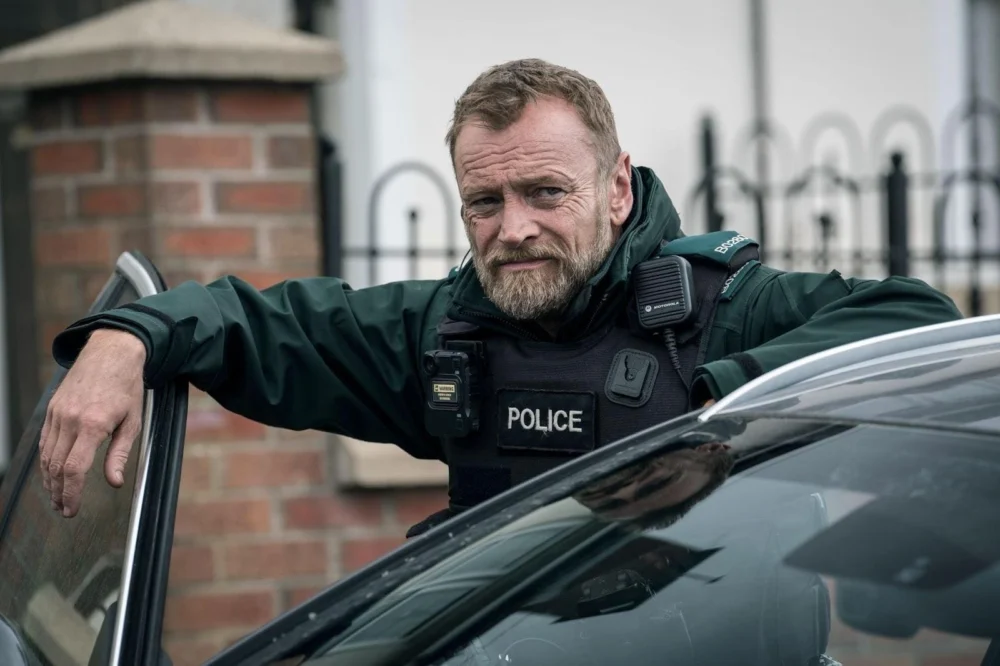
The landscape of modern television is often defined by its willingness to subvert expectations, yet few announcements have resonated with the force of the recent revelation regarding the fourth season of the critically acclaimed police procedural, Blue Lights. In a move that has sent shockwaves through its dedicated international fanbase, it has been confirmed that Richard Dormer will reprise his role as the irrepressible Gerry Cliff. For viewers who have followed the series since its inception, this news is nothing short of seismic. Gerry Cliff, the veteran beat officer whose sardonic wit and paternal guidance served as the moral compass of the show’s debut season, met a tragic and visceral end in a sequence that remains one of the most harrowing moments in contemporary British broadcasting. His return, therefore, signals a complex narrative pivot that promises to bridge the gap between the show’s origins and its increasingly ambitious future.
Set against the backdrop of a modern, post-conflict Belfast, Blue Lights has distinguished itself from the crowded field of "cop shows" by eschewing the glossy tropes of American procedurals in favor of a gritty, hyper-realistic portrayal of the Police Service of Northern Ireland (PSNI). While the first season focused on the steep learning curve of three probationary officers—Grace Ellis, Tommy Foster, and Annie Conlon—it was Dormer’s Gerry Cliff who anchored the emotional stakes. His death was not merely a plot point; it was a structural rupture that forced the remaining characters to harden their resolve and navigate a city where the ghosts of the past are never truly buried. By bringing Dormer back for Season 4, the show’s creators, Declan Lawn and Adam Patterson, are signaling that the trauma of Season 1 is far from resolved.
The mechanics of this return are rooted in the show’s commitment to narrative integrity. Gerry Cliff will not be resurrected in the literal sense; rather, he is set to appear in a specialized flashback episode. This creative choice is more than a nostalgic nod to a fan-favorite character. According to production insights, this look into the past will feature other departed characters, including Jen Robinson (portrayed by Hannah McClean) and the former Inspector Jonty (Jonathan Harden). The inclusion of these specific figures suggests a deep dive into the institutional secrets of the Blackthorn station. The upcoming season’s logline confirms that the murder trial of Gerry Cliff will serve as the primary catalyst for the plot, unearthing "dangerous and long-buried secrets" that threaten to destabilize both the police hierarchy and the criminal underworld of Belfast.
This narrative strategy reflects a broader trend in high-end television drama: the "Rashomon effect" applied to long-form storytelling. By revisiting the events leading up to Gerry’s death through new perspectives or previously unseen footage, the writers can recontextualize the entire series. For the characters of Tommy Foster—Gerry’s former trainee who has struggled with the weight of his mentor’s legacy—and Sandra Cliff, Gerry’s widow, this return offers a chance for a complicated form of closure. It also allows the show to explore the systemic rot that often exists within police organizations, a theme that Blue Lights has handled with a level of nuance comparable to HBO’s The Wire.
From an industry perspective, the return of Richard Dormer is a significant coup. Dormer, perhaps best known to global audiences for his role as Beric Dondarrion in Game of Thrones and his lead performance in the psychological thriller Fortitude, brings a specific gravitas to the screen. His portrayal of Gerry Cliff was a masterclass in understated charisma, blending a weary cynicism with a deep-seated humanity. His presence in Season 4 ensures that the show maintains its high-caliber acting pedigree, even as it expands its scope. The success of Blue Lights—which saw its second season secure a BAFTA for Best Drama—has turned it into a flagship property for BritBox and the BBC, proving that hyper-local stories with universal emotional truths can find a massive global audience.

The fourth season finds its central trio—Grace, Tommy, and Annie—three years into their tenure as response officers. This time jump is a sophisticated narrative tool. By moving past the "rookie" phase, the show can now explore the psychological toll of long-term policing in a divided city. The officers are no longer wide-eyed recruits; they are "operating at their limit," facing a city that feels increasingly uncontrollable. This evolution mirrors the trajectory of the Northern Irish television industry itself, which has moved from being a location for international fantasy epics to a powerhouse of domestic, character-driven storytelling.
The socio-political context of Belfast is essential to understanding why Gerry Cliff’s return is so potent. In Northern Ireland, the past is never just the past; it is a living entity that informs every interaction on the street. By centering Season 4 on a murder trial and "buried secrets," the show leans into the region’s complex relationship with truth and reconciliation. The "truth" mentioned in the logline is not just about who pulled the trigger, but about the institutional failures and the overlapping circles of crime and policing that allowed the tragedy to occur. This thematic depth is what elevates Blue Lights above standard "police procedurals." It is an interrogation of a society in transition, told through the eyes of those tasked with keeping the peace.
Furthermore, the reintroduction of Jen Robinson and Inspector Jonty suggests that the show is ready to address some of the lingering questions regarding the internal politics of the PSNI. Jen’s departure was marked by a sense of disillusionment, while Jonty’s exit was shrouded in the fallout of his professional and personal choices. Their return in a flashback capacity implies that the events of Season 1 were part of a much larger, more insidious web than previously understood. For the audience, this creates a compelling "detective" experience, where they must piece together the past alongside the characters in the present.
The technical execution of Blue Lights has always been a point of praise, particularly its use of the Belfast cityscape. The city is a character in its own right—claustrophobic, vibrant, and scarred. The fourth season’s focus on "upper and upper-middle-class crime," a shift that began in Season 3, indicates an expansion of the show’s investigative lens. While the early episodes were concerned with street-level drug dealing and local paramilitaries, the show is now looking at the white-collar networks that facilitate sex trafficking and large-scale narcotics operations. This shift suggests that the "dangerous secrets" unearthed by Gerry’s trial may reach the highest echelons of Northern Irish society.
As we look toward the future of the series, the return of Richard Dormer serves as a bridge. It honors the foundation upon which the show was built while providing the fuel for its next phase of evolution. The core cast, including Siân Brooke as Grace, Nathan Braniff as Tommy, and Katherine Devlin as Annie, have matured alongside their characters, delivering performances that are both physically demanding and emotionally resonant. The addition of supporting players like Frank Blake (Shane), Joanne Crawford (Helen), and Dearbháile McKinney (Aisling) ensures that the world of Blackthorn station remains populated by distinct, believable individuals rather than archetypes.
In conclusion, the decision to bring Richard Dormer back for Blue Lights Season 4 is a bold testament to the show’s narrative ambition. It refuses to let its characters—or its audience—forget the costs of the journey so far. By weaving the past into the present through the trial of Gerry Cliff, the series is set to deliver its most complex and emotionally charged season yet. In an era where television content is often disposable, Blue Lights stands out as a work of profound substance, a show that understands that the most dangerous threat an officer can face is not a weapon on the street, but the truth hidden within the system they serve. For fans, the wait for Season 4 will be defined by the anticipation of seeing Gerry Cliff one last time, and the dread of what his return might reveal about the world he left behind.