

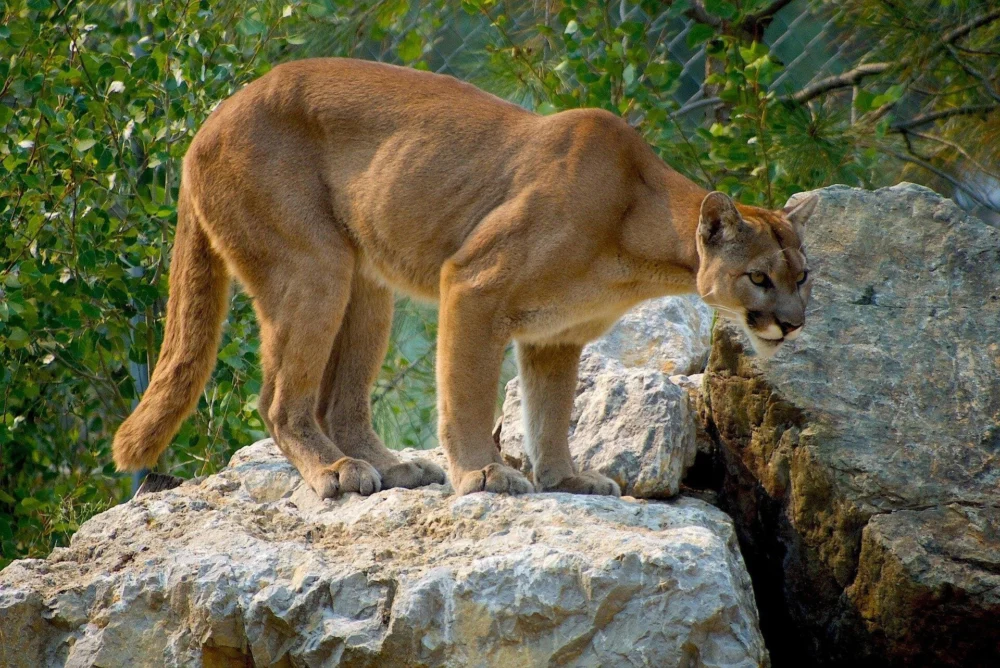
In the high-altitude theaters of Yellowstone National Park, a silent and sophisticated arms race is unfolding between two of North America’s most formidable carnivores. While the gray wolf (Canis lupus) and the cougar (Puma concolor) have long shared the same rugged geography, new longitudinal research is illuminating a starkly asymmetrical power dynamic that is fundamentally reshaping the ecology of the American West. This relationship, often characterized by ecologists as "enemies without benefits," reveals that the survival of the solitary cougar is increasingly dependent on its ability to outmaneuver the socially dominant wolf through a combination of dietary adaptation and tactical retreat.
The tension between these apex predators is not merely a matter of occasional skirmishes; it is a profound example of interspecific competition that dictates where these animals hunt, what they kill, and how they spend their energy. According to recent data synthesized from nearly a decade of observation, the presence of wolves acts as a persistent tax on cougar productivity. To mitigate the risk of lethal encounters and the theft of their hard-earned kills—a behavior known as kleptoparasitism—cougars are undergoing a significant niche shift, moving away from large, shared prey like elk and toward smaller, more rapidly consumable targets such as deer.
The Historical Context: A Century of Erasure and Return
To understand the current friction, one must look back at the radical transformations the Yellowstone ecosystem underwent during the 20th century. In the early 1900s, state-sponsored predator extermination campaigns effectively purged both cougars and wolves from the landscape. By the 1930s, the park was eerily devoid of its primary carnivores, leading to an explosion in elk populations that subsequently overgrazed the willow and aspen groves, altering the very hydrology and bird life of the region.
While wolves were completely eradicated, cougars proved more resilient, surviving in the impenetrable, rugged terrain of the deeper West. As legal protections gained traction and public sentiment shifted toward conservation, cougars began a natural, unassisted recolonization of northern Yellowstone in the 1980s. They arrived at a time of "predatory vacuum," enjoying a surplus of elk and no competition from other large carnivores. This golden age for the big cats was short-lived, however. In 1995, the high-profile reintroduction of gray wolves began, setting the stage for a modern ecological collision.
Today, Yellowstone represents one of the few places on Earth where a full suite of native carnivores has been restored. However, the "balance of nature" is far from a peaceful equilibrium; it is a relentless struggle for resources that forces each species to find its specialized corner of the environment.

The Mechanics of Dominance: Social Packs vs. Solitary Stalkers
The primary driver of the wolf’s dominance over the cougar is not individual size or strength—in a one-on-one fight, a large male cougar is a terrifyingly efficient combatant—but rather the power of the pack. Wolves are obligate social carnivores, relying on complex communication and group coordination to bring down massive prey and defend their territory. In contrast, the cougar is the ultimate "lone wolf" of the feline world, relying on stealth, camouflage, and a single, explosive ambush.
The recent study, led by researchers from Oregon State University and the Yellowstone Cougar Project, utilized a sophisticated array of 140 remote cameras and GPS telemetry collars to track the movements of approximately 130 wolves and 45 cougars. The data revealed a striking pattern: wolves are not merely roaming the park in search of their own kills; they are actively monitoring the movements of cougars. By following cougar scent trails and GPS "clusters" (indicating a kill site), wolf packs routinely move in to commandeer the carcass.
This kleptoparasitism is overwhelmingly one-sided. Researchers identified over 3,900 potential feeding events, discovering that 42% of wolf-cougar interactions occurred at sites where a cougar had successfully made a kill. Conversely, there was only one recorded instance of a cougar attempting to scavenge from a wolf kill. The risk for the cougar is extreme; the study documented two cases where wolves killed the cougar specifically to gain access to the meat.
The Technological Edge: AI and GPS in Wildlife Biology
The ability to document these clandestine interactions represents a leap forward in wildlife technology. Historically, studying predator-prey dynamics required physical tracking and visual confirmation, which is notoriously difficult with secretive species like the cougar. Modern researchers now employ machine learning models to analyze millions of GPS data points. By training these models to recognize the specific movement patterns associated with a "kill site"—such as a sudden localized cluster of activity followed by a period of stasis—scientists can identify predation events with high accuracy without ever stepping foot on the site.
This "digital twin" of the Yellowstone wilderness allows for a more granular understanding of how predators influence one another’s spatial ecology. For example, the data showed that cougar movements are now tightly tethered to "escape terrain." These are areas characterized by steep cliffs and, most importantly, climbable trees. Because wolves are cursorial hunters (built for running on flat ground) and cannot climb, the cougar’s survival strategy involves hunting in areas where a vertical retreat is always within reach.
Dietary Diversification as a Survival Strategy
Perhaps the most significant finding of the recent research is how the shifting herbivore population in Yellowstone has provided a "buffer" for cougar survival. Thirty years ago, the northern Yellowstone elk herd was at a historic peak. As the elk population stabilized and declined due to a combination of renewed predation, hunter harvests, and environmental stressors like drought, both wolves and cougars were forced to diversify their diets.

Wolves have increasingly turned their attention to bison—a dangerous and difficult prey that requires the full strength of a pack. Cougars, meanwhile, have pivoted toward deer. This shift is tactical. A large bull elk provides hundreds of pounds of meat but takes days for a solitary cougar to consume, providing a long window for a wolf pack to detect the kill and move in. A deer, being smaller, can be consumed much more quickly. By targeting smaller prey, cougars reduce the time they spend at a "hot" kill site, thereby minimizing the probability of a lethal confrontation with their canine rivals.
This transition from a "shared" prey economy (elk) to a "partitioned" one (bison for wolves, deer for cougars) is a classic example of niche partitioning. It is the mechanism that allows two species with similar requirements to coexist in the same space without one driving the other to local extinction.
Global Parallels and Evolutionary Implications
The "enemies without benefits" dynamic seen in Yellowstone is an echo of carnivore interactions across the globe. In the African savanna, a similar hierarchy exists between the lion and the cheetah, or the spotted hyena and the African wild dog. In these systems, the larger or more social predators (lions and hyenas) are less efficient hunters but dominate the landscape through brute force and theft. The subordinate predators (cheetahs and wild dogs) compensate with higher hunting success rates and higher caloric requirements, often "bolting" their food as quickly as possible before a larger rival arrives.
This suggests that the "scavenger-dominant" model is a universal feature of intact ecosystems. It also highlights the evolutionary pressure on solitary hunters to be more intelligent and more adaptable in their habitat selection. The cougar’s ability to persist in the presence of a superior competitor like the wolf is a testament to the species’ plasticity.
Industry and Management Implications
The findings from Yellowstone have significant implications for wildlife management and the agricultural industry across the Western United States. As both wolves and cougars continue to recolonize their former ranges in states like Oregon, Washington, and Colorado, understanding their interaction is vital for predicting how they will affect livestock and local deer and elk populations.
For ranchers, the "wolf-tax" on cougars might actually have a counterintuitive benefit. If cougars are forced into steeper, more rugged terrain to avoid wolves, they may be less likely to frequent the flatter valley bottoms where cattle often graze. Conversely, if wolves drive cougars out of traditional hunting grounds, those cougars may be pushed into the "human-wildlife interface," leading to increased sightings in suburban or agricultural areas.

Furthermore, state wildlife agencies must adjust their "harvest" models for deer and elk. If cougars are killing more deer to avoid wolves, the impact on deer populations may be higher than previously estimated by models that only accounted for single-predator impacts. The "synergistic" effect of multiple predators can lead to rapid changes in prey numbers that traditional management strategies might miss.
The Future of the Yellowstone Experiment
As we look toward the mid-21st century, the relationship between Yellowstone’s apex predators will continue to be tested by a changing climate. Rising temperatures and shifting precipitation patterns are already affecting the migration routes of elk and the winter survival of bison. If the "prey base" becomes more volatile, the competition between wolves and cougars will likely intensify.
However, the stability of both populations over the last decade offers a glimmer of hope. Despite the asymmetry and the occasional violence, both species are thriving. This suggests that the Yellowstone ecosystem is large enough and diverse enough to support a complex hierarchy of killers. It serves as a living laboratory for the "Rewilding" movement, proving that even the most contentious of neighbors can find a way to coexist if given enough room to run—and enough trees to climb.
In the end, the story of Yellowstone’s wolves and cougars is one of strategic resilience. It reminds us that in the natural world, dominance is not just about who is at the top of the food chain, but about who can best adapt to the presence of their rivals. The cougar remains the silent shadow of the forest, not because it is the strongest, but because it is the most cunning, turning the verticality of the landscape into a fortress against the social power of the pack. This delicate dance of avoidance and adaptation is what keeps the heart of the wilderness beating.