


The digital marketplace, particularly the Google Play Store, represents a critical nexus between developers and billions of Android users. Yet, for an entity that fundamentally built its reputation on the efficacy of information retrieval, Google’s flagship app distribution platform frequently demonstrates a profound lack of sophisticated search capabilities. This paradoxical deficiency forces users into a frustrating cycle of algorithmic suggestion rather than precision searching, a situation that has persisted despite the platform’s maturity. For many seasoned Android enthusiasts and power users, navigating the Play Store to locate specific, high-quality, or niche applications often feels like navigating a heavily curated, advertisement-saturated labyrinth. This experience stands in stark contrast to the robust, query-driven search environments prevalent across other digital frontiers, leading to a clear user demand for superior discovery mechanisms.
This context illuminates the value proposition of alternative solutions developed by independent engineers who recognize these systemic gaps. One such pioneering tool, App Finder, has emerged as a significant countermeasure to the Play Store’s inherent search limitations. It functions not as a direct replacement for the storefront itself, but as an immensely powerful, external query engine specifically engineered to mine the vast Play Store database with an unprecedented level of user-defined granularity. It effectively serves as the missing "Advanced Search" functionality that the official platform conspicuously lacks.
The Search Paradigm Failure at Google
To fully appreciate the necessity of a tool like App Finder, one must first dissect the operational philosophy underpinning the official Play Store search. Google’s core search engine is renowned for its ability to interpret natural language and intent, often prioritizing relevance based on complex behavioral models. However, when this philosophy is transposed onto the Play Store, the results are often sub-optimal for discerning users. The results feed is heavily influenced by commercial incentives—sponsored placements dominate the initial view—and by Google’s proprietary ranking algorithms, which often push popular or heavily advertised titles to the forefront, irrespective of the user’s precise criteria.
This dynamic shifts the user’s action from searching to browsing suggestions. If a user seeks an application based on a specific technical requirement (e.g., an obscure library dependency mentioned in an app’s changelog or a precise package name), the Play Store’s inherent design often obfuscates these details behind broader, commercially viable matches. The search results are not a reflection of raw data matching, but rather a mediated experience where user intent is secondary to platform monetization strategy. This systemic bias makes finding hidden gems, tracking niche software updates, or conducting comparative analysis extremely difficult within the native interface.

App Finder: Restoring Algorithmic Sovereignty to the User
App Finder operates on a fundamentally different premise: prioritizing comprehensive data access and user control over algorithmic curation. It interfaces with the Play Store’s public data streams, extracting and indexing metadata far more deeply than the native app allows. This includes parsing not just the title, summary, and description, but crucially, the granular details found within the update history (changelogs) and technical identifiers (package names). This extensive indexing capability immediately places it leagues ahead of the built-in search.
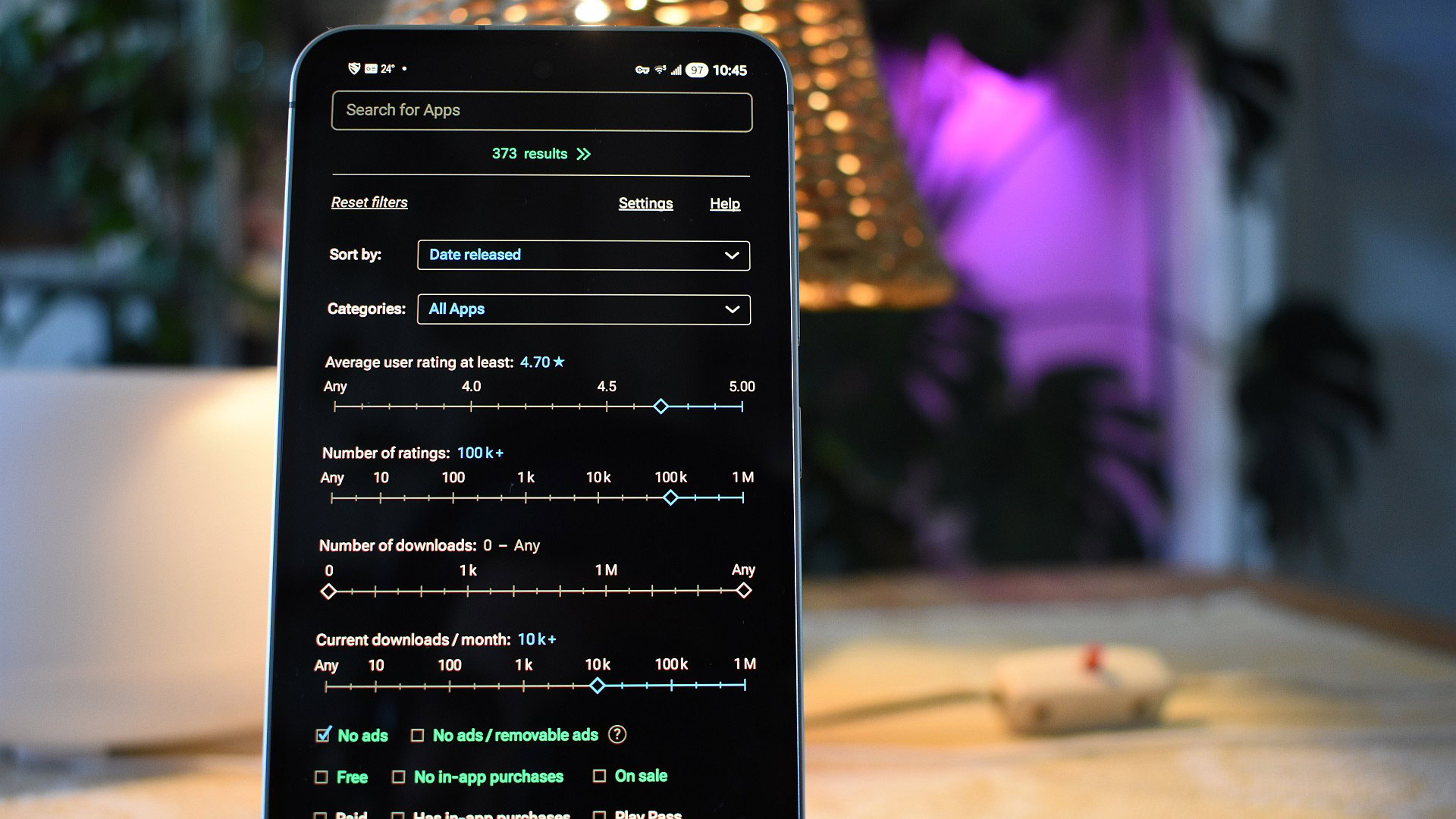
The initial impression of App Finder, as often noted by its users, centers on its aesthetic austerity. It makes no pretense of modern, visually expressive design principles, often falling short of current Material 3 standards. Its user interface (UI) is pragmatic, prioritizing speed and accessibility of complex parameters over visual flair. From a journalistic perspective, this apparent design flaw is arguably its greatest strength. For a utility whose sole purpose is data filtering, prioritizing function over form is a sound engineering decision; the goal is efficiency in data retrieval, not visual appeal. Furthermore, the application is intelligently designed to allow users to customize the home screen layout, ensuring that the most frequently used filters and scales remain immediately accessible, streamlining workflows for power users.
The Power of Precision: Modifiers, Filters, and Scales
Where App Finder truly distinguishes itself is in its implementation of advanced search parameters. A simple keyword search, while functional, reveals the tool’s latent power when modifiers are introduced. For instance, searching for the term "music" might yield tens of thousands of results in an unfiltered query—a data volume the official Play Store would never present transparently. However, the true utility is unlocked when applying constraints: filtering by an average user rating of 4.7 stars or higher, requiring a minimum threshold of 100,000 ratings to ensure adoption stability, and applying an "Ad-Free" toggle. These layered constraints can reduce that initial pool of 55,000 applications to a highly curated list of perhaps 30 validated options. This capability to sculpt the results set based on quantifiable quality and popularity metrics is simply unavailable within the official ecosystem.
The breadth of available filtering mechanisms is extensive, covering essential metrics for application assessment:
- Volume Metrics: Total downloads and specific price range filters (useful for finding temporarily discounted paid applications).
- Temporal Data: Filtering by release date or last update date, critical for identifying newly launched software or applications that are actively maintained.
- Categorization and Sorting: Filtering by genre and, significantly, sorting by "current downloads per month." This metric offers a far more dynamic and accurate gauge of an app’s current traction than the Play Store’s often static or delayed "Trending" charts.
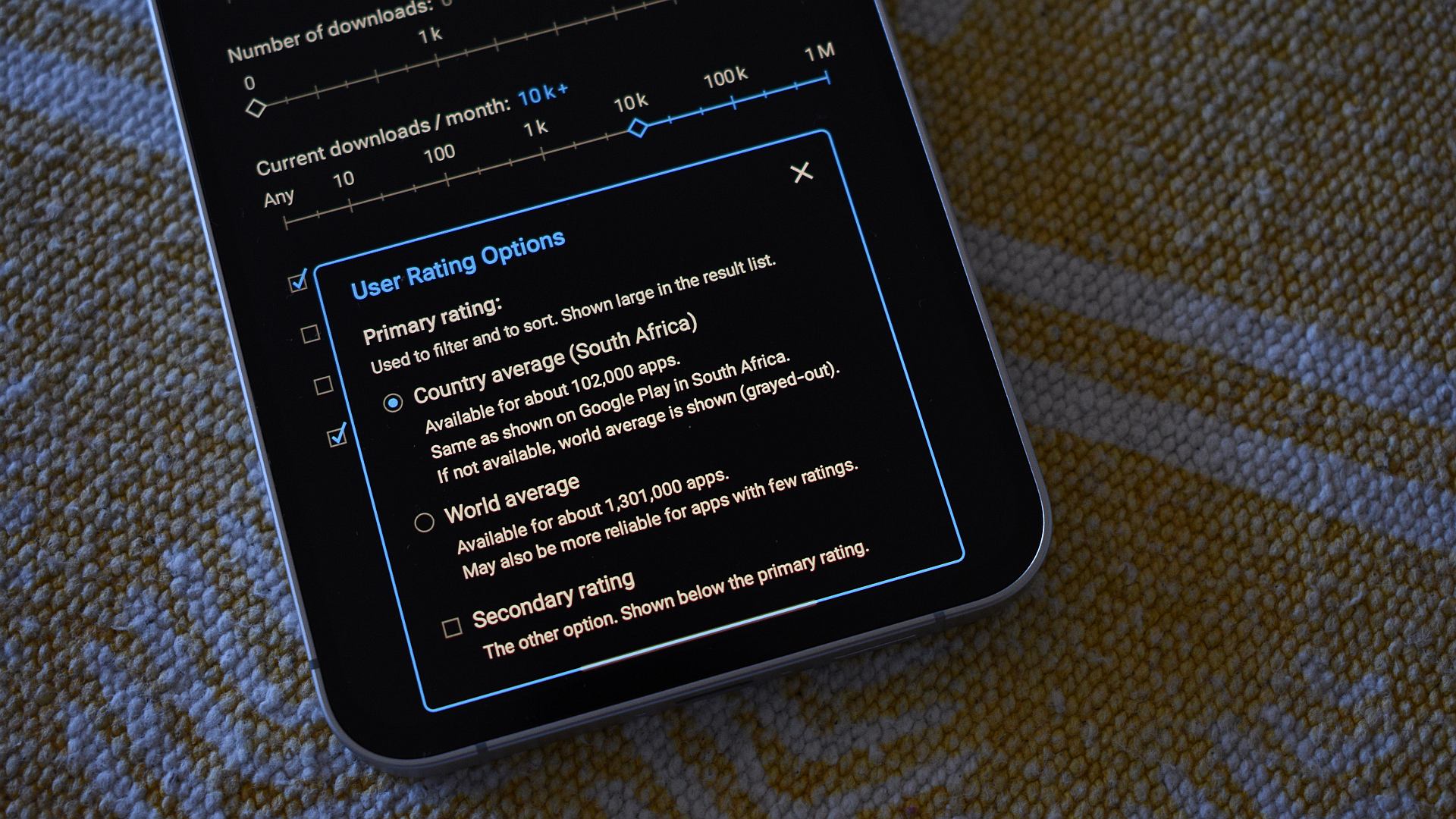
- Geographic Specificity: The ability to segment data by country or view aggregated global statistics adds a layer of market analysis previously requiring external data scraping tools.
This level of data exposure facilitates sophisticated use cases. For instance, researchers or niche communities can efficiently track the adoption rate of specific software types or identify applications receiving recent, significant quality-of-life updates. The platform’s utility for identifying temporary sales, particularly within the premium gaming segment, transforms the search process into a targeted acquisition strategy rather than a passive observation. By setting high rating minimums alongside temporary price reductions, users can uncover high-value, low-cost software that would otherwise remain buried.
For those requiring near-Boolean precision, App Finder supports standard search operators. The inclusion of the + operator to enforce mandatory inclusion of a term, the use of quotation marks for exact phrase matching, and the OR operator for logical disjunction (e.g., "video player OR media player") provides the linguistic power familiar to advanced search engine users. The developer’s decision to include a dedicated, easily accessible in-app help page detailing these operators underscores a commitment to power-user functionality, acknowledging that these features are not intuitive but are crucial for advanced data retrieval.
Industry Implications and The Long-Term View
The existence and utility of App Finder raise significant implications for the broader digital distribution industry. Firstly, it exposes the deliberate limitations imposed by centralized application stores. When a third-party tool must be employed to extract basic quality metrics or perform nuanced searches, it suggests that the platform owner (Google) has chosen to prioritize metrics that benefit its revenue stream (promotions, visibility) over metrics that benefit user long-term satisfaction (precise discovery, quality assurance).
This trend suggests a growing bifurcation in the digital marketplace: the curated, commercially optimized storefront versus the raw data access layer. For developers, particularly those in highly competitive or niche categories, reliance on the official search visibility is becoming increasingly perilous. Tools like App Finder democratize access to high-intent users, provided those users are willing to seek out the appropriate tooling.
The reliance on monthly download data as a proxy for current popularity is a particularly insightful feature. In a rapidly evolving app ecosystem, an app that was highly downloaded two years ago but has seen zero activity in the last six months is functionally obsolete or abandoned. Official metrics often lag, while App Finder’s reliance on recent data provides a real-time pulse on software vitality—a key indicator for discerning consumers.
Architectural Concerns and Future Trajectories
Despite its functional superiority, App Finder is not without structural vulnerabilities that warrant critical examination. The primary concern revolves around maintenance and futureproofing. The application appears to have experienced a significant lull in development activity, with the last update noted in late 2024. In the high-velocity world of mobile operating systems and APIs, stagnation is perilous. A minor update to the Play Store’s backend structure could render the entire third-party indexing mechanism obsolete overnight.
Furthermore, the developer’s stated future intention to integrate "AI-based natural language search" presents a complex dichotomy. While the ambition aligns with current technological trends, for a tool whose primary value is its objectivity and control over algorithmic suggestion, introducing opaque, black-box AI processes risks undermining its core appeal. Many users seeking this level of granularity are often actively trying to escape the very types of suggestive, often biased, "natural language" processing that dominates mainstream search results. This potential pivot could alienate the very user base that currently champions the application for its raw filtering power.
Financially, the application employs a freemium model. The core functionality—the essential filtering capabilities—is accessible without charge. Premium tiers unlock advanced features such as extended scale ranges, more comprehensive filters, and crucially, data export functionality. The lifetime unlock price point, reported around $10, represents a minimal investment for the significant gain in search efficiency, especially when contrasted against the often-high opportunity cost of time wasted sifting through irrelevant Play Store results. This pricing structure seems sustainable, assuming API access remains stable.
Conclusion: A Necessary Compromise
In summary, App Finder stands as a vital utility born from necessity. It is a direct response to the frustrating inadequacy of the Google Play Store’s native search apparatus, which favors algorithmic opacity and commercial promotion over user-driven precision. Its strength lies in its comprehensive data access and its exhaustive suite of filters, enabling users to construct highly specific queries based on quality, maintenance status, and empirical popularity metrics like monthly downloads.
While the application’s dated user interface and the developer’s potentially distracting future plans regarding AI integration represent minor drawbacks, these are currently outweighed by the sheer power and depth of information it surfaces. As long as the dominant digital storefront prioritizes curated visibility over genuine discovery, tools engineered to bypass these limitations will remain not merely convenient accessories, but essential components of the advanced Android user’s toolkit, ensuring that the best applications, regardless of their marketing budget, have a pathway to be found. The continued evolution of such third-party tools reflects a crucial ongoing tension between platform gatekeepers and the user demand for unfiltered, actionable data.