


The introduction of the Google Pixel 10a marks a strategic recalibration within Google’s budget-focused smartphone lineup. This year’s iteration presents a notable deviation from the expected trajectory of yearly flagship silicon upgrades. Instead of integrating the cutting-edge Tensor G5 processor—the silicon powering the current flagship Pixel 10—the Pixel 10a opts for the previous generation’s Tensor G4. This decision immediately tempers expectations for consumers anticipating a raw performance leap over the Pixel 9a. For those scrutinizing price-to-performance ratios in the mid-range segment, this apparent stagnation in raw CPU power could initially register as a significant disappointment.
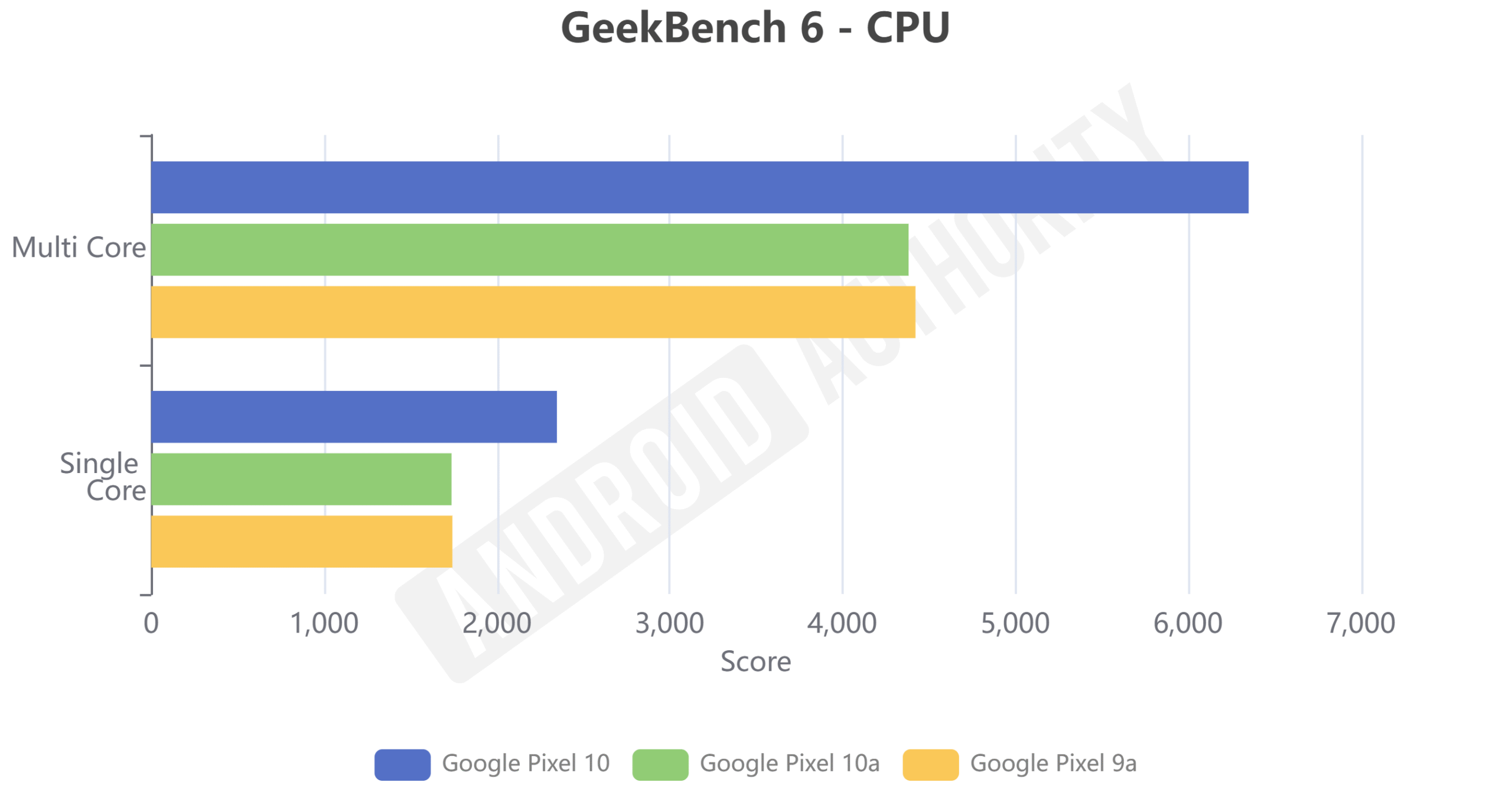
However, to frame the Tensor G4 solely as "last year’s chip" overlooks its foundational strengths. When it debuted, the Tensor G4 represented Google’s commitment to delivering competitive, if not leading, processing capabilities within its ecosystem. It remains a highly competent System-on-a-Chip (SoC) capable of handling the vast majority of daily operational demands, from intensive multitasking to standard application loads. Consequently, initial synthetic benchmarks, such as the widely referenced GeekBench 6 CPU evaluation, confirm this parity: the raw computational throughput of the Pixel 10a appears virtually indistinguishable from its direct predecessor, the Pixel 9a.
This adherence to the established G4 silicon suggests a shift in focus for the ‘a’ series, prioritizing platform stability, manufacturing efficiency, or perhaps directing the newest Tensor development entirely toward scaling up the flagship experience. From an industrial perspective, reusing a proven architecture significantly de-risks the supply chain and final assembly costs, allowing Google to maintain its aggressive sub-$500 pricing target, which is crucial for market penetration against aggressive rivals.
Deconstructing the Benchmarks: Raw Power vs. Real-World Sustained Use
The initial GeekBench 6 results place both the Pixel 10a and the 9a squarely within a statistical margin of error of one another. This consistency is logical, given that the core processing units are identical and likely operating at the same maximum clock frequencies. Contextualizing these scores against the broader Android landscape reveals that the Tensor G4 performance profile aligns closely with high-end mid-range offerings from competitors, exemplified by devices like Samsung’s Galaxy S23 FE from the preceding year. While this demonstrates respectable performance for a device priced at approximately $500, it underscores the reality that the Google budget line is not chasing the absolute bleeding edge of silicon development embodied by Qualcomm’s current Snapdragon flagships or even the Tensor G5.
The narrative pivots, however, when moving beyond instantaneous, burst-load synthetic testing and into scenarios that test thermal management and sustained performance—the true crucible for mobile processing units. It is here, under extended duress, that the Pixel 10a begins to carve out a meaningful, if subtle, differentiation from the 9a.
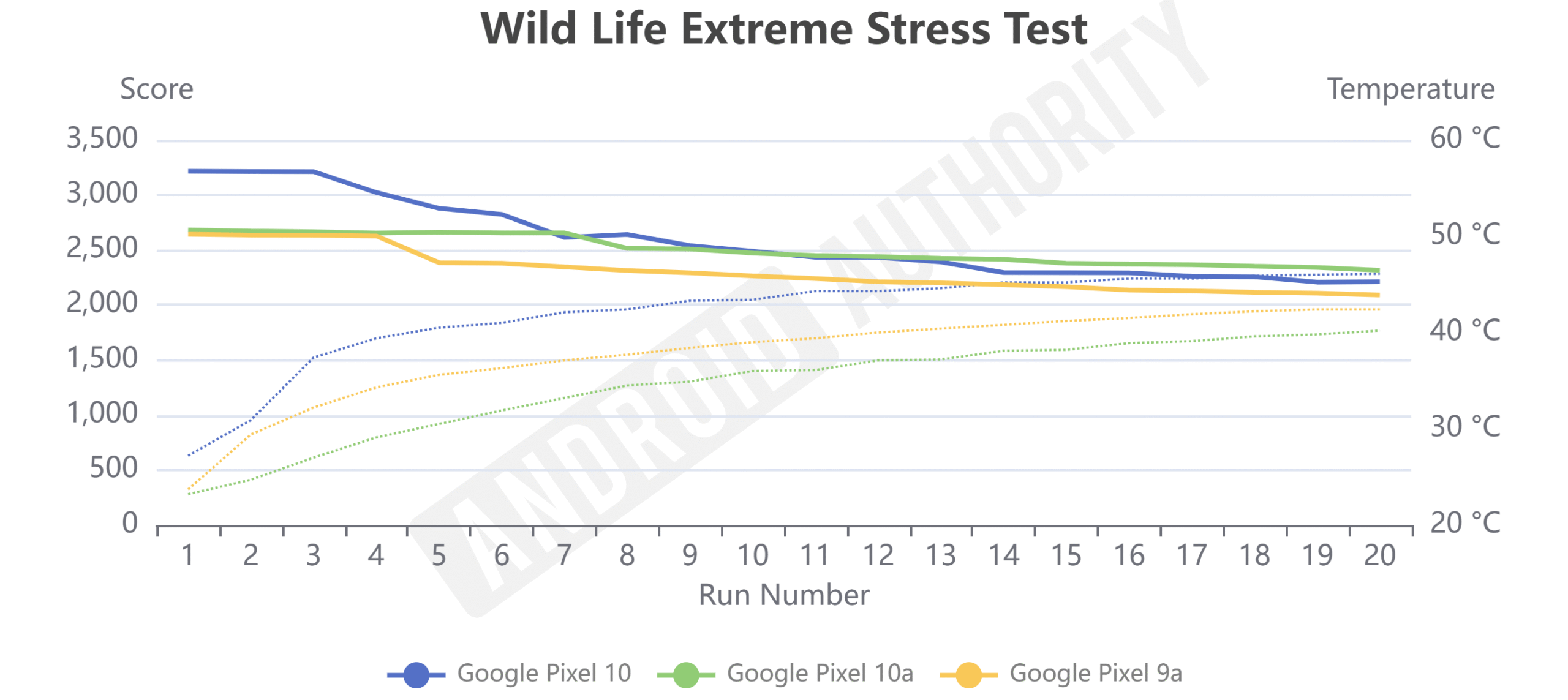
In rigorous stress testing environments, specifically utilizing 3DMark’s Wild Life Extreme benchmark loop, the divergence becomes apparent. Initial performance metrics for both the 10a and 9a mirror each other precisely, starting from the same high-water mark, albeit significantly trailing the more powerful, higher-TDP Tensor G5 found in the contemporary Pixel 10 flagship. The critical observation occurs over time: the Pixel 10a demonstrates a superior capacity for thermal dissipation or, perhaps, a more conservative and optimized thermal throttling profile.
For nearly seven continuous minutes of peak graphical load, the Pixel 10a manages to maintain its initial performance trajectory with remarkable stability. In stark contrast, the Pixel 9a begins exhibiting measurable performance degradation—thermal throttling—sooner than its successor. This difference allows the newer budget device to effectively "catch up" to the performance level of the more expensive Pixel 10 after the initial transient period, effectively leveling the playing field during prolonged, graphically intensive tasks.
The Thermal Advantage: A Quiet Revolution in Budget Chip Optimization
This enhanced thermal stability in the Pixel 10a is not merely an anecdotal finding; it represents a significant engineering consideration for Google’s mid-range strategy. While the raw silicon instruction set remains the same (Tensor G4), the implementation likely benefits from refinements in the phone’s physical construction—improved vapor chambers, better thermal paste application, or revised internal component layouts optimizing airflow within the constrained chassis of the ‘a’ series.
For the end-user, this translates directly into tangible benefits in real-world usage patterns that stress the GPU and CPU simultaneously. Gamers, particularly those engaging in lengthy sessions of visually demanding titles or, crucially, those utilizing demanding emulators for classic console systems, will find the Pixel 10a offers a more consistent frame rate experience than the 9a. Where the 9a might exhibit noticeable stuttering or frame drops after 15-20 minutes due to heat saturation, the 10a offers a plateaued experience, sustaining its performance closer to its initial peak.
This subtle victory in thermal endurance redefines the value proposition. Performance isn’t solely about peak theoretical speed; it’s about the speed maintained when the user is actively engaged. If the Pixel 10a can keep its operating temperature lower under load, it results in a device that is not only more responsive over time but also physically more comfortable to hold during extended use—a direct benefit for consumer satisfaction often overlooked in spec sheet comparisons.
Industry Implications: The Maturation of the Tensor Line
The decision to halt the silicon upgrade cycle for the 10a has broader implications for the mobile processor industry and Google’s internal product segmentation.
Firstly, it suggests that the Tensor G4 platform has reached a level of maturity where iterative generational gains in the mid-range are yielding diminishing returns, or that the manufacturing cost of the G5 is too high to absorb while maintaining the $500 entry price point. By reusing the G4, Google effectively maximizes the lifespan and cost-effectiveness of that chip generation. This is a practice common in the broader tech industry (e.g., Apple reusing A-series chips in SE models), but less common for Google’s usually rapid-fire Tensor cycle.
Secondly, this strategy highlights the increasing divergence between Google’s flagship and budget lines. The Pixel 10 is positioned as the showcase for the Tensor G5’s AI prowess and raw computational power. By deliberately handicapping the 10a with the G4, Google creates a clearer demarcation, driving aspirational buyers toward the more expensive flagship when peak performance is desired.
However, this reliance on aging silicon raises legitimate questions about long-term viability, especially given Google’s ambitious seven-year software support promise for the Pixel 10a. While the chassis and camera hardware might physically endure seven years of use, the Tensor G4’s capabilities in 2028 or 2029—when Android OS versions will be significantly more resource-intensive, especially concerning on-device generative AI tasks—remain an open query. Current user feedback regarding flagship Pixels feeling sluggish after only a year suggests that hardware amortization over a full seven-year cycle might prove optimistic for the G4 platform.
Competitive Landscape Analysis: Holding the Line at $500
Against direct competitors in the fiercely contested sub-$500 space—such as the Samsung Galaxy A56 5G, the Nothing Phone 4a Pro, or the Moto G Stylus (2025)—the Tensor G4, even a year old, maintains a significant competitive edge, particularly in graphics processing. In gaming and complex application handling, the G4 consistently outperforms the typical SoCs deployed by these rivals at the same price tier. This suggests that while the 10a may not be fast by 2025 flagship standards, it remains a performance leader within its designated budget segment.
The narrative shifts when considering slightly higher-priced alternatives that still undercut the mainline Pixel 10. Devices like the OnePlus 13R or the rumored Samsung Galaxy S25 FE often occupy a $550–$650 bracket. These devices frequently incorporate chips that surpass the Tensor G4, sometimes even outperforming the G5 in specific synthetic benchmarks due to different manufacturing priorities (e.g., focusing on raw GPU clocks over Tensor’s specialized AI cores). For consumers prioritizing raw, future-proofed performance over Google’s ecosystem integration and immediate AI features, these slightly more expensive, non-Tensor alternatives offer a better long-term processing guarantee.
The ultimate challenge for the Pixel 10a, therefore, is not its performance against the 9a, but its performance ceiling against the market’s slightly more premium, yet still accessible, offerings. Is the thermal advantage of the 10a worth sacrificing the performance headroom provided by a newer, faster SoC found just a small step up the price ladder?
Future Trends and the Role of Efficiency
The Pixel 10a’s thermal story hints at a critical trend in mobile computing: the growing importance of efficiency over raw peak power. As on-device AI models become standard—requiring sustained processing from the Neural Processing Unit (NPU) alongside the CPU/GPU—thermal envelopes become the primary bottleneck, not transistor count. A chip that runs cooler, even if it has fewer total teraflops of theoretical peak performance, provides a superior user experience during continuous AI-driven tasks or extended gaming sessions.
Google appears to be leveraging this understanding. By ensuring the G4 runs optimally within the 10a’s thermal design, they are delivering a product where the performance delivered per watt under load is perhaps better optimized than that of the G5 in the flagship, which might be pushed closer to its thermal limits to achieve its headline benchmark numbers.
In conclusion, the Pixel 10a represents a calculated trade-off. It sacrifices the headline excitement of next-generation silicon for the tangible benefits of optimized thermal performance and cost control. While the initial synthetic scores show stagnation against the 9a, the ability of the 10a to sustain peak performance for longer durations under stress constitutes a genuine, albeit nuanced, generational improvement. This efficiency gain translates into a device that is cooler to the touch and potentially more reliable during intense usage. The lingering uncertainty remains whether this solid mid-range performance will remain ‘good enough’ to satisfy Google’s ambitious seven-year software longevity commitment. For the typical user focused on daily operation and occasional gaming, the 10a offers a compelling, thermally stable package that successfully leverages its predecessor’s capable silicon.