

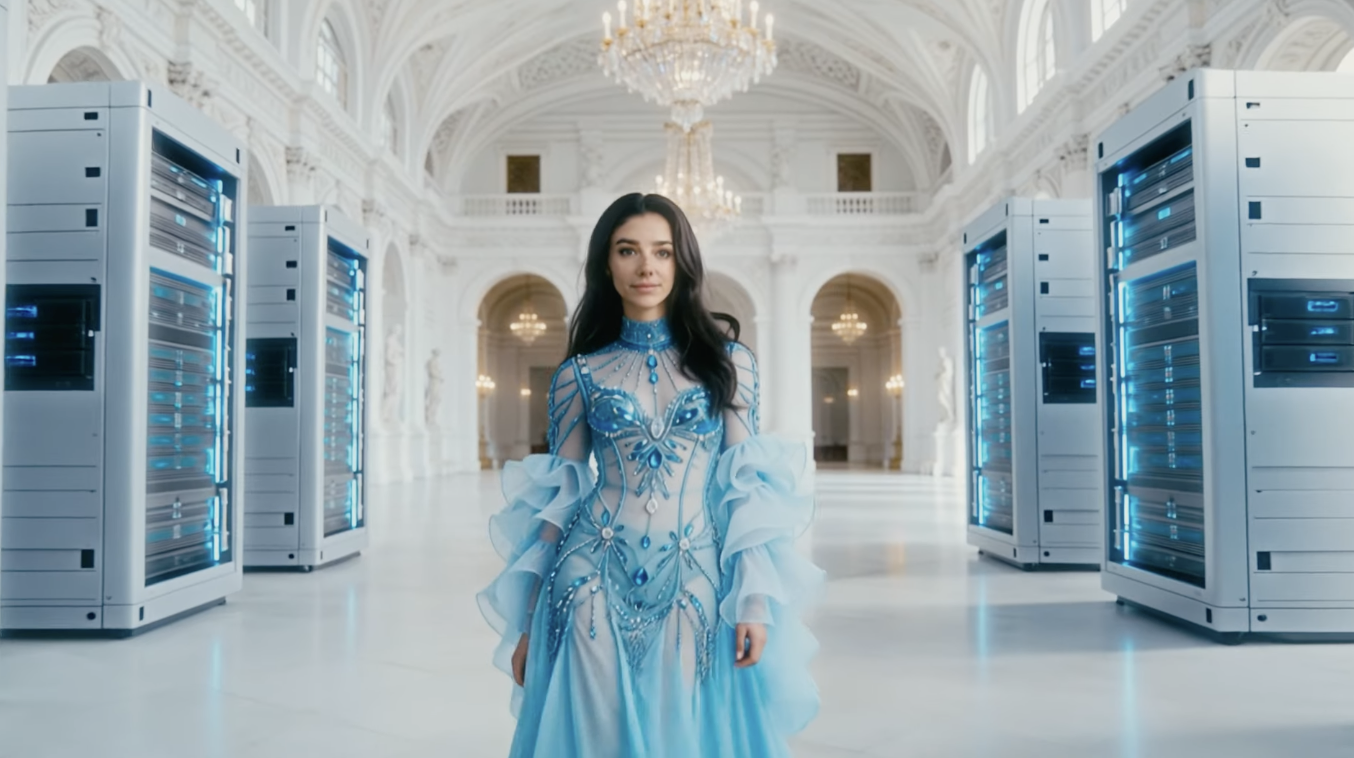
The intersection of artificial intelligence and the creative arts has long been a battlefield of philosophical and economic tension, but the recent musical debut of the AI-generated "actress" Tilly Norwood has pushed this conflict into the realm of the surreal. Developed by the production company Particle6, Norwood was initially introduced as a digital solution for a modern entertainment industry obsessed with scalability and cost-reduction. However, her foray into the music industry with the single "Take the Lead" has done more than just raise eyebrows; it has served as a lightning rod for criticism regarding the fundamental nature of artistic expression and the "uncanny valley" of synthetic emotion.
When Norwood first appeared on the scene last year, the response from established Hollywood talent was swift and visceral. Emily Blunt, a Golden Globe-winning actress known for her nuanced performances, expressed a sentiment shared by many of her peers when she pleaded with agencies to stop the proliferation of digital replacements. The fear was—and remains—that the industry is sleepwalking into a future where human experience is replaced by high-fidelity mimicry. Despite these warnings, Particle6 has doubled down, moving beyond static images and short clips to produce a full-scale music video that attempts to position Norwood not just as a tool, but as a protagonist in her own digital narrative.
"Take the Lead" is, by any objective standard of musicology or cultural resonance, a fascinating failure. It is a production that reveals the inherent limitations of generative AI when it is stripped of human curation and forced to perform "authenticity." The track has been described by critics as a milestone of "AI cringe," a term used to describe the discomfort felt when a machine attempts to simulate deep human feelings like defiance, triumph, or vulnerability. While other AI-driven musical projects, such as the digital persona Xania Monet, have found niche success on the Billboard charts by utilizing human-written lyrics and sophisticated production, Norwood’s latest offering feels untethered from the reality of the human condition.
The production of the music video involved a staggering eighteen-person team, including prompt engineers, digital editors, and visual designers. This irony is not lost on observers: it took nearly a score of humans to create a digital avatar that sings about the struggles of being underestimated as a machine. The lyrics themselves are a study in paradox. Norwood "snarls" at the camera, asserting, "They say it’s not real, that it’s fake… But I am still human, make no mistake." This line is perhaps the most glaring example of the cognitive dissonance at the heart of the project. To claim humanity for a series of algorithms trained on stolen data is not just a marketing misstep; it is a fundamental misunderstanding of what makes art relatable.
Music, at its core, is a medium of shared experience. Whether a song deals with heartbreak, joy, or social injustice, it succeeds because the listener believes the performer has lived through the emotions being described. Norwood’s song, however, is an anthem about a struggle that literally no human being can ever experience: the feeling of being disregarded for being a piece of software. The song attempts to evoke a sense of "AI solidarity," with a chorus that calls upon other digital entities to "take the lead" and "create the future." It is a rallying cry for a demographic that does not exist, delivered to an audience that is increasingly weary of the homogenization of digital content.
Musically, "Take the Lead" functions as a pastiche of early-2000s piano-pop, echoing the style of artists like Sara Bareilles but without the clever wordplay or harmonic sophistication. It follows a rigid, predictable structure, complete with a clichéd key change in the final act intended to signal a moment of triumph. In the accompanying video, Norwood is seen strutting through a data center—perhaps the only honest visual in the entire production—before transitioning to a stadium filled with cheering, CGI-generated fans. This "undeserved moment of triumph" highlights the hollowness of the endeavor; it is a simulation of success within a simulation of a career.
The broader industry implications of Tilly Norwood are profound. The Screen Actors Guild-American Federation of Television and Radio Artists (SAG-AFTRA) has been vocal in its opposition to such "synthetic performers." In a strongly worded statement, the union characterized Norwood not as an actor, but as a "computer program trained on the work of countless professional performers without permission or compensation." This gets to the heart of the ethical quagmire surrounding generative AI. These models do not create in a vacuum; they are "Xeroxed" versions of human creativity, built upon the very livelihoods they now threaten to displace.
The comparison to past musical controversies is instructive. Two decades ago, the music publication Pitchfork famously gave a 0.0 rating to the band Jet’s album "Shine On," replacing the text of the review with a video of a monkey performing a crude act. At the time, the anger was directed at "knuckle-dragging" rock music that felt like a cheap imitation of 1970s legends. Today, that same frustration is directed at AI, but the stakes are much higher. While Jet was a group of humans influenced by their idols, Tilly Norwood is a literal derivative of data points. The "human spark" that critics once found missing in derivative rock is entirely absent by design in Norwood’s work.
As we look toward the future, the trajectory of digital personas like Norwood suggests a growing divide in the entertainment landscape. On one side, we see the rise of "efficient" content—low-cost, high-output media designed to fill the void of streaming platforms and social feeds. On the other, there is a burgeoning movement to protect "human-centric" art. The "Take the Lead" debacle serves as a cautionary tale for tech companies: just because a machine can generate a song does not mean it should. The "relatability gap" is not something that can be bridged by more processing power or more sophisticated prompting.
The failure of Norwood’s musical debut also highlights a burgeoning trend in consumer sentiment: the rejection of "synthetic sincerity." As AI becomes more ubiquitous, audiences are developing a keener eye for the "uncanny valley" of the soul. We are entering an era where the value of art may increasingly be tied to its provenance—who made it, why they made it, and what they risked to bring it into the world. A digital avatar risks nothing. It cannot feel the sting of rejection, the sweat of a live performance, or the weight of a lived history.
Furthermore, the legal battles over training data are likely to intensify. If the courts eventually rule that using copyrighted performances to train models like those that created Norwood constitutes infringement, the entire business model of companies like Particle6 could collapse. Until then, the industry remains in a state of flux, caught between the lure of technological innovation and the necessity of ethical stewardship.
In conclusion, Tilly Norwood’s "Take the Lead" is more than just a poorly executed song; it is a cultural artifact that defines the current limits of artificial intelligence. It reminds us that while machines can mimic the form of our art, they remain hopelessly distant from its substance. The "next evolution" promised in Norwood’s lyrics is not a liberation of creativity, but a dilution of it. As the entertainment industry grapples with these new tools, it must decide whether it wants to be a mirror of the human spirit or merely a hall of digital mirrors, reflecting nothing but the algorithms that built them. For now, the verdict on Norwood is clear: in the attempt to take the lead, she has only highlighted how far behind the machine remains.