

The initial excitement surrounding generative artificial intelligence has settled, giving way to a period of rigorous corporate scrutiny. Following a wave of rapid, often undisciplined pilot projects, many organizations discovered that enthusiasm alone does not translate into measurable business value. Reports indicate a significant portion of early enterprise AI experiments—particularly those focused purely on novelty or minor optimization—have been relegated to the "pilot graveyard," failing to progress past the proof-of-concept stage. The prevailing sentiment across boardrooms is now less about technological capability and more about concrete, verifiable return on investment (ROI). Designing for AI success in this demanding climate requires moving beyond scattered experimentation and establishing a deliberate, foundational blueprint for transformation.
This shift mandates a structured methodology that begins not with the model itself, but with the precise definition of an “iconic use case.” This first, critical project serves as the scaffolding for all subsequent AI deployments, setting the technical standards, governance frameworks, and cultural momentum necessary for long-term organizational change. Choosing correctly is the demarcation line between sustained, scalable impact and perpetual cycles of unproductive tinkering.
Defining the Iconic Use Case: The Four Pillars of Viability
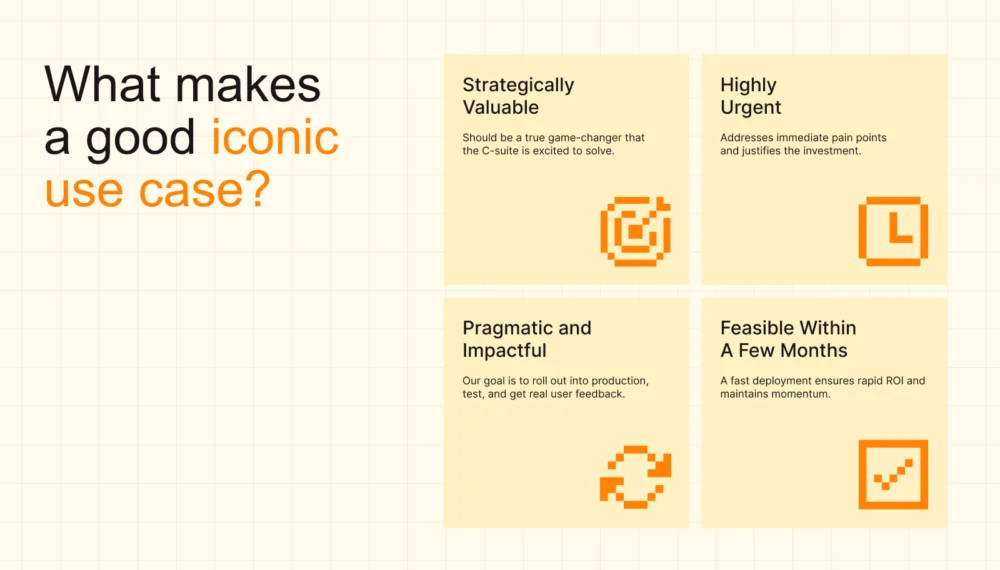
Effective AI deployment methodologies emphasize a rigorous selection process, filtering potential projects through a lens of strategic necessity, immediate urgency, quantifiable impact, and rapid feasibility. These four criteria ensure that the inaugural AI system is robust, relevant, and capable of generating the early wins required to secure executive buy-in for future investments.
1. Strategic Alignment: Beyond Optimization
An iconic use case must be strategically valuable, meaning it addresses a core business process bottleneck or unlocks a fundamentally transformative new capability. It must transcend minor efficiency gains and function as a genuine gamechanger. The project must carry enough weight to capture the attention and commitment of the C-suite and the board of directors, linking directly to top-line growth or critical operational resilience.
Consider the dichotomy between simple automation and strategic revenue generation. An internal human resources (HR) chatbot, while useful for streamlining employee queries, is essentially a tactical optimization. It is relatively easy to solve and does not fundamentally alter the company’s market position or competitive advantage. Conversely, a sophisticated, external-facing financial services assistant that not only answers complex client queries but is empowered to execute actions—such as blocking fraudulent transactions, facilitating securities trades, or proactively suggesting personalized upsell and cross-sell opportunities—transforms a cost-center function (customer support) into a strategic revenue-generating asset. This level of transformation elevates the project from a departmental fix to an enterprise mandate.
2. Urgency: Solving Immediate, Critical Pain Points
The best foundational projects solve business-critical problems that are highly urgent and resonate deeply with end-users. AI transformation demands significant time and resource investment from subject-matter experts (SMEs), IT teams, and operational staff. If the use case does not address an acute, recognized pain point, securing the necessary internal resources and maintaining engagement becomes nearly impossible. The project must demonstrate its necessity by alleviating immediate operational pressures, thereby justifying the reallocation of time and capital. Urgency ensures that the organization remains focused and that delays are swiftly addressed.
3. Impact and Pragmatism: Designing for Production
An impactful use case is inherently pragmatic. The shared objective from the project’s inception must be deployment into a real-world production environment, enabling testing with genuine users and gathering authentic operational feedback. The history of enterprise AI is littered with sophisticated prototypes that function brilliantly in controlled demonstration settings but lack the stability, security, and governance scaffolding required for real-world deployment. To avoid the "demo graveyard," solutions must be built with production readiness as a non-negotiable requirement, integrating necessary support, monitoring, and compliance frameworks from day one. Impact is measured not just by technical metrics (e.g., accuracy scores) but by organizational adoption rates and verifiable operational improvements.
4. Feasibility and Quick ROI
While strategic scope is essential, the first iconic project must also be highly feasible, focusing on delivering a quick, demonstrable return on investment (ROI). This balance is crucial for maintaining the operational momentum required to secure further funding and scale the AI initiative. Feasibility typically translates into aggressive timelines: ideally, a functional prototype should be ready for initial user feedback within a few weeks, with a stable, production-ready solution deployed within three months. This rapid iteration cycle minimizes risk, allows for timely pivoting based on user feedback, and quickly validates the core business case.
Deconstructing the Anti-Patterns: Where Enterprise AI Initiatives Stall
The path to identifying an iconic use case is often cluttered by internal proposals that, while superficially attractive, lack the necessary convergence of the four pillars. Through structured workshops involving cross-functional teams and end-users, enterprises must systematically weed out projects destined for failure. These common anti-patterns reveal critical gaps in planning:
- Moonshots: These are ambitious, high-risk bets that excite executive leadership but typically lack a clear, short-term path to ROI. They often satisfy the criteria for being strategic and urgent, but they fail the feasibility and short-term impact tests, requiring massive, multi-year investments before any value is realized.
- Tactical Fixes: These projects are characterized by solving immediate, localized pain points—the corporate equivalent of firefighting. While they are urgent and highly feasible, they rarely move the organizational needle. They fail to qualify as iconic because they lack strategic depth and quantifiable enterprise-wide impact.
- Blue Sky Ideas: These are conceptually game-changing and highly strategic, promising revolutionary impact. However, they are often premature, requiring technological maturity, significant data restructuring, or regulatory shifts that are years away. They meet the strategy and impact criteria but critically fail on urgency and feasibility.
- Hero Projects: These high-pressure initiatives are often driven by an internal champion or immediate crisis. They may be urgent and impactful, but they typically lack formalized executive sponsorship, realistic timelines, or the necessary internal governance structures, making their long-term sustainability and scalability tenuous.
The methodology requires finding the narrow overlap where strategy, urgency, impact, and feasibility intersect, ensuring the project is transformative enough to inspire, critical enough to demand resources, and contained enough to succeed quickly.
Industry Implications and the Role of Open Frontier Models
The complexity of modern enterprise systems, especially in highly regulated sectors like manufacturing, finance, and automotive, necessitates bespoke AI solutions built upon customizable, powerful models. For organizations tackling industry-specific challenges—such as accelerating lithography innovation (ASML), enhancing vehicle intelligence (Stellantis), or optimizing complex customer journeys (Cisco)—relying solely on off-the-shelf generalized models is insufficient.
Partnerships focused on co-designing tailored AI solutions, often starting with open frontier models, provide the necessary foundation. Open models offer flexibility, allowing proprietary enterprise data to be used for fine-tuning or retrieval-augmented generation (RAG) without incurring the risks associated with complete vendor lock-in or compromising data privacy. This approach allows enterprises to customize the AI system to their unique operational context, technical debt, and governance requirements, delivering impact precisely where generalized solutions would fail.
Operationalizing Success: From Validation to Self-Sufficiency
Once the iconic use case is clearly defined, the initiative must transition swiftly into a structured validation and deployment pipeline.
Validation and Data Readiness
The validation phase begins with a deep dive into data exploration and mapping. Successful AI systems are fundamentally data-driven, and the initial phase must identify data readiness, including quality, accessibility, and compliance requirements. This step also involves defining the target pilot infrastructure (e.g., cloud, on-premise, or hybrid environment) and establishing a foundational governance process. This governance includes identifying key participants for the proof-of-concept (PoC) and defining the metrics that will determine success, moving beyond simple technical accuracy to include measures like user adoption rate, operational efficiency gains, and time-to-value.
Co-Creation and Knowledge Transfer
The subsequent building phase must emphasize co-creation rather than simple outsourcing. Organizations partnering with AI experts should focus on embedding applied AI scientists directly into their internal operational teams. This collaborative approach ensures that the design, building, and deployment of the first solution serve as a mechanism for profound knowledge and skills transfer.
The ultimate output of this phase is not just a deployed AI solution, but an empowered, self-sufficient internal team capable of operating, maintaining, and innovating upon the new system independently. This mitigates the risk of long-term dependency on external vendors and establishes the internal AI muscle required for future scaling.
The Future Trajectory: Building the AI Flywheel
The initial success of an iconic use case generates organizational momentum—the "AI flywheel." The learnings, refined data pipelines, established governance models, and empowered teams become the foundational blueprint for identifying and deploying subsequent high-value AI solutions across other business units.
In the long term, this foundational approach enables the enterprise to move beyond single-task automation toward complex, orchestrated multi-agent systems. The future of enterprise AI involves integrating interconnected models that handle sequential, sophisticated tasks—such as a system that manages customer onboarding, verifies regulatory compliance, and simultaneously predicts optimal pricing strategies.
The successful identification of the first iconic use case is, therefore, more than a project selection; it is the establishment of an organizational capability. It transforms the AI journey from a series of scattered, speculative experiments into a strategic, repeatable, and scalable mechanism for continuous innovation, ensuring that the enterprise not only adopts advanced technology but strategically embeds it to generate enduring competitive advantage. The path to scalable AI success starts with this singular, well-chosen foundation, one that is bold enough to inspire transformation and pragmatic enough to guarantee immediate, measurable delivery.