

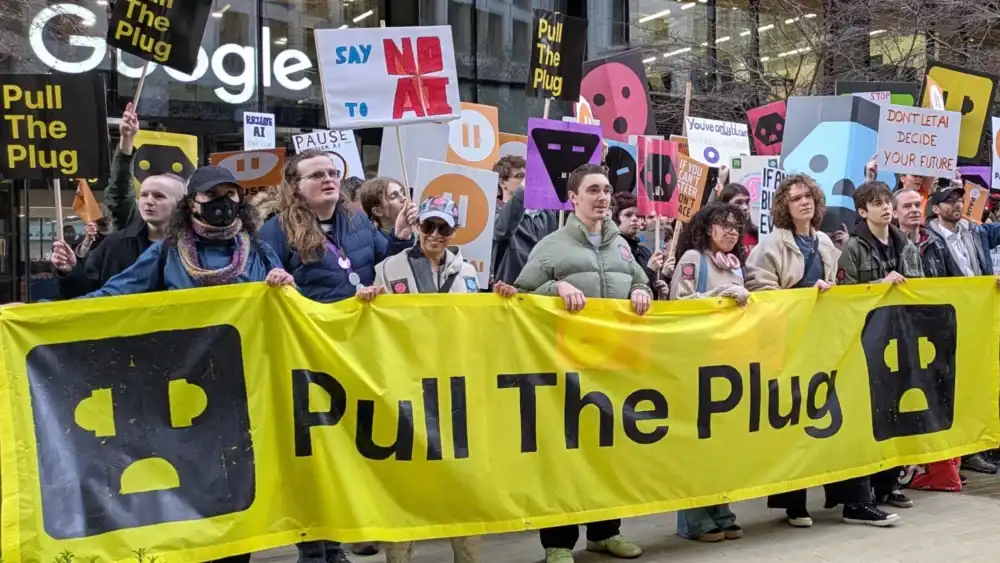
On a crisp Saturday in late February, the sleek, glass-and-steel canyons of London’s King’s Cross—a district that has rapidly transformed from a post-industrial wasteland into the beating heart of the United Kingdom’s technology sector—witnessed a spectacle that felt like a glitch in the digital matrix. The air, usually filled with the quiet hum of commuters and the hushed conversations of software engineers, was instead pierced by a rhythmic, analog defiance. "Pull the plug! Pull the plug! Stop the slop! Stop the slop!"
This was the rallying cry of several hundred protesters who converged on the doorsteps of some of the world’s most powerful corporate entities. Organized by the activist groups Pause AI and Pull the Plug, the march was billed as the largest mobilization against the current trajectory of artificial intelligence to date. It represented a significant milestone in the evolution of AI skepticism: the transition from academic white papers and Twitter debates to physical, boots-on-the-ground activism.
The choice of location was surgical. King’s Cross is the UK headquarters for OpenAI, Meta, and Google DeepMind. It is a geographic nexus of the "compute" and "capital" that drive the generative AI revolution. Yet, the people gathered outside these offices were not there to celebrate innovation. They were there to voice a dizzying array of anxieties that span the spectrum from the immediate and tangible to the speculative and existential.
The visual language of the protest was as eclectic as the concerns it represented. One woman navigated the crowd wearing a large, homemade billboard on her head that asked, "WHO WILL BE WHOSE TOOL?" with the "Os" in "TOOL" serving as eye holes—a literal embodiment of the fear of human obsolescence. Signs ranged from the witty—"Demis the Menace," a jab at Google DeepMind CEO Demis Hassabis—to the blunt: "EXTINCTION=BAD" and "Stop using AI."
For the casual observer, the movement might appear like a modern-day Luddite revival. However, the intellectual pedigree of the organizers suggests something more complex. This isn’t merely a rejection of technology by those it has left behind; it is a burgeoning resistance led, in part, by those who understand the technology best.
Joseph Miller, the head of Pause AI’s UK branch and a co-organizer of the march, is an Oxford University PhD student specializing in mechanistic interpretability. This niche but critical field of research attempts to "peek under the hood" of Large Language Models (LLMs) to understand the specific neural pathways that lead to certain outputs. Miller’s academic work has led him to a chilling conclusion: we are building systems that we cannot truly control or even fully understand.
"We’ve been growing very rapidly," Miller noted, drawing a parallel between the movement’s momentum and the very technology they oppose. "In fact, we also appear to be on a somewhat exponential path, matching the progress of AI itself." Miller’s primary concern isn’t necessarily a sentient, "Terminator"-style superintelligence, but rather the catastrophic intersection of high-powered AI and human fallibility. He points to the danger of integrating AI into command-and-control structures for nuclear weapons. "The more silly decisions that humanity makes, the less powerful the AI has to be before things go bad," he argued.
This fear of the "military-industrial-AI complex" has gained fresh urgency following recent geopolitical maneuvers. While Anthropic recently made headlines for resisting US government pressure to allow its model, Claude, to be used for "legal" military purposes, OpenAI took a different path, signing a deal with the Department of Defense. This divergence highlights a deepening rift within the industry regarding the ethical boundaries of dual-use technology.
The protest also served as a "broad tent" for more immediate societal grievances. An older man in a sandwich board reading "AI? Over my dead body" spoke of the looming specter of mass unemployment. "The devil finds work for idle hands," he remarked, capturing a sentiment shared by many who fear that the "efficiency" promised by generative AI is simply a euphemism for the permanent displacement of the middle class.
Then there is the issue of "slop"—the colloquial term for the deluge of low-quality, AI-generated content currently polluting the internet. A chemistry researcher at the march articulated a concern shared by many in academia: the spread of AI-generated misinformation and "hallucinations" is making it increasingly difficult to find reliable, peer-reviewed sources. Their proposed solution was radical: make it illegal for companies to profit from AI. "If you couldn’t make money from AI, it wouldn’t be such a problem," they suggested, pointing toward a de-commodification of the technology.
Despite the gravity of the topics—extinction, total surveillance, and the collapse of the labor market—the atmosphere of the march was strangely convivial. It felt less like a riot and more like a social gathering of the concerned. This lack of overt anger might be the movement’s greatest strength or its primary weakness. The organizers had intentionally pitched the event as a "social," encouraging the curious to join.
"Sometimes you don’t have that much to do on a Saturday anyway," one participant, a finance professional who joined out of curiosity, admitted. "If you can see the logic of the argument, if it sort of makes sense to you, then it’s like, ‘Yeah, sure, I’ll come along.’" He noted that unlike more polarizing political protests, the core message of AI caution is difficult to totally oppose. Who, after all, is "pro-extinction"?
However, this lack of friction with the public stands in stark contrast to the movement’s relationship with the tech giants themselves. Most protesters were under no illusions that their presence would change the minds of CEOs like Sam Altman or Mark Zuckerberg.
Maxime Fournes, the global head of Pause AI and a 12-year veteran of the AI industry, was blunt about the prospects of corporate persuasion. "I don’t think that the pressure on companies will ever work," he said. "They are optimized to just not care about this problem." Instead, Fournes is pursuing a strategy of "frictional activism." By advocating for whistleblower protections and attempting to "de-glamorize" the industry, he hopes to dry up the talent pipeline that feeds these companies. If working in AI is no longer seen as a "sexy," high-status career but as a morally dubious endeavor, the pace of development might naturally slow.
This shift in strategy—from trying to convince the boardrooms to trying to discourage the classrooms—marks a new phase in the AI safety debate. It recognizes that as long as the "AI arms race" is framed as a matter of national security and shareholder value, corporate entities will continue to accelerate.
As the march wound its way through the historic streets of Bloomsbury and ended in a humble church hall, the participants began the less-glamorous work of organizing. They wrote names on stickers, sat in rows of folding chairs, and discussed the minutiae of policy and public outreach. The "Pause AI" movement is attempting to build a durable political infrastructure, one that can survive the initial wave of hype and the inevitable pushback from the tech sector.
The challenges they face are immense. The history of technology suggests that once a capability is "out of the bag," it is nearly impossible to put back in. From the printing press to the steam engine to the internet, society has generally opted for adaptation rather than cessation. Furthermore, the economic incentives driving AI are measured in the trillions of dollars, making any "pause" a hard sell to governments desperate for growth.
Yet, the King’s Cross protest suggests that a segment of the public is no longer willing to accept "inevitability" as an answer. For activists like Matilda da Rui, AI is the "last problem" humanity will ever face. In her view, the technology will either solve every human ailment or ensure there are no humans left to have them. "It’s a mystery to me that anyone would really focus on anything else if they actually understood the problem," she said.
As the sun set over the London skyline, the protesters remained in their church hall, debating how to save a world that seems increasingly intent on automating its own future. They represent a growing minority who believe that just because we can build something, it doesn’t mean we must. Whether they can transform from a Saturday afternoon curiosity into a global political force remains to be seen, but for one afternoon in London, the "exponential" progress of AI met a very human, very loud resistance.