

SpotDraft, a leading developer of contract lifecycle management (CLM) solutions powered by artificial intelligence, has secured a pivotal $8 million strategic investment from Qualcomm Ventures. This funding, structured as an extension to its successful Series B round, is explicitly earmarked for accelerating the deployment and scalability of its groundbreaking on-device contract review technology, VerifAI, tailored for highly regulated legal and professional services workflows. This capital injection immediately validates the startup’s architectural focus on decentralized AI, propelling its valuation to approximately $380 million, a near-doubling from its post-money valuation of $190 million following the initial $56 million Series B closure last year.
The valuation surge underscores a rapidly crystallizing trend within the enterprise technology sector: the urgent requirement for generative AI applications capable of functioning effectively without compromising data security, privacy, or governance protocols by transmitting sensitive information to external cloud infrastructure. While enterprises across virtually every vertical have enthusiastically begun piloting large language models (LLMs), the legal domain remains one of the most cautious, and rightly so. Contracts are the repositories of a company’s most privileged data, including intellectual property details, confidential pricing structures, proprietary deal terms, and regulatory exposure. Consequently, privacy and security risks have consistently been identified by major industry analysts as the principal impediments to the widespread adoption of cloud-based GenAI tools in professional services.
SpotDraft’s strategic alliance with Qualcomm—the foundational technology provider driving the emerging ecosystem of high-performance, edge-capable computing—signals a critical inflection point in enterprise AI deployment. The investment extends beyond mere financing, evolving into a technical and market collaboration focused on joint development and coordinated go-to-market strategies for on-device deployments. This move directly capitalizes on the rise of the "AI PC," a new generation of endpoint devices equipped with dedicated Neural Processing Units (NPUs) designed to handle complex AI workloads locally.
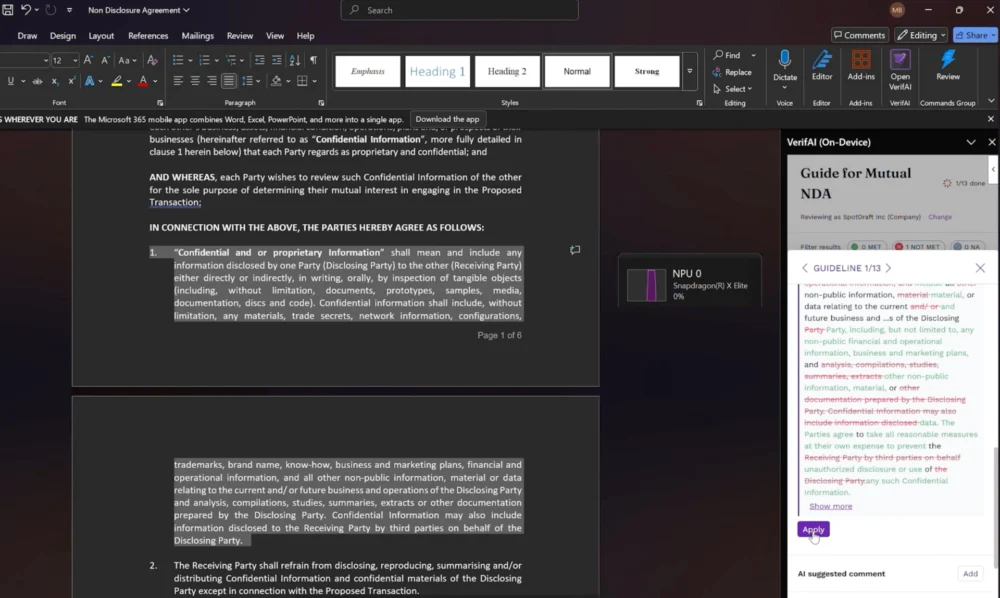
The feasibility of this approach was recently showcased at the Qualcomm Snapdragon Summit 2025, where SpotDraft successfully demonstrated the VerifAI workflow running entirely end-to-end on laptops powered by the Snapdragon X Elite platform. This demonstration confirmed the system’s ability to perform sophisticated contract review, risk scoring, and redlining functionalities fully offline. Crucially, the sensitive legal documents never leave the local machine, addressing core concerns around data residency and privileged information security. While internet connectivity remains necessary for authentication, licensing, and collaborative features, the core intelligence processing that touches the contract data operates securely at the edge.
Shashank Bijapur, co-founder and CEO of SpotDraft, articulated the rationale for this architectural shift, emphasizing the non-negotiable requirements of sensitive enterprise use cases. "The future of how enterprise AI is going to be—right now, there’s got to be AI that is close to the document, which is privacy critical, latency sensitive, and legally sensitive," Bijapur stated. "Those are the things that will move on device."
The Regulatory Imperative and Decentralized Intelligence
The shift toward decentralized AI processing is not merely a technical preference; it is increasingly becoming a regulatory and compliance mandate. Highly regulated industries—particularly defense contractors, pharmaceutical companies managing drug trials, and financial institutions handling customer data—are subject to stringent internal security reviews and international data residency laws (such as GDPR in Europe or specific state laws in the US). These constraints often make the utilization of generalized, third-party cloud LLMs for core legal or strategic workflows untenable. Sending a high-value merger agreement or a sensitive patent license to a distant, generalized cloud server introduces security vulnerabilities and compliance risks that legal departments are mandated to eliminate.
SpotDraft positions legal technology as the perfect proving ground for this new paradigm. The VerifAI tool goes far beyond the simplistic summarization often associated with early generative AI applications. It is engineered to integrate deeply into existing professional environments, specifically Microsoft Word, where legal teams spend the majority of their time drafting and negotiating. VerifAI’s on-device capabilities allow it to execute complex logic, comparing the text of a contract against a client’s internal legal guidelines, established playbooks, and historical policy precedents. Madhav Bhagat, co-founder and CTO of SpotDraft, highlighted this functional depth: "VerifAI will compare a contract against your guidelines, your playbooks, your prior policies," ensuring that automated recommendations are contextually relevant and compliant with corporate standards, all while maintaining data sovereignty.
The technical leap required to achieve this involves advanced model optimization techniques, including quantization and fine-tuning, to shrink large models down to efficient, high-performing versions suitable for NPU acceleration. This process ensures that the local models retain the accuracy and contextual understanding necessary for complex legal tasks. Historically, the trade-off for running AI locally was a significant drop in quality compared to the massive, frontier models hosted in the cloud. However, the performance gap has dramatically narrowed. Bhagat confirmed that in terms of evaluation metrics, the fine-tuned on-device models show "as little as 5% difference" compared to their cloud-based counterparts.

Furthermore, the dedicated silicon acceleration provided by chips like the Snapdragon X Elite delivers substantial performance gains, directly addressing latency issues that plague cloud-based interactions. The CTO noted that processing speeds on these newer chips are now approximately "one-third of what we get in the cloud." This combination of near-parity accuracy and drastically reduced latency makes the on-device architecture superior for time-sensitive, iterative workflows like contract negotiation, creating a compelling total value proposition for enterprise adoption.
Industry Implications: The Dawn of the AI PC Enterprise
Qualcomm’s investment is highly strategic, marking a pivotal moment in the hardware-software convergence at the enterprise edge. For Qualcomm, validating its high-performance Snapdragon platform in a mission-critical, high-value enterprise application like legal tech is essential for driving the mass adoption of the AI PC. As more enterprise software vendors follow SpotDraft’s lead, the demand for powerful local processing capabilities (NPUs) will surge, cementing Qualcomm’s position as a key enabling layer in the decentralized AI ecosystem.
The industry implications extend far beyond contract management. The success of VerifAI in solving the privacy-compliance challenge for legal documents serves as a blueprint for other professional services and sensitive sectors. We can anticipate similar architectural shifts across areas involving proprietary research and development data, internal financial modeling, healthcare patient records, and classified government data. This trend signifies a foundational change in how enterprise software is built and deployed, favoring hybrid models where privacy-critical tasks remain local, while generalized or collaborative functions might still leverage the cloud.
This movement away from total cloud dependency for sensitive computation offers significant advantages for enterprises, including predictable costs (as inference is offloaded from cloud APIs), resilience (ability to work offline), and enhanced security posture. It fundamentally changes the risk profile associated with integrating powerful generative AI tools into the corporate fabric.
Market Momentum and Future Expansion
Since its founding in 2017, SpotDraft has successfully established itself as a fast-growing leader in the CLM space. The company has demonstrated impressive market momentum, expanding its customer base from around 400 last year to over 700 current clients, including notable names such as Apollo.io, Panasonic, Zeplin, and Whatfix.
The adoption of the platform is scaling dramatically. Customers are collectively processing more than 1 million contracts annually, reflecting a massive 173% year-over-year growth in contract volumes. This operational expansion is supported by nearly 50,000 monthly active users who rely on the platform for mission-critical legal functions. Financially, SpotDraft projects continued hyper-growth, expecting 100% year-over-year revenue growth in the upcoming year (2026), following robust growth rates of 169% in 2024 and similar expansion in 2025. While specific revenue figures were not disclosed, these metrics illustrate a robust and scaling business poised to capture significant market share in the rapidly evolving legal tech landscape.
The fresh capital infusion will be strategically deployed to deepen the company’s core product offerings and AI capabilities, ensuring VerifAI maintains its technological edge. Crucially, the funding will fuel aggressive enterprise expansion across key global markets. CEO Bijapur outlined plans for significant growth across the Americas, the EMEA region (Europe, Middle East, and Africa), and India.
The widespread availability of the on-device workflow is currently limited to a select group of pilot customers. However, the founders anticipate a rapid, broad rollout coinciding directly with the increasing availability and adoption of compatible AI PC hardware across the global enterprise landscape. This staged rollout is a practical recognition of the ongoing transition in corporate hardware cycles, ensuring that the VerifAI deployment scales synchronously with the underlying technology ecosystem championed by partners like Qualcomm.
SpotDraft, headquartered between Bengaluru and New York, maintains a global workforce of over 300 employees, positioning it strategically to serve multinational clients. The total capital raised by the startup now stands at $92 million, reflecting strong confidence from its diverse investor base, which includes Vertex Growth Singapore, Trident Growth Partners, Xeed VC, Arkam Ventures, and Prosus Ventures, alongside the newest strategic partner, Qualcomm Ventures. The partnership with Qualcomm solidifies SpotDraft’s role as a technological vanguard, demonstrating how privacy, performance, and compliance can be seamlessly integrated into the next generation of enterprise AI applications operating securely at the edge.