

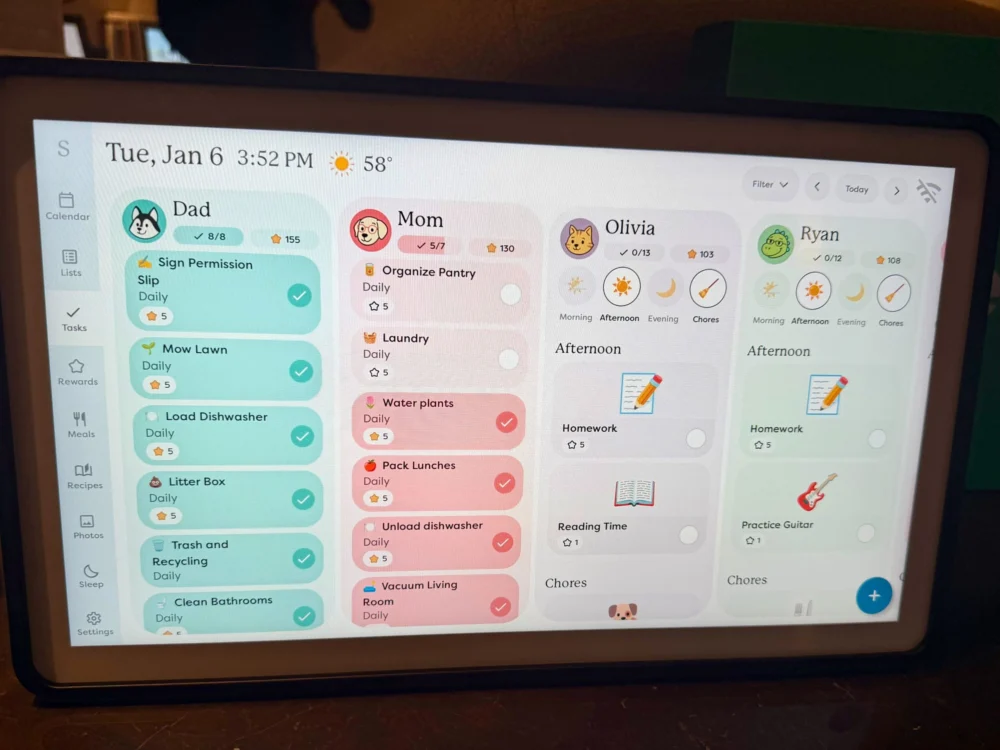
The Consumer Electronics Show (CES) 2026 served as the launching pad for Skylight’s most ambitious step yet into the burgeoning market of dedicated domestic management systems: the Skylight Calendar 2. Having strategically pivoted from its initial roots as a simple digital picture frame vendor, Skylight is now firmly focused on solving the logistical complexities inherent in modern family life, offering a centralized platform that integrates scheduling, task management, meal planning, and communication. This newest iteration of their digital calendar ecosystem underscores a critical trend in smart home technology: the transition from multi-function hubs to specialized, contextual computing appliances designed for specific household pain points.
The Calendar 2 slots neatly into Skylight’s existing hardware portfolio, designed to offer a balance between screen real estate and discreet aesthetic integration. It occupies the middle ground between the compact 15-inch first-generation model and the imposing, wall-mounted 27-inch Calendar Max. While specific dimensions were not immediately released, the emphasis is on a notably sleeker physical profile compared to its predecessor. Crucially, the device maintains the family-friendly customization pioneered by its larger counterpart, featuring swappable magnetic frames available in a diverse palette of colors. This seemingly minor design detail is, in fact, integral to the product’s core philosophy—acknowledging that digital organizational tools must blend seamlessly into the home environment rather than dominate it, a requirement essential for achieving mass adoption in ambient computing.
While the hardware provides the necessary canvas, the true innovation, and indeed the primary selling point, resides in the sophisticated software stack and its deep integration of artificial intelligence capabilities. In an era where family schedules are fragmented across multiple platforms—professional commitments on Microsoft Outlook, personal appointments on Google Calendar, shared events on Apple’s iCal, and specialized activities tracked through third-party applications like youth sports organizer TeamSnap—the cognitive load required to maintain synchronization is immense. The Skylight Calendar 2 addresses this head-on by functioning as a universal aggregation layer. It pulls data from all these disparate sources, compiling a singular, comprehensive family schedule.
This amalgamation process is made intelligible through robust color-coding, where each family member or specific type of activity (e.g., school events, work travel, chores) is assigned a distinct visual identifier. This design choice elevates the product beyond a simple display, turning it into a glanceable dashboard where the entire household’s logistics can be assessed in seconds. This reduction in the time needed for information processing is a key differentiator in the crowded smart display market.
The most compelling technological leap forward is the application of computer vision and optical character recognition (OCR) capabilities to bridge the stubborn gap between the physical world and digital scheduling. Often, crucial family logistics—such as school holiday schedules, team practice changes, or parent-teacher meeting notes—are conveyed via physical paper flyers tucked into backpacks or embedded within unstructured email bodies. Skylight leverages proprietary AI to solve this friction point. Users can simply use the companion mobile application to snap a photograph of a printed schedule or forward an event-laden email, and the system automatically extracts the relevant dates, times, and descriptions, importing them directly into the unified calendar. This level of automated data extraction represents a significant reduction in the parental burden of manual data entry, a pain point frequently cited by consumers of organizational tech.
Beyond scheduling, the Calendar 2 seeks to conquer the perennial domestic challenges of nutrition and provisioning. The platform includes dedicated modules for managing shared grocery lists, scheduling recurring appointments, and sophisticated meal planning. This capability goes far beyond basic list functionality. The system can automatically generate a comprehensive shopping list of ingredients necessary for planned recipes, and crucially, it features direct API integration with third-party grocery fulfillment services, such as Instacart. This allows users to move seamlessly from meal idea to scheduled delivery with minimal intermediate steps.
Further demonstrating its commitment to contextual intelligence, the Calendar 2 incorporates another clever AI utility focused on minimizing food waste and maximizing efficiency. Users can snap a photo of the contents of their refrigerator or pantry, and the device’s computer vision system will analyze the available ingredients. Based on this real-time inventory, the system then generates recipe recommendations, solving the common dilemma of "what to cook tonight" based solely on what is already on hand. This integration of inventory management with nutritional planning positions Skylight as a true domestic orchestrator, not merely a scheduler.
The user interface design is meticulously optimized for multi-generational use. Recognizing that a family organizer must be accessible to all members, including young children who may not yet be fully literate, the interface employs simple navigation, high-contrast color palettes, and heavy use of imagery. For instance, the chore tracking module allows children to visually confirm completion of tasks by interacting with graphical representations—a picture of a bed for "make your bed," or a dish for "load the dishwasher." This low-friction, visual approach fosters early responsibility and ensures system adoption across the entire household demographic, a critical factor for the longevity and utility of any family-centric technology. When the device is not actively displaying organizational data, it reverts gracefully to its roots, serving as a high-definition digital picture frame, showcasing family photo memories.
Industry Context and Competitive Landscape
Skylight’s continued success and the launch of the Calendar 2 occur within a highly competitive ecosystem. The company is operating at the intersection of the smart home, ambient computing, and personal productivity markets. Major competitors include general-purpose smart displays like the Amazon Echo Show and Google Nest Hub Max. However, Skylight has carved out a profitable niche by eschewing the "everything-for-everyone" approach of these giants.

Expert analysis suggests that consumers are increasingly experiencing "smart home fatigue," where the sheer complexity and conflicting interfaces of multi-purpose devices detract from their utility. Skylight’s strategy is the opposite: offering a dedicated, single-purpose appliance optimized entirely for family coordination. This strategic focus minimizes setup time, reduces user distraction (unlike a device constantly pushing notifications or video content), and guarantees a highly polished experience for its core function.
The financial performance of Skylight further validates this specialized approach. The company is notably bootstrapped and has maintained profitability since its inception. This is a powerful counter-narrative in the often-venture-capital-dependent technology sector. With over 1.3 million families already integrated into the Skylight ecosystem, the company demonstrates robust customer validation for dedicated organizational appliances. This success signals that a significant segment of the consumer market is willing to pay a premium for solutions that specifically target and alleviate the cognitive load of managing complex household logistics, rather than relying on subsidized or ad-supported general smart displays.
This trend toward specialized ambient computing devices is expected to accelerate. As chip costs decrease and AI processing becomes more efficient, manufacturers will find greater margins and consumer demand in hyper-focused appliances. The Calendar 2 is a prime example of this evolution: it is not just a screen, but a highly tuned computational appliance designed to solve a very specific set of problems—schedule fragmentation and domestic chaos.
Expert Analysis: Cognitive Load Reduction as a Feature
From a human-computer interaction (HCI) perspective, the most valuable contribution of the Calendar 2 is its measurable reduction of cognitive load, particularly for primary caregivers. Research in domestic psychology consistently shows that the mental burden of "household management," often referred to as the "invisible workload," involves tracking, planning, reminding, and coordinating disparate schedules.
The AI features in the Calendar 2 are specifically engineered to automate these invisible tasks. The photo-to-event feature, for instance, eliminates the process of remembering to input an event, finding the right app, and typing the details. Similarly, the meal planning and fridge inventory system moves planning from a stressful, open-ended task ("What should we eat?") to a streamlined, suggestion-driven process ("Here are three recipes based on the chicken, peppers, and rice you currently possess").
Dr. Eleanor Vance, a consultant specializing in ambient technology integration, notes that this level of seamless automation is crucial for long-term user retention. “The true success metric for domestic AI isn’t how many features it has, but how many decisions it removes from the user’s daily life,” Vance explains. “Skylight is moving toward proactive scheduling and predictive assistance. By aggregating data across calendars, meal plans, and shopping lists, the system gains a holistic view of the family unit, allowing it to predict needs—suggesting a rest day after a particularly busy week, or automatically adding more milk to the list based on consumption patterns.”
Future Impact and Trend Forecasting
The introduction of the Skylight Calendar 2 at CES 2026 solidifies the roadmap for the next generation of family-centric smart technology. Looking forward, the platform is ideally positioned to expand its utility through deeper integrations within the broader smart home ecosystem.
One anticipated development is the integration of personalized, context-aware reminders delivered via other smart home devices. For example, if a family member is scheduled for a late practice, the system could automatically adjust smart lighting routines in specific rooms or prompt a smart speaker reminder near the door about necessary equipment. The integration with HVAC systems could also be optimized, preemptively adjusting home temperature based on known occupancy schedules derived from the calendar data.
Furthermore, the data collected by the Skylight platform—with robust privacy safeguards, which are essential for consumer trust—offers significant potential for predictive analytics. Future iterations could move beyond mere organization to offer behavioral suggestions: identifying scheduling conflicts before they arise, suggesting optimized routes for carpooling based on real-time traffic data combined with synchronized sports schedules, or even recommending optimal times for shared family activities based on historically low conflict periods.
The evolution of Skylight from a simple photo frame to a powerful, AI-driven domestic logistics hub mirrors the larger trajectory of consumer technology. It demonstrates that the future of the smart home is not a single, centralized general-purpose computer, but rather a network of dedicated, highly intelligent appliances that perform specific, high-value functions seamlessly. The Calendar 2 is a strong indicator that the era of contextual computing—where devices understand the ‘who, what, where, and when’ of daily life—has arrived, fundamentally redefining how modern families manage their increasingly complex existence. Skylight’s ability to execute this vision while maintaining profitability and customer satisfaction ensures they will remain a pivotal player in the digital home organization space.