

The technological landscape of Central Asia reached a new milestone this week as Uzum, Uzbekistan’s premier digital ecosystem, saw its valuation surge to $2.3 billion. This 53% leap in value, achieved in a mere seven-month window, signals a profound shift in investor sentiment toward frontier markets and underscores the rapid maturation of the Uzbek digital economy. As global capital seeks growth beyond saturated Western and East Asian markets, Uzum has emerged as the definitive proxy for Uzbekistan’s modernization, successfully bridging the gap between traditional commerce and a high-tech future.
The latest valuation is anchored by a $131.5 million investment round, a sophisticated capital injection led by sovereign wealth funds from Oman. The round was further bolstered by a roster of high-profile existing backers, including the global technology conglomerate Tencent, VR Capital, and FinSight Ventures. This funding structure is notably bifurcated: it consists of $81.5 million in immediate equity and $50 million in convertible financing. The latter is strategically pegged to Uzum’s next funding milestone, serving as a bridge toward a substantial pre-IPO raise of $250 million to $300 million anticipated for late 2026 or early 2027.
To understand Uzum’s meteoric rise, one must look at the broader economic canvas of Uzbekistan. As the most populous nation in Central Asia, the country is currently undergoing a radical transition. Driven by a young, tech-savvy demographic and an aggressive government push for digitalization, Uzbekistan has become one of the fastest-growing digital economies in the Europe and Central Asia (ECA) region. Historically, the retail landscape was dominated by informal "bazaars" and cash-heavy transactions. However, the convergence of rapid smartphone adoption and a previously underserved banking sector has created a vacuum that Uzum has moved aggressively to fill.
Founded as recently as 2022, Uzum’s trajectory has been nothing short of explosive. It secured its status as Uzbekistan’s first-ever "unicorn" in March 2024 and was valued at $1.5 billion by August 2025 following a $65.5 million raise. That its valuation has now crested above $2.3 billion in such a short interval suggests that the "super app" model—pioneered by the likes of WeChat in China and Grab in Southeast Asia—is finding fertile ground in the heart of the Silk Road.
The "Leapfrog" Strategy: From Bazaars to Binary
Uzum’s core philosophy, as articulated by Chief Executive Djasur Djumaev, revolves around the concept of "leapfrogging." In many developed economies, the transition from traditional retail to digital commerce was a multi-decade evolution that moved from street markets to department stores, then to big-box retailers, and finally to e-commerce. Uzbekistan, however, is bypassing the middle stages.
"E-commerce is something that’s going to transform into retail," Djumaev noted during the funding announcement. By moving directly from informal trade and local bazaars to a sophisticated digital ecosystem, Uzum is effectively building the country’s modern commercial infrastructure from scratch. This isn’t just about shopping; it is about creating a unified digital layer for the daily lives of 35 million people.

The ecosystem currently comprises several distinct but synergistic verticals. Uzum Market serves as the e-commerce flagship; Uzum Bank provides the fintech backbone; Uzum Nasiya offers Sharia-compliant "buy now, pay later" (BNPL) and consumer lending services; and Uzum Tezkor handles express food and grocery delivery. This integration allows Uzum to capture data and value at every touchpoint of the consumer journey, from the moment a user receives their salary to the moment they order dinner or purchase a new appliance on credit.
Financial Performance and the Fintech Engine
While e-commerce provides the visibility, it is the fintech arm that serves as the ecosystem’s profit engine. Uzum’s financial disclosures reveal a company that is not just growing but is increasingly efficient. The startup reported a staggering $691 million in revenue for 2025, a significant jump from $505 million the previous year. More importantly for investors wary of "growth at any cost," Uzum is demonstrating a clear path to profitability. Net income rose to $176 million in 2025, up from $150 million in 2024.
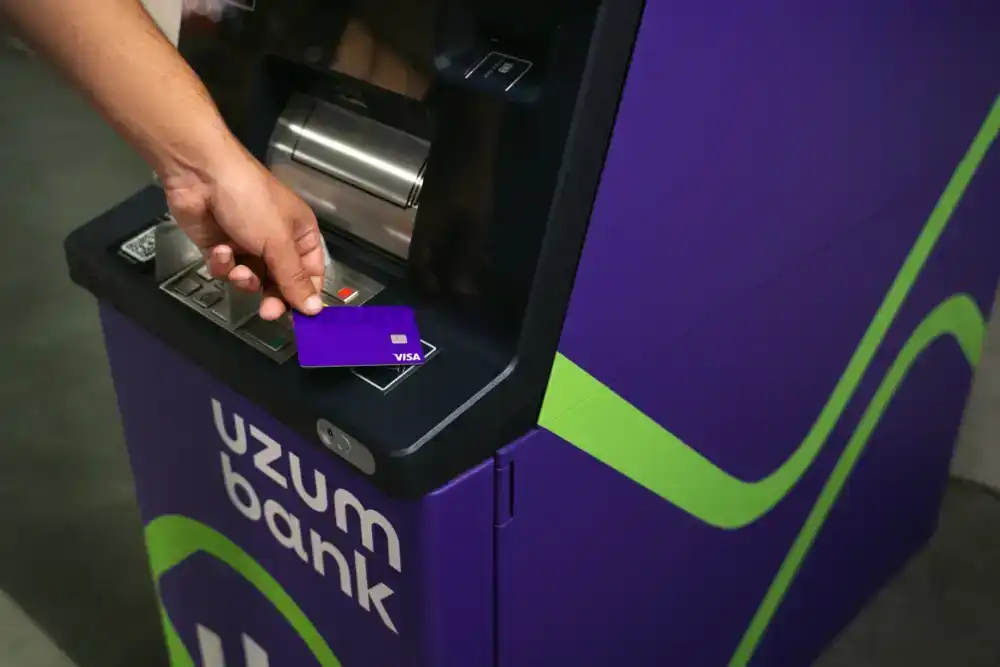
Nikolay Seleznev, Uzum’s Chief Strategy and Business Development Officer, highlighted that the fintech operations are the primary source of this profitability. Uzum Bank now serves approximately 5 million customers. In 2025 alone, it issued 4.1 million debit cards, representing roughly half of all new cards issued in the entire country for that year. This level of market penetration is rare for a private entity and places Uzum in a position of systemic importance within the national economy.
The lending business is equally robust. Uzum’s unsecured loan book has expanded to $400 million, while its total finance volume—the total credit disbursed through its platform—reached $1.2 billion in 2025. By providing credit to a population that was previously largely excluded from the formal banking system, Uzum is driving consumption and financial inclusion simultaneously. The company expects to add another 5 million banking customers in the coming year, effectively doubling its current fintech reach.
Building the Physical Backbone of a Digital Giant
One of the most significant barriers to e-commerce in frontier markets is the lack of reliable third-party logistics. In Uzbekistan, Uzum realized early on that it could not rely on existing infrastructure to meet the demands of modern consumers. Consequently, the company has become a logistics powerhouse in its own right.
Uzum currently operates a network of 1,500 pickup points across the nation, with plans to double that footprint to 3,000 locations by 2026. This physical presence is crucial in a market where home delivery can still be hampered by complex urban layouts and rural geography. The pickup points act as trusted community hubs where consumers can inspect goods before finalizing payment—a key factor in building trust in digital platforms.
To support this front-end growth, Uzum is massively scaling its back-end capacity. It currently manages 125,000 square meters of warehouse space, but it has embarked on an ambitious plan to reach 500,000 square meters through the construction of four new logistics centers. According to Seleznev, this investment is a prerequisite for success: "You need to invest in infrastructure yourself to deliver and shift customer expectations."

By controlling the entire supply chain—from the digital storefront to the physical warehouse and the final pickup point—Uzum can offer next-day delivery on over 1.5 million local products. Furthermore, the company has recently expanded into cross-border commerce, adding nearly 200 million stock-keeping units (SKUs) from international markets like China and Turkey, significantly broadening the variety of goods available to Uzbek consumers.
Industry Implications and the Road to IPO
Uzum’s success is being closely watched by emerging market analysts as a bellwether for the "Central Asian Tiger" narrative. The involvement of Oman’s sovereign wealth funds and China’s Tencent indicates that the region is no longer seen as a peripheral market but as a strategic corridor for investment.
The startup’s path toward a public listing is the next major chapter in its story. While the exact venue remains undecided, Seleznev indicated that an IPO is likely within the next three years. Uzum is evaluating exchanges in the United States, Europe, the Middle East, and Southeast Asia. A successful listing would not only provide an exit for early investors but would also put Uzbekistan on the map for global institutional equity funds.
The implications for the regional tech scene are profound. Uzum’s ability to scale and achieve profitability in a relatively short period provides a blueprint for other startups in Central Asia and the Caucasus. It proves that with the right combination of local market knowledge and global capital, it is possible to build a multi-billion dollar tech enterprise in a non-traditional hub.
Future Outlook: Deepening the Ecosystem
With the fresh $131.5 million in capital, Uzum intends to deepen its technological moat. This includes expanding its payment acceptance infrastructure, deploying a wider network of ATMs, and integrating more sophisticated point-of-sale (POS) systems for merchants. The goal is to move beyond being a "service provider" to becoming the very "operating system" of the Uzbek economy.
As of today, Uzum employs approximately 12,500 people, making it one of the largest private employers in the country. Its ecosystem reaches 20 million users—more than half of the adult population of Uzbekistan. In 2025, the platform processed approximately $11 billion in payment volume.
As Uzum continues to scale, the challenges will shift from infrastructure building to regulatory navigation and regional competition. However, for now, the company stands as a testament to the transformative power of the digital economy in Central Asia. By turning the "challenges" of a frontier market—low banking penetration, informal retail, and lack of logistics—into "opportunities" for a vertically integrated super app, Uzum has not only leaped over its competition but has also leaped into the ranks of the world’s most significant emerging market unicorns.