

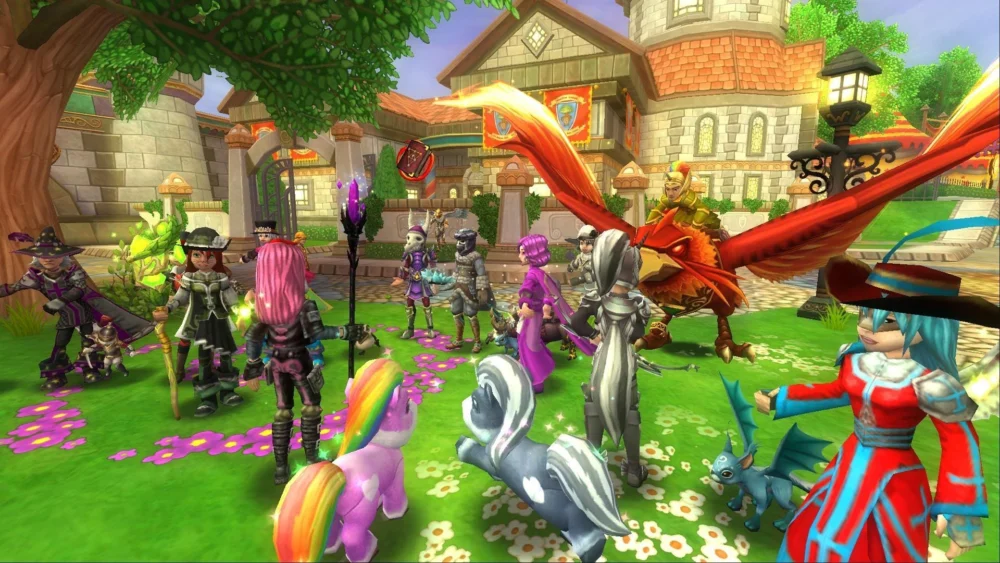
In an industry often obsessed with the "next big thing" and the rapid-fire lifecycle of live-service titles, the enduring success of legacy software remains one of the most compelling narratives in modern gaming. While many of its contemporaries from the late 2000s have either shuttered their servers or retreated into maintenance mode, KingsIsle Entertainment’s Wizard101 has achieved a feat that few industry analysts would have predicted a decade ago. More than 17 years after its initial debut on PC, the magical deckbuilding MMORPG has officially surpassed 1 million downloads across PlayStation, Xbox, and Nintendo Switch platforms. This milestone, reached within just months of its console debut, signals a significant shift in how legacy MMOs can find new life by pivoting toward modern hardware ecosystems.
The success of Wizard101 on consoles is not merely a story of nostalgia, though that certainly plays a role. It is a case study in technical adaptation, strategic monetization, and the identification of an underserved demographic in the console market. When the game first launched in 2008, it occupied a unique niche: a family-friendly, turn-based alternative to the "hardcore" real-time combat of World of Warcraft or EverQuest II. By bringing that same formula to the living room, KingsIsle has tapped into a fresh audience that, in many cases, was not even born when the game first entered its closed beta phase.
A Legacy Reimagined for the Living Room
The transition from PC to console is a path littered with technical and mechanical failures. Many MMORPGs struggle with the "controller problem"—the difficulty of mapping dozens of hotkeys and complex UI elements to a standard gamepad. However, Wizard101 possessed an inherent advantage that made it a prime candidate for this migration: its combat system.
Unlike the high-APM (actions per minute) requirements of modern action-RPGs, Wizard101 utilizes a turn-based, card-driven combat mechanic. This system translates seamlessly to a controller, where players can cycle through their deck and select spells with the d-pad or thumbsticks without the frantic precision required by mouse-and-keyboard setups. This mechanical compatibility reduced the barrier to entry for console players, allowing the game to maintain its core identity while feeling native to the new hardware.
Furthermore, the game’s visual style—a stylized, whimsical aesthetic—has aged remarkably well. While hyper-realistic games from 2008 often look dated and "muddy" on modern 4K displays, the vibrant, cartoony art direction of the Spiral (the game’s universe) retains its charm. This visual longevity, combined with recent engine optimizations by the development team, allowed the console ports to launch with a level of polish that many older titles fail to achieve when ported to modern systems like the PlayStation 5 or Xbox Series X|S.
The Power of Unified Ecosystems and Cross-Play
One of the most critical decisions in the console rollout was the implementation of a unified console player base. While the PC version remains on its own separate infrastructure—likely due to nearly two decades of accumulated database complexity and economic differences—the PlayStation, Xbox, and Nintendo Switch versions share the same servers.
This decision was instrumental in the game’s rapid ascent to the 1-million-download mark. By enabling cross-play between the three major console manufacturers, KingsIsle ensured that the game felt "alive" from day one. In the MMO genre, population density is a key metric for player retention; a world that feels empty is a world that players quickly abandon. By funneling all console users into a single ecosystem, the developer created a bustling environment where low-level areas like Wizard City are constantly populated, encouraging new players to stick around and engage with the community.
The performance on the Nintendo Switch has been particularly noteworthy. Shortly after its launch, Wizard101 climbed to the top of the Switch download charts, highlighting a significant demand for "cozy" yet deep RPG experiences on handheld hardware. The portable nature of the Switch aligns perfectly with the game’s pacing, allowing players to complete a few quests or a dungeon crawl during a commute or in short bursts—a playstyle that the original PC client didn’t always facilitate.
Strategic Monetization: Adapting the Business Model
The console launch also saw a refinement of the game’s business model to better suit the expectations of modern digital storefronts. On PlayStation and Xbox, the game follows a traditional free-to-play model, allowing players to explore a significant portion of the early game before hitting content gates. To progress further, players can use the game’s premium currency, Crowns, or opt for the "Arc 1 Access Pass."

The Arc 1 Access Pass, priced at $19.99, is a strategic masterstroke. It grants permanent access to the game’s first major story arc—encompassing the worlds of Wizard City, Krokotopia, Marleybone, MooShu, and Dragonspyre. By packaging this content as a single, upfront purchase, KingsIsle has effectively offered a "buy-to-play" experience that resonates with console players who may be wary of the recurring subscription models that defined the early MMO era.
The Nintendo Switch version takes this a step further by offering the game as a $19.99 premium purchase from the outset, which includes the Arc 1 content. This approach aligns with the Switch’s marketplace culture, where players are often more inclined to pay an entry fee for a curated experience than to navigate complex F2P microtransaction systems. These modular content delivery options demonstrate a deep understanding of platform-specific consumer behavior.
The "Cozy" Trend and the Nostalgia Cycle
To understand why Wizard101 is succeeding now, one must look at the broader cultural trends within the gaming industry. We are currently in the midst of a "cozy gaming" explosion, led by titles like Animal Crossing: New Horizons and Stardew Valley. Players are increasingly seeking experiences that offer progression and social interaction without the stress of high-stakes competitive play or toxic environments. Wizard101, with its focus on gardening, pet training, and housing alongside its magical combat, fits perfectly into this trend.
Additionally, the "Nostalgia Cycle" is currently hitting the 2000s era. The children who played Wizard101 in their middle school computer labs are now adults in their late 20s and early 30s. This demographic possesses both disposable income and a desire to revisit the formative experiences of their youth. The console launch provided the perfect excuse for these "lapsed wizards" to return to the Spiral, often bringing their own children along for the journey. This multi-generational appeal is a rare commodity in gaming and has served as a powerful engine for the game’s growth.
Industry Implications: The Future of Legacy MMOs
The success of Wizard101 sends a clear message to other developers and publishers holding onto legacy IP: there is still immense value in "old" games if they are handled with care. For years, the industry consensus was that porting an old MMO to consoles was a "death march" of technical debt and poor ROI. However, the million-download milestone proves that there is a massive audience on consoles hungry for depth and long-term progression systems.
We may see this success trigger a wave of similar ports. Titles like The Lord of the Rings Online, Dungeons & Dragons Online, or even older entries like RuneScape could potentially find renewed vigor on consoles if they can solve the UI and controller challenges that KingsIsle navigated so successfully. The key takeaway is that platform expansion should not be viewed as a "last gasp" for a dying game, but as a legitimate growth strategy to extend a franchise’s lifecycle by decades.
Wolfgang Duhr, CEO of gamigo group (KingsIsle’s parent company), noted that this milestone is a testament to the strength of the brand. His statement that the project was "long-awaited by players worldwide" underscores the importance of listening to community feedback. For years, the Wizard101 community had begged for console versions, and the data now shows that the demand was not just vocal, but actionable.
Looking Toward the Horizon
The 1-million-download mark is likely just the beginning of this new chapter for Wizard101. KingsIsle has made it clear that the console versions will receive the same steady stream of content updates as the PC version. This means that new worlds, higher level caps, and expanded gameplay systems will roll out to console players, ensuring that the "new" audience has a roadmap of content that could last them for years.
There is also the lingering question of a mobile port. Given that the game now runs on the Nintendo Switch’s ARM-based architecture and has a UI optimized for controllers and smaller screens, a move to iOS and Android seems like the logical next step. If Wizard101 can successfully bridge the gap to mobile while maintaining cross-play with consoles, it could become one of the most accessible and ubiquitous MMORPGs on the market.
In conclusion, Wizard101’s triumph on consoles is a rare "win-win" in the gaming world. Long-time fans get to see their favorite game thrive and reach new audiences, the developers are rewarded for their technical perseverance, and a new generation of players gets to experience a world of magic that has been carefully refined for nearly twenty years. As the game moves toward its second million downloads, it stands as a beacon of hope for legacy software everywhere, proving that with the right strategy, a classic can become a contemporary hit all over again.