

For decades, quantum computing resided in the realm of high-concept science fiction—a theoretical marvel discussed in the hallowed halls of physics departments but largely absent from the pragmatic world of enterprise IT. However, as we move through 2025, the narrative has shifted from "if" to "when" and, more importantly, "how." While the vision of a quantum laptop remains a distant dream, the infrastructure of a new computational era is being assembled in real-time. From the laboratories of IBM in Yorktown Heights to the burgeoning tech hubs of Florida and the photonic startups of New Jersey, the quest to harness the subatomic properties of matter is no longer just an academic pursuit; it is a multi-billion-dollar industrial race.
The current state of quantum technology is best viewed as a three-pronged spear: sensing, communication, and computation. While quantum computing (QC) captures the lion’s share of headlines and investment, its siblings—quantum sensing and quantum secure communications—are already seeing practical deployment. In the sensing arena, quantum devices are providing revolutionary solutions for Position, Navigation, and Timing (PNT). These systems allow for high-precision navigation in environments where Global Navigation Satellite Systems (GNSS) are denied or unavailable, such as deep-sea exploration, sub-surface mining, and outer space. Similarly, quantum key distribution (QKD) has moved from research papers to fiber-optic networks, securing data through the laws of physics rather than just complex algorithms.
The Economic Engine: From Speculation to Revenue
The financial landscape of quantum technology has undergone a dramatic transformation. According to recent industry analysis, investments have accelerated at an unprecedented pace over the last five years. Billions are being funneled into the sector, not only through venture capital for lean startups but also via massive internal R&D budgets at "Big Tech" stalwarts like Alphabet, Amazon, Microsoft, and IBM.

The economic justification for this spending is becoming clearer. In 2025, the quantum computing sector surpassed the $1 billion annual revenue milestone. While this is modest compared to the traditional semiconductor industry, the growth trajectory is staggering. Projections suggest the market could swell to between $50 billion and $130 billion by 2040. Although these figures carry the inherent volatility of long-term forecasting, they signal a deep-seated belief among institutional investors that quantum supremacy will unlock value that classical computers simply cannot touch.
The fundamental value proposition is efficiency and speed. Conventional computers, perfected over the last half-century, rely on bits—binary switches that are either 0 or 1. Quantum computing utilizes "Qubits." Unlike a standard bit, a qubit can exist in a state of 0, 1, or both simultaneously, a phenomenon known as superposition. When you combine this with entanglement—a state where qubits become inextricably linked regardless of distance—the result is a system that can process a vast multidimensional space of possibilities at once. To put this in perspective, Microsoft has noted that while a classical system would need billions of bits to represent the state of a complex molecule, a quantum system could achieve the same with just a few hundred qubits.
The Engineering Frontier: The Coldest Places in the Universe
Building a quantum computer is perhaps the greatest engineering challenge of the 21st century. The primary obstacle is "noise." Quantum states are incredibly fragile; the slightest vibration, temperature fluctuation, or electromagnetic interference can cause "decoherence," where the quantum information is lost.
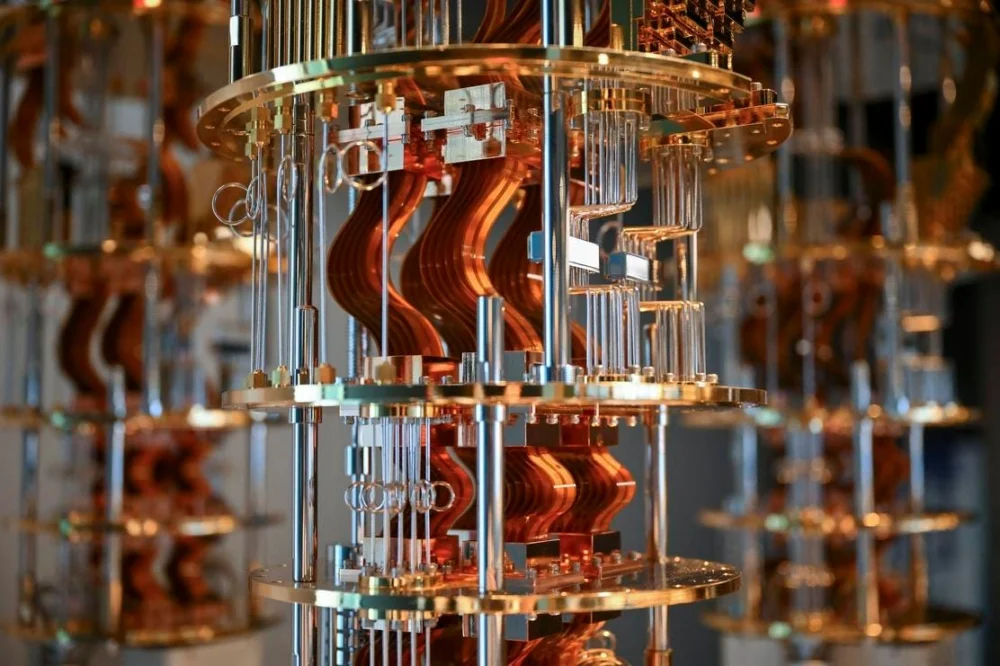
To combat this, most current quantum architectures require extreme environments. Superconducting circuits, like those used by IBM and Google, must be cooled to near absolute zero—approximately -273 degrees Celsius. These systems are housed in "dilution refrigerators," elaborate structures of gold and copper that look like high-tech chandeliers.

Beyond the cooling requirements, the industry is exploring diverse hardware paths:
- Ion Trapping: Using electromagnetic fields to suspend individual ions in a vacuum.
- Quantum Dots: Leveraging the spin of electrons within semiconductor materials.
- Photonics: Using light particles (photons) to carry information, which offers the tantalizing possibility of room-temperature quantum operations.
Each of these methods faces the same dual challenge: isolation and control. A system must be isolated enough to prevent decoherence but accessible enough for engineers to manipulate qubits using precise lasers or microwave pulses.
Strategic Ecosystems: The Role of QED-C and Government Mandates
Recognizing that no single company can solve the quantum puzzle in isolation, governments have stepped in to foster collaborative ecosystems. In the United States, the National Quantum Initiative Act of 2018 paved the way for the Quantum Economic Development Consortium (QED-C). Managed by SRI (formerly Stanford Research Institute) and supported by NIST, the QED-C now boasts over 250 members across industry, academia, and government laboratories.
Celia Merzbacher, Executive Director of QED-C and a veteran of the White House Office of Science and Technology, emphasizes that the goal is to remove the "bottlenecks" to commercialization. These barriers include a lack of standardized metrics, a shortage of specialized components (like cryogenic cables), and a massive talent gap in the workforce.

The strategic importance of this work cannot be overstated. Recent White House strategies have expanded support for quantum technologies, viewing them as essential for national security—particularly in the realm of "Post-Quantum Cryptography." As quantum computers grow more powerful, they will eventually be capable of breaking the RSA encryption that currently protects the world’s financial and governmental data. Preparing for that "Q-Day" is now a matter of sovereign priority.
Quantum Annealing: The Pragmatic Approach to Optimization
While many firms chase the "Universal Quantum Computer"—a machine that can run any quantum algorithm—D-Wave Systems has taken a different, more specialized path: Quantum Annealing. D-Wave, which recently moved its headquarters to Boca Raton, Florida, claims the title of the world’s first commercial quantum supplier.
Quantum annealing is specifically designed for optimization problems. Consider the "Traveling Salesman Problem," where the goal is to find the most efficient route between a set of cities. As the number of cities increases, the number of possible routes grows exponentially, quickly overwhelming even the most powerful classical supercomputers.
D-Wave’s Advantage2 system uses loops of superconducting wire to model these problems as a "spin-glass" system. By utilizing quantum tunneling and superposition, the machine can explore all possible routes simultaneously, settling into the lowest-energy state, which represents the optimal solution. This technology is already being applied in logistics, manufacturing, and financial services. A recent $20 million deal with Florida Atlantic University underscores the shift toward applying these machines to real-world applied innovation rather than just laboratory experiments.

Vertical Impact: Revolutionizing Drug Discovery
One of the most promising applications for quantum computing lies in the life sciences. PolarisQB, a North Carolina-based startup, is using quantum annealing to solve the "computational bottleneck" in drug design.
Traditionally, identifying a new drug molecule is a process of trial and error that can take a decade and cost billions of dollars. Classical AI can help, but it struggles with the sheer complexity of molecular binding constraints and safety profiles. PolarisQB’s Quantum-Aided Drug Design (QuADD) platform can analyze up to 10³⁰ candidate molecules in a matter of hours.
By running these simulations on quantum hardware, researchers can identify small molecules that inhibit specific viral proteins—such as those found in the Ebola virus—with a much higher probability of success in clinical trials. This isn’t just a marginal improvement; it is an exponential leap that could fundamentally change how we respond to global health crises.
The Optical Alternative: QCi and Room-Temperature Systems
While IBM and D-Wave focus on superconductivity, Hoboken-based Quantum Computing Inc. (QCi) is betting on photonics. Led by CEO Yuping Huang, QCi focuses on delivering "near-term" solutions that don’t require the massive cooling infrastructure of their competitors.

The company’s flagship Dirac 3 system is an optical quantum optimization machine. Because it uses photons rather than electrons, it can operate at room temperature, significantly lowering the barrier to entry for commercial deployment. QCi’s approach is deliberately engineering-heavy, focusing on stability and scalability. With over $30 million in funding from agencies like DARPA and NASA, the company is proving that the path to quantum utility might not be as cold as we once thought.
The Decadal Outlook
As we look toward the end of the decade, the roadmap for quantum computing is becoming increasingly defined. IBM has laid out plans for "practical" quantum systems by 2029—machines capable of tackling large-scale problems with integrated error correction.
The transition from experimental "Noisy Intermediate-Scale Quantum" (NISQ) devices to fault-tolerant systems will be the defining technical struggle of the next five years. However, the successes seen in 2024 and 2025 suggest that the foundation is solid. We are witnessing the birth of a new computational paradigm—one that will redefine materials science, revolutionize cryptography, and perhaps solve the most complex logistical challenges of a globalized society.
The "science fiction" phase of quantum computing is over. The era of quantum engineering has begun. While the average consumer may not feel the impact today, the molecules of their future medicines, the security of their bank transfers, and the efficiency of the power grids they rely on are already being reimagined in the language of qubits.