

As the global technology landscape approaches the mid-2020s, the television industry stands at a critical crossroads. For two decades, Samsung has maintained a vice-like grip on the top spot of the global TV market, a feat of industrial consistency that is almost unparalleled in the volatile world of consumer electronics. However, as the company prepares to celebrate its 20th consecutive year as the market leader in both share and sales, it finds itself navigating a landscape that is fundamentally changing. The era of competing solely on panel resolution or bezel thickness is drawing to a close, replaced by a new frontier defined by silicon intelligence and next-generation emissive materials.
The year 2026 is already being circled on the calendars of industry analysts and retail giants alike. It represents a "perfect storm" for the display industry, driven by two primary catalysts. First, we are entering a natural replacement cycle; it has been approximately six years since the massive surge in home entertainment spending triggered by the global pandemic. Consumers who invested in 4K sets in 2020 are now looking toward the next leap in fidelity. Second, 2026 marks a FIFA World Cup year, an event that historically serves as the single greatest driver for large-format television upgrades globally. For Samsung, this convergence is not just an opportunity for sales, but a stage upon which to debut a radical shift in what a television actually is.
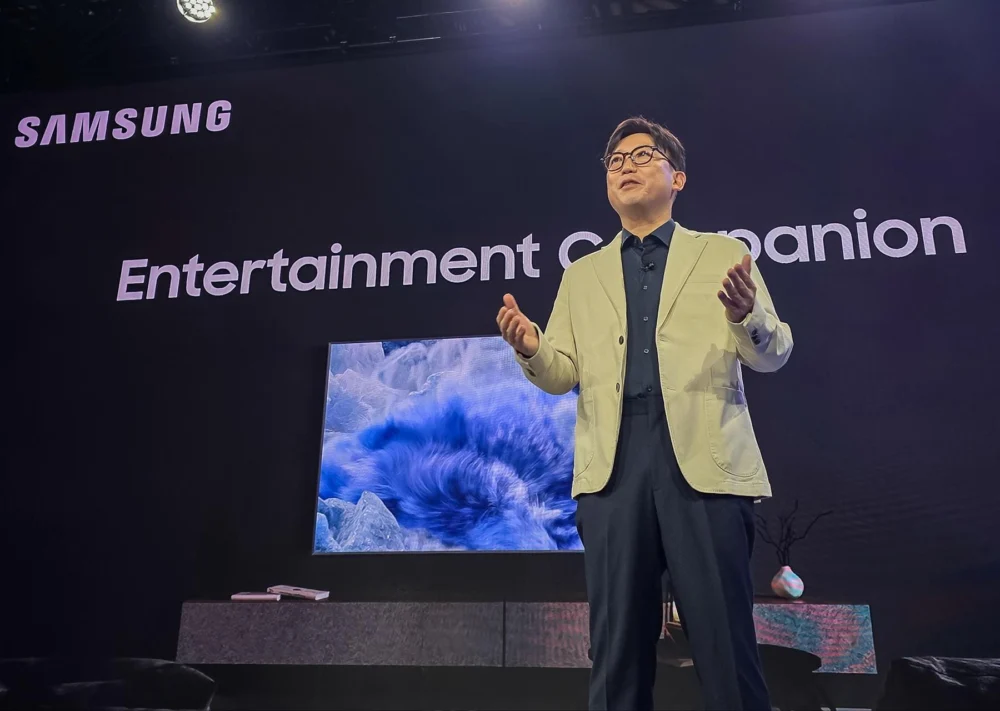
In recent discussions regarding the company’s trajectory, Seok Woo Yong, Corporate President and Head of Visual Display Business at Samsung—widely known in the industry as SW Yong—has been candid about the challenges ahead. Despite Samsung’s formidable lead in the premium sector, Yong acknowledges that the industry is facing significant "headwinds." Demand in certain sectors remains subdued, and perhaps more importantly, the underlying technology of television manufacturing has reached a level of standardization that threatens to commoditize the product. When every manufacturer can source high-quality panels and offer 4K resolution, the "distinct differences" in product quality begin to blur. To avoid this trap of commoditization, Samsung is pivoting its entire strategy around two pillars: the perfection of Micro RGB (MicroLED) hardware and the total integration of Artificial Intelligence.
The hardware evolution is spearheaded by Micro RGB, a technology that many industry insiders believe will eventually render OLED obsolete. While OLED has long been the darling of videophiles due to its perfect blacks and infinite contrast, it is an organic technology subject to degradation and brightness limitations. Micro RGB, by contrast, uses microscopic, non-organic LEDs that provide their own light and color. This allows for the same perfect black levels as OLED but with significantly higher peak brightness, a wider color gamut, and a much longer lifespan without the risk of "burn-in." Samsung introduced Micro RGB as its flagship premium category in late 2025 and is now aggressively expanding the lineup. By miniaturizing these components, Samsung is moving toward a future where the "screen" is no longer a fixed object, but a modular, scalable surface that can fit any architectural space.
Simultaneously, the company is doubling down on Mini LED technology for the mass market. By using thousands of tiny backlights instead of a few dozen local dimming zones, Samsung’s Neo QLED range provides a bridge between traditional LCDs and the ultra-premium Micro RGB sets. This two-tiered hardware approach allows the company to defend its entry-level market share against rising competition while maintaining an aspirational "halo" product at the top of the pyramid.
However, the most significant shift in Samsung’s philosophy is the move from "Hardware First" to "AI First." The company is currently engaged in a massive branding effort to establish a new industry equation: "AI TV equals Samsung." This is not merely marketing hyperbole; it represents a fundamental change in the internal processing architecture of the television. Modern TVs are no longer just display monitors; they are high-performance computers dedicated to image reconstruction.
The practical applications of this AI integration are already manifesting in features like AI Upscaling and the AI Motion Enhancer. As consumers move toward larger and larger screens—with 85-inch and 98-inch models becoming increasingly common in living rooms—the flaws in low-resolution content become glaringly obvious. Samsung’s neural processing units (NPUs) use deep learning to analyze content in real-time, referencing a vast database of visual patterns to "fill in" missing pixels. This ensures that even legacy content or standard-definition broadcasts look crisp on an 8k or 4k panel.

The AI Motion Enhancer is perhaps even more critical for the upcoming 2026 sports cycle. High-speed motion, such as a football traveling across a pitch or a racing car pivoting through a corner, often suffers from "judder" or motion blur on digital displays. Samsung’s AI algorithms predict the path of moving objects and insert synthetic frames with such precision that the human eye perceives perfectly fluid motion without the dreaded "soap opera effect" that plagued earlier motion-smoothing technologies.
Looking further into the horizon, the vision for the next 20 years of television is even more transformative. SW Yong suggests that the industry is moving away from "one-way consumption" toward "interactive connectivity." This evolution is heavily influenced by the concept of "generative interfaces," a term popularized by figures like Demis Hassabis of Google DeepMind. In this future model, the traditional grid of apps and menus disappears. Instead of a user navigating through Netflix, Disney+, and YouTube to find a show, the AI interface acts as a proactive concierge.
Under this generative model, the television becomes an ambient part of the home. Users may no longer use a remote control at all, instead relying on sophisticated voice commands or even gesture-based intent. The AI will not just find a program; it will create a customized user interface on the fly based on the user’s current mood, time of day, or specific request. Imagine a scenario where a user says, "I want to watch a summary of today’s sports news while I eat breakfast," and the TV automatically assembles a personalized news feed, adjusting the brightness to account for the morning sun and focusing the audio specifically toward the kitchen table using beam-forming technology.
This level of personalization extends to the very aesthetics of the device. Samsung’s Tizen operating system is being retooled to support these AI-driven experiences, allowing screens to blend into the background when not in use—a concept Samsung pioneered with "The Frame" and "Ambient Mode," but which is now being supercharged by generative art. The screen of the future may be part of virtually every space in a home, functioning as a window, a piece of art, or a workspace, depending on the immediate need of the inhabitant.
The sonic experience is also undergoing a silicon-led revolution. Samsung’s proprietary technologies, such as Q-Symphony and Eclipsa Audio, use AI to analyze the acoustic properties of a room. By syncing the TV’s built-in speakers with external soundbars and even mobile devices, the system creates a three-dimensional "sound bubble." For the growing segment of home cinema enthusiasts and gamers, this level of immersion is becoming just as important as raw pixel count.
Speaking of gaming, the demand for high-performance, gaming-optimized displays is one of the fastest-growing sectors of the market. Samsung has recognized that for Gen Z and Gen Alpha consumers, the TV is primarily a gaming monitor. This has led to the integration of cloud gaming hubs directly into the Tizen OS, allowing users to stream AAA titles without a console. The AI here plays a vital role in reducing input lag and optimizing HDR settings on a per-game basis, ensuring that the display reacts as fast as the player’s reflexes.
As Micro RGB technology matures and costs eventually scale down, it will likely become the standard for this ultra-high-performance gaming and sports viewing. SW Yong notes that the industry-wide interest in Micro RGB is a signal that the market is ready for a new premium category. Samsung’s goal is to ensure that their version of this technology remains the gold standard by infusing it with their most advanced AI-driven picture and sound enhancements.
Ultimately, Samsung’s strategy for the next two decades is built on the realization that hardware dominance is temporary, but ecosystem and intelligence are "sticky." By positioning the TV as the central hub of the smart home—a device that doesn’t just show pictures but understands the user’s environment and preferences—Samsung is attempting to redefine the very nature of the "hearth" in the modern home. The 20-year milestone of market leadership is a testament to their past engineering prowess, but the "AI TV" initiative is their blueprint for surviving a future where the screen is everywhere and the interface is invisible. As we approach the 2026 World Cup and beyond, the battle for the living room will not be won by the company with the biggest factory, but by the company with the smartest silicon.