

For half a century, the red dust of Mars has been the exclusive playground of American ingenuity. From the pioneering Viking landers of the 1970s to the sophisticated, semi-autonomous rovers of the modern era, NASA has systematically dismantled the mysteries of our neighbor planet. To the casual observer, the Martian surface is a sterile, radiation-blasted void—a "nightmarish ocher desert." But to the planetary scientist, it is a vast, frozen archive. The rocks scattered across its basins are crystal-filled time capsules, preserving the chemical signatures of a world that, billions of years ago, boasted rivers, lakes, and perhaps even vast, churning oceans.

In July 2024, the search for life reached a fever pitch. The Perseverance rover, exploring the ancient river delta of Jezero Crater, encountered a rocky outcrop that stopped scientists in their tracks. This was no ordinary sedimentary layer. It was covered in tiny, distinct spots—some resembling poppy seeds, others mimicking the rosettes of a leopard. On Earth, these "leopard spots" are a geological smoking gun; they are almost exclusively produced through chemical reactions facilitated by microbial life. While not yet definitive proof of extraterrestrial biology, the discovery was the most significant hint to date that life might not be a terrestrial fluke. It was a moment that promised to redefine human history.
However, a discovery of this magnitude requires more than remote sensing. To confirm the presence of fossilized alien microbes, these rocks must be brought home to the world’s most sophisticated laboratories. This was the impetus for the Mars Sample Return (MSR) mission, a multi-stage "space heist" involving NASA and the European Space Agency (ESA). But just as the finish line came into view, the American effort began to fracture under the weight of mismanagement, soaring costs, and shifting political winds. Now, as the U.S. program sits on life support, China is moving with predatory efficiency to seize the crown. The race to solve the most existential question in science—Are we alone?—has transformed into a high-stakes geopolitical drama.

The Complexity of the Heist
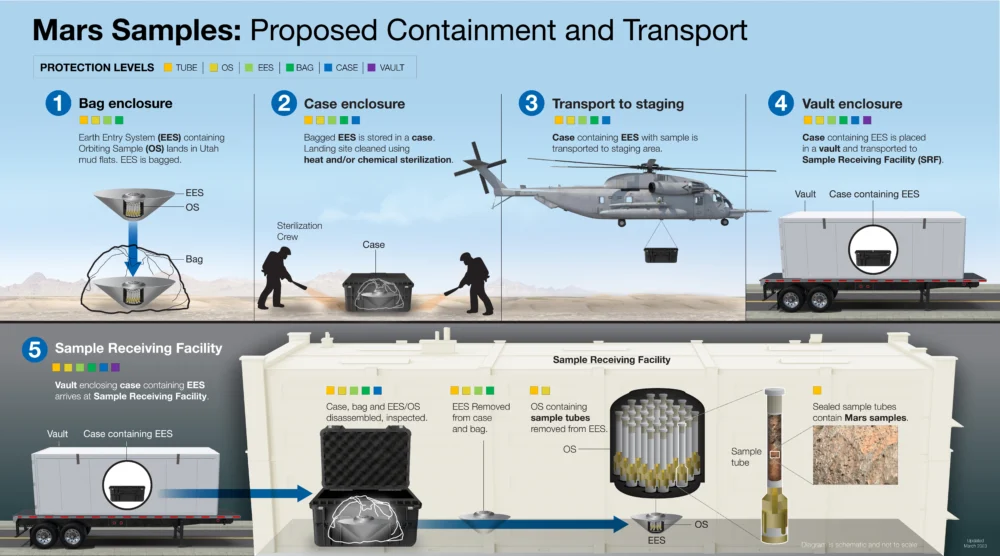
The original MSR architecture was a masterpiece of robotic choreography. It required three distinct phases: first, a rover (Perseverance) to cache samples; second, a lander to retrieve those samples and launch them into Martian orbit; and third, an orbiter to catch that "space baseball" and ferry it back to Earth. The complexity was often compared to a Rube Goldberg machine, yet it was deemed necessary to ensure the samples remained pristine and bio-secure.
The scientific stakes cannot be overstated. While NASA has successfully analyzed Martian soil in situ, rover-based instruments are limited by size, power, and sensitivity. "We currently have no rocks from Mars that are sedimentary—the rock type likely to contain fossils," notes Sara Russell, a planetary scientist at London’s Natural History Museum. Meteorites that have reached Earth from Mars are valuable but "contaminated" by their violent journey through space and our own atmosphere. A pristine sample from Jezero Crater would allow scientists to use room-sized mass spectrometers and synchrotrons to hunt for the faint, billion-year-old ghosts of Martian biology.

Yet, by late 2023, the dream began to sour. An independent review board issued a blistering report, revealing that MSR was "organized under an unwieldy structure" with "unrealistic budget and schedule expectations." The price tag had ballooned from an initial $5 billion to a staggering $11 billion, with a return date slipping into the 2040s. In the halls of Congress, the appetite for a decade-long, multi-billion-dollar gamble began to vanish.
The Dragon’s Ascent
While Washington grappled with audits and budget caps, Beijing was executing a masterclass in incremental progress. China’s space program, once viewed as a laggard, has achieved more in the last decade than most nations have in fifty. The Chang’e project successfully returned samples from the moon—including the first-ever samples from the lunar far side—demonstrating a mastery of the very "catch-and-return" mechanics required for Mars.

In 2020, China launched Tianwen-1, a mission that achieved an orbiter, lander, and rover arrival in a single stroke—a feat of "spaceflight acrobatics" that no other nation had accomplished on its first attempt. This was merely the prologue. In June 2025, Chinese researchers formally unveiled the blueprint for Tianwen-3. The goal is audacious: to return at least 500 grams of Martian material to Earth by 2031.
The Chinese approach is notably leaner than the NASA-ESA collaboration. Rather than a multi-decade roving mission across diverse terrains, Tianwen-3 will likely focus on a single, high-probability site. Using a combination of a lander, a drill capable of reaching seven feet beneath the surface, and even a small scouting helicopter, the mission aims to snatch-and-grab samples before the U.S. can even finalize its redesigned architecture. "Being there first is what matters," laments Philip Christensen, a planetary scientist at Arizona State University. If China returns samples in 2031, the scientific journals and history books will belong to them, regardless of whether the U.S. eventually brings back a "higher quality" haul in the 2040s.

Geopolitical Fallout and the "America Undone" Narrative
The potential loss of leadership in Martian exploration is more than a blow to scientific ego; it is a symptom of a broader crisis in American innovation. Under the "America First" agenda and subsequent budgetary contractions, NASA’s science division has been pushed to the brink. A proposed 2026 budget threatened to give the agency its smallest inflation-adjusted funding since 1961, potentially forcing the termination of nearly 20 active missions.
This "demoralization of the science community," as Christensen puts it, has profound implications for national security and the future of the aerospace industry. Space has always been a proxy for soft power and technological supremacy. If the United States—the nation that put men on the moon and rovers on the red desert—cannot figure out how to bring a box of rocks home, it raises uncomfortable questions about its ability to execute the next great leap: human colonization.

"If you’re going to bring humans back from Mars, you sure as shit have to figure out how to bring the samples back first," says Paul Byrne, a planetary scientist at Washington University in St. Louis. The MSR mission is a vital dress rehearsal for the life-support systems, ascent vehicles, and orbital rendezvous technologies required to keep astronauts alive. By ceding this ground, the U.S. risks showing up to Mars only to find a Chinese flag already planted at the most resource-rich sites.
Industry Implications: The Pivot to Commercial Partners
In a desperate bid to save the program, NASA has turned to the private sector. In early 2025, the agency previewed options for a "faster, cheaper" MSR. One proposal involves using the "sky crane" technology—the hovering platform that successfully landed Perseverance—to drop a simplified sample-retrieval lander. Another suggests leveraging commercial heavy-lift rockets, such as SpaceX’s Starship or Lockheed Martin’s specialized ascent vehicles, to bypass the traditional, slow-moving procurement cycles.

This shift toward a commercial-centric model represents a new era in planetary exploration. If the private sector can drive the cost down to a more palatable $8 billion, MSR might survive. But the clock is ticking. Every month of Congressional indecision is another month China gains. The "leaner" Chinese architecture is already in production, unencumbered by the same level of public audit and political vacillation that defines American federal spending.
The Future of the Red Planet
The most heartbreaking scenario for American scientists is one of "orbital observation." It is entirely possible that by the early 2030s, the Perseverance rover—still functional but running low on power—will point its high-resolution Mastcam-Z toward the Martian sky. It might catch a glimpse of a small, bright spark ascending from the horizon: the Tianwen-3 return vehicle, carrying the first-ever evidence of life beyond Earth back to a laboratory in Hefei.

Meanwhile, the carefully sealed sample tubes left by Perseverance—the ones containing those tantalizing leopard spots—would remain on the surface, slowly disappearing under a layer of fine, red dust. They would become monuments to a missed opportunity, a testament to a time when the world’s leading space power lost the will to "dare mighty things."
The search for life is not just a quest for biological data; it is a test of a civilization’s endurance and vision. As China ramps up its Tianwen-2 mission to an asteroid and prepares for its 2031 Martian return, the global scientific community is watching. The transition of leadership in space exploration may not happen with a bang, but with the quiet closing of a budget book in Washington and the roar of a Long March rocket in Hainan. For the American planetary science community, the question is no longer just "Are we alone?" but "Are we still in the lead?" If the answer to the latter is no, the answer to the former may well be written in a language other than English.