

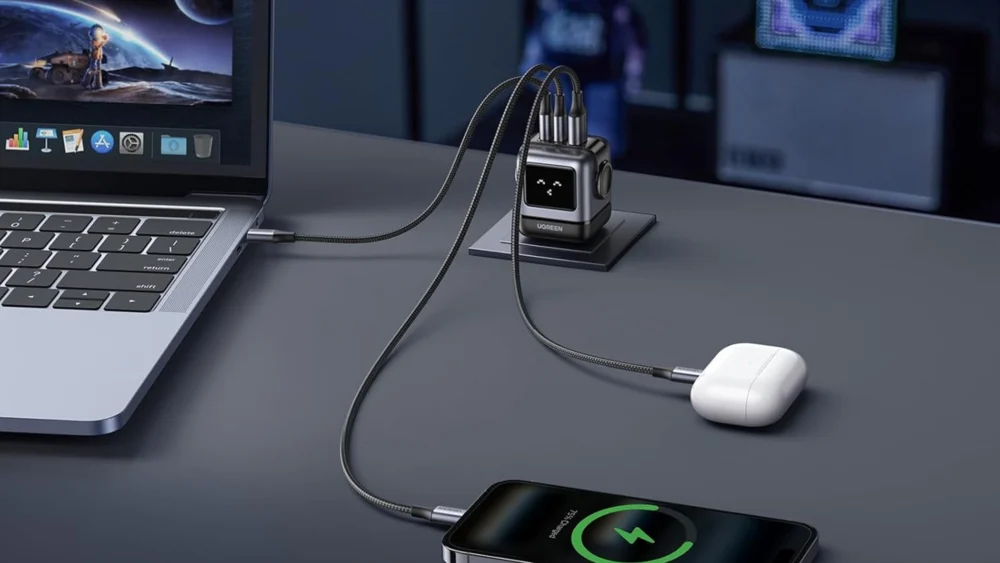
The relentless march toward consolidation in personal electronics charging infrastructure continues, driven by innovations in semiconductor technology. The widespread adoption of Gallium Nitride (GaN) components has fundamentally reshaped the power adapter landscape, delivering unprecedented power density and thermal efficiency. A recent market event underscores this trend: the UGREEN Uno 65W charger, a device distinguished not only by its technical specifications but also by its distinctly non-traditional, anthropomorphic design, has seen a significant price reduction, settling around the $34.49 mark for eligible consumers. This development signals a crucial inflection point where cutting-edge charging technology transitions from a niche premium offering to a readily accessible commodity, even when wrapped in a novel aesthetic package.
The Technological Underpinnings: Why GaN Matters
To fully appreciate the significance of a 65W multi-port charger available at this price point, one must first understand the paradigm shift represented by GaN. Traditional chargers rely on silicon-based MOSFETs, which, while reliable, possess inherent limitations regarding switching frequency and operational temperature. As device manufacturers demanded faster charging speeds (e.g., 100W and beyond) while simultaneously demanding smaller form factors, silicon reached its physical constraints.
Gallium Nitride, a wide-bandgap semiconductor material, bypasses these limitations. GaN transistors can operate at significantly higher voltages, handle much higher switching frequencies, and manage heat far more effectively than their silicon counterparts. This translates directly into smaller, lighter power bricks that generate less waste heat for the same power output. The UGREEN Uno, delivering 65W across three ports (two USB-C, one USB-A), is a direct beneficiary of this miniaturization. A silicon-based charger capable of reliably delivering 65W while maintaining a compact footprint would typically be bulkier and considerably more expensive.
The 65W threshold itself is strategically important. It represents the sweet spot for modern productivity. This wattage is sufficient to fast-charge most premium smartphones (often achieving 50% to 80% capacity in under 30 minutes, depending on proprietary protocols), while also being capable of sustainably powering mainstream ultrabooks, such as the latest MacBook Air variants or high-end Windows notebooks designed for portability. The capability to simultaneously charge a laptop and a primary mobile device from a single, small outlet plug alleviates significant travel and desktop clutter—the primary pain point these consolidated chargers aim to solve.
Design as a Differentiator in a Saturated Market
The power accessory market is intensely competitive, dominated by established giants and a proliferation of agile third-party manufacturers. In this crowded field, technical specifications alone are often insufficient to capture consumer attention. This is where the UGREEN Uno introduces its unique selling proposition: its aesthetic divergence.
The device is reportedly styled to resemble a "tiny robot," complete with a display capable of showing dynamic expressions correlated to its charging status—be it active charging, idle, or fully powered. This anthropomorphic element transforms the charger from a utilitarian component into a piece of desk décor or a conversation starter. For a journalist analyzing the consumer technology space, this move is fascinating. It reflects a maturing segment where emotional resonance and personalization begin to compete with raw performance metrics.
In previous hardware generations, customization often meant different color options for standard rectangular blocks. The adoption of overtly playful, expressive industrial design suggests manufacturers are targeting younger demographics or professionals seeking to inject personality into otherwise sterile workspace environments. The inclusion of magnetic feet further suggests an attention to usability beyond mere power delivery, aiding in cable management and ensuring the unit remains securely placed on metallic surfaces—a subtle but appreciated ergonomic detail.
Industry Implications: The Democratization of High-Density Power
The price point of $34.49 for a 65W GaN charger with three ports is not merely a good deal; it reflects a fundamental shift in the supply chain economics of GaN technology. When GaN chargers first emerged, they often commanded prices well over $80 or $100. This steep reduction indicates several critical industry developments:
- Scaling of GaN Manufacturing: As more semiconductor fabs integrate GaN processes and production volumes increase, the cost per wafer and per component naturally decreases. This economy of scale is now being passed down to the end-consumer.
- Intensified Competition: The proliferation of brands like UGREEN, Anker, and numerous others has driven aggressive pricing strategies. To maintain market share, manufacturers must compete on price while avoiding a race to the bottom that sacrifices safety or reliability.
- Protocol Standardization: While proprietary fast-charging protocols exist (like Qualcomm Quick Charge or specialized OEM standards), the increasing dominance of USB Power Delivery (USB-PD) allows manufacturers to deploy standardized, widely compatible components, simplifying design overheads.
This trend signals the end of the era where high-speed, multi-port charging was an extravagance. For consumers, it lowers the barrier to entry for adopting high-efficiency charging across all their portable devices. An individual can now realistically replace three or four older, bulkier silicon chargers—one for their laptop, one for their phone, perhaps a third for earbuds or a tablet—with a single, significantly smaller unit for under forty dollars.
Expert Analysis: Power Distribution and Protocol Management
A critical technical consideration for any multi-port charger is how it intelligently allocates power when multiple devices are connected. A poorly managed charger might default to low-power output across all ports, negating the benefit of the 65W peak capability.
For the UGREEN Uno, the stated capacity implies a sophisticated internal power management circuit. Typically, in a 65W system:
- Single Port Use (USB-C1): Up to 65W.
- Dual Port Use (USB-C1 + USB-C2): The total power is capped at 65W, often split dynamically (e.g., 45W/20W or 30W/35W), depending on which devices request priority according to the USB-PD negotiation handshake.
- Triple Port Use (C1 + C2 + USB-A): The total distribution becomes even more complex, often limiting the primary port to accommodate the secondary and tertiary devices.
The success of this charger hinges on the reliability of its firmware executing these power-sharing protocols accurately and quickly. In the context of charging sensitive lithium-ion batteries, inconsistent power delivery can lead to reduced battery lifespan or overheating. The expectation, given the established reputation of reputable third-party accessory makers, is that this unit incorporates necessary safety mechanisms: over-voltage protection (OVP), over-current protection (OCP), and short-circuit protection (SCP). The GaN architecture inherently aids thermal management, reducing the risk of failure due to heat buildup, which is a common weak point in older, densely packed silicon chargers.
Future Trajectory: Integration and Intelligent Energy Management
The UGREEN Uno, with its blend of high efficiency, multi-port utility, and unusual design, serves as a microcosm of where consumer power solutions are headed. We can anticipate three primary vectors of evolution stemming from this market movement:
1. Further Miniaturization and Increased Wattage: As GaN technology matures (moving towards next-generation wide-bandgap materials like Silicon Carbide, though GaN remains dominant for this power class), the practical limit for a wall-wart charger will likely increase to 100W or 120W while maintaining the current size envelope. This will allow users to reliably fast-charge even high-performance gaming laptops or multiple high-draw devices simultaneously from a device the size of a standard phone adapter.
2. Enhanced User Interface and Diagnostics: The expressive screen on the Uno is an early foray into making the charger communicative. Future iterations will likely incorporate true diagnostic capabilities accessible via companion apps, perhaps using Bluetooth or Wi-Fi. Users could monitor real-time power draw, track battery health metrics influenced by charging patterns, and receive proactive alerts about connection issues—moving the charger from a passive peripheral to an active node in the smart home energy ecosystem.
3. Sustainability and Modular Design: While the current deal focuses on affordability, consumer awareness regarding e-waste is rising. The next frontier for these compact chargers will involve modularity—allowing users to replace only the detachable power cable or the internal GaN module if a specific component fails, rather than discarding the entire unit. This aligns with broader industry pushes toward circular economy principles within consumer electronics.
In conclusion, the $34.49 price point for the UGREEN Uno 65W GaN charger is more than just a fleeting discount; it is a concrete indicator that sophisticated, powerful, and space-saving charging technology has become mainstream. While the "cute robot" exterior offers consumer appeal and personalization, the underlying technological efficiency—driven by GaN advancements—is what truly validates this product category as the future standard for portable power delivery. The convergence of high performance, compact size, multi-port capability, and affordability is rapidly eliminating the need for bulky, single-purpose charging bricks across the digital consumer landscape.