

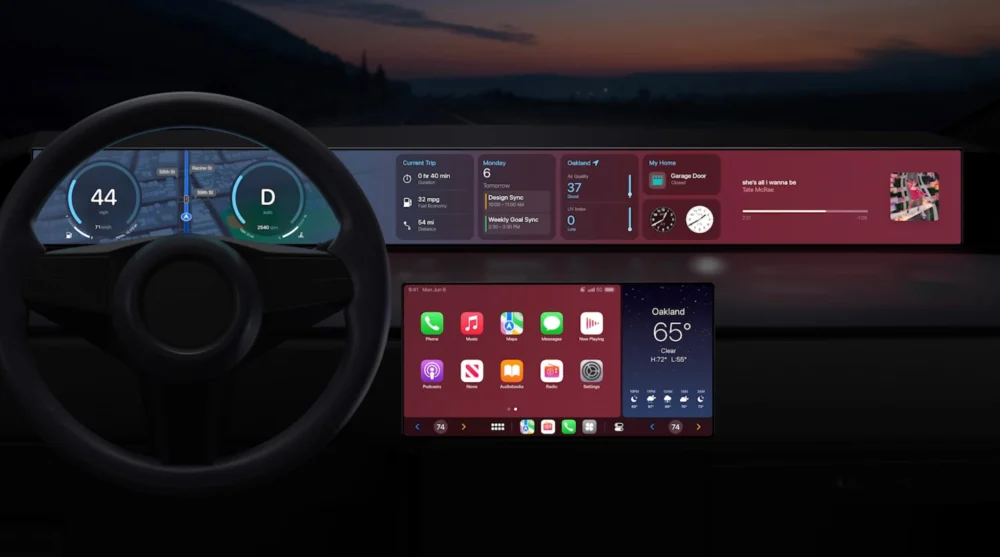
The traditional boundaries of the automotive voice assistant are rapidly dissolving, driven by the seismic capabilities of Generative Artificial Intelligence (AI). Apple, a long-standing gatekeeper of its proprietary ecosystem, is reportedly preparing for a significant strategic pivot that acknowledges this reality: opening its ubiquitous CarPlay platform to external, advanced Large Language Models (LLMs) such as OpenAI’s ChatGPT, Google’s Gemini, and Anthropic’s Claude. This move is not merely a feature update; it represents a fundamental re-evaluation of Apple’s long-term platform strategy within the burgeoning connected car sector, potentially repositioning the company’s own voice assistant, Siri, from the central cockpit command to a background utility function.
For over a decade, Apple CarPlay has served as the essential bridge between the mobile device and the vehicle’s infotainment stack. Operating as a sophisticated projection system, CarPlay mirrors core iPhone functionalities—navigation, messaging, media playback—onto the car’s central display, ensuring a familiar, safety-optimized interface accessible primarily through touch commands and the native voice assistant. Siri has historically been the sole arbiter of voice interaction within this environment, capable of handling transactional requests like sending a dictated text, initiating a phone call, or navigating to an address.
However, the rapid maturation of generative AI has exposed the inherent limitations of these older, rule-based assistants. Siri, while dependable for simple tasks, struggles profoundly with complex, multi-step queries, nuanced contextual understanding, and creative problem-solving—precisely the domains where modern LLMs demonstrate transformative power. The integration of cutting-edge generative models into the CarPlay framework would allow drivers and passengers to engage in conversational, non-linear interactions, unlocking capabilities far beyond traditional command-and-control functions. The ability to ask, "Summarize the key plot points of the book I was listening to earlier, then find the nearest gas station that sells premium fuel and has highly-rated coffee," necessitates the deep reasoning and context switching that only a powerful LLM can deliver.
The Architectural Necessity: CarPlay Ultra and Platform Expansion
This transition is inextricably linked to the planned rollout of the next generation of the system, often referred to by industry observers as "CarPlay Ultra" or "Next-Generation CarPlay." Current CarPlay is constrained by its projection architecture; it merely overlays the vehicle’s operating system. The forthcoming iteration, however, is designed for deeper integration, capable of taking over the instrument cluster, digital dashboard, and even accessing critical vehicle controls like climate management and seat settings.
For Apple to justify this comprehensive integration and convince automakers to cede control over vital dashboard real estate, the user experience must be revolutionary. Simply offering a slightly better version of Siri would not suffice. The decision to integrate third-party LLMs transforms CarPlay Ultra from a mere interface upgrade into a true automotive operating system replacement, powered by the most sophisticated conversational intelligence available on the market, regardless of its origin.
This strategic concession highlights Apple’s prioritization of platform dominance over proprietary technology purity. If users find Google’s Gemini or OpenAI’s models significantly more useful in their daily lives, forcing them to use an inferior, proprietary Apple alternative (Siri) within the vehicle risks driving users toward competing platforms like Android Auto, or, more critically, toward vehicles that offer native, deeply integrated LLM capabilities, such as those being developed by Tesla or dedicated automotive software suites. By acting as the unified gateway, Apple maintains control over the hardware and the user interface standards, effectively leveraging the innovation velocity of its competitors to strengthen its own ecosystem.
Industry Implications: The Controlled Openness Model
The move is not without precedent in the broader tech ecosystem, but it is revolutionary for Apple in such a high-stakes environment as the connected car. It signifies a strategic shift toward a "controlled openness" model. Apple remains the gatekeeper, setting the standards for how these LLMs interact with the driver and the vehicle, particularly concerning safety and data privacy.
Competitive Dynamics: The introduction of third-party LLMs dramatically alters the competitive landscape.
- Siri’s Relegation: Siri will likely remain for core, transactional device functions (setting timers, opening first-party apps), but its role as the primary knowledge and reasoning engine will be minimized. This necessitates a significant strategic pivot for the Siri development team, perhaps focusing it solely on deep device integration rather than general knowledge retrieval.
- Google’s Challenge: Google, which is aggressively pushing Gemini across its mobile and automotive offerings, faces a dual challenge. While their model gains access to the massive CarPlay user base, they must now compete on Apple’s terms regarding interface and integration limitations, potentially limiting how deeply Gemini can hook into the core vehicle functions compared to its integration within native Android Auto or Android Automotive OS.
- Developer Opportunity: For companies like OpenAI and Anthropic, this represents a crucial opportunity to establish their conversational models as the dominant in-car intelligence layer, a highly coveted domain given the amount of time consumers spend in vehicles.
Safety and Regulatory Scrutiny: Integrating advanced, potentially unpredictable generative models into a safety-critical environment like a moving vehicle presents massive regulatory and technical hurdles.
LLMs are prone to "hallucinations" and can generate lengthy, highly engaging, but potentially distracting content. Apple, in collaboration with regulatory bodies like the National Highway Traffic Safety Administration (NHTSA) in the US, will need to define strict safety APIs (Application Programming Interfaces). These APIs must enforce constraints on output length, complexity, and content type when the vehicle is in motion. For instance, the system must ensure that an LLM’s response to a complex itinerary query is delivered concisely and audibly, rather than requiring the driver to read a multi-paragraph text summary on the screen. Furthermore, access to critical vehicle controls (e.g., braking systems or engine management) must remain strictly segregated from the third-party LLM environment. The integration architecture will likely be a sandbox environment, providing LLMs with controlled access to non-critical vehicle parameters (like climate and navigation inputs) while maintaining Apple’s strict control layer for safety assurance.
Expert Analysis: Technical Complexities and Data Sovereignty
The technical challenges inherent in this integration are substantial, requiring more than just linking an API. The conversational experience in a car must be near-instantaneous. Cloud-based LLMs require significant bandwidth and low latency, which can be challenging in areas with poor cellular coverage.
Latency and Processing: A key architectural decision for Apple will be determining the division of labor between the device (iPhone/CarPlay unit) and the cloud. While massive LLMs like GPT-4 must reside in the cloud due to computational requirements, the trend toward smaller, optimized on-device models is accelerating. Apple may mandate that partner LLMs utilize smaller, highly efficient models for pre-processing or quick responses, reserving cloud processing for complex, deeply reasoned requests. This hybrid approach—leveraging local processing for low-latency interactions and cloud power for deep intelligence—is essential for meeting automotive safety standards that prioritize immediate response times.
Data Privacy and Monetization: The question of data sovereignty becomes central. When a user asks Gemini a question via CarPlay, who owns the resulting data stream? Does Apple, as the platform intermediary, receive anonymized usage data? Do the LLM providers gain valuable, high-fidelity data about driving habits, location, and in-car context?
Apple has historically built its brand around robust user privacy. Any integration strategy must ensure that user data remains protected and that the LLM providers cannot indiscriminately harvest detailed driving patterns or conversational content for commercial targeting. The contractual agreements between Apple and the LLM developers will likely be highly restrictive, defining precise limits on data utilization and retention, ensuring Apple remains the trusted intermediary between the user’s data and the third-party AI service. This control is critical not just for privacy, but for maintaining user trust in the CarPlay ecosystem itself.
The Future Impact: Personalized, Contextualized Mobility
The successful integration of advanced LLMs promises a radical transformation of the driving experience, moving beyond mere convenience to offering truly contextualized and personalized mobility assistance.
- Proactive Assistance: LLMs can analyze calendar data, real-time traffic, and vehicle diagnostics simultaneously. Instead of the driver asking, "Where am I going?" the LLM could proactively suggest, "Traffic is heavy on your route to the 2 PM meeting. Would you like me to find a co-working space closer to your current location where you can hold the meeting virtually?"
- Complex Diagnostics and Repair: Future applications could see drivers speaking naturally to their vehicle’s systems. If a warning light appears, instead of consulting a manual, the driver could ask, "Explain exactly what the flashing engine light means in non-technical terms, and list the three nearest certified repair shops that have availability this afternoon." The LLM, integrating vehicle sensor data with vast external knowledge bases, delivers the answer.
- In-Car Education and Entertainment: For passengers, especially in autonomous or semi-autonomous vehicles, the LLM integration means having a true conversational companion capable of providing real-time historical commentary on landmarks, generating personalized trivia games, or even helping students with homework assignments during a long commute.
This strategic move by Apple to embrace third-party LLMs is an inflection point for the entire automotive technology industry. It signals a tacit acknowledgment that no single company can maintain supremacy in the rapidly evolving field of generative AI. By opening the CarPlay gate, Apple ensures that its automotive platform remains relevant, highly functional, and future-proofed, leveraging external intelligence to solidify its dominant position in the driver interface market. The road ahead for the connected car is now definitively paved with the conversational prowess of generative AI, and Apple is positioning itself squarely as the essential infrastructure provider.