

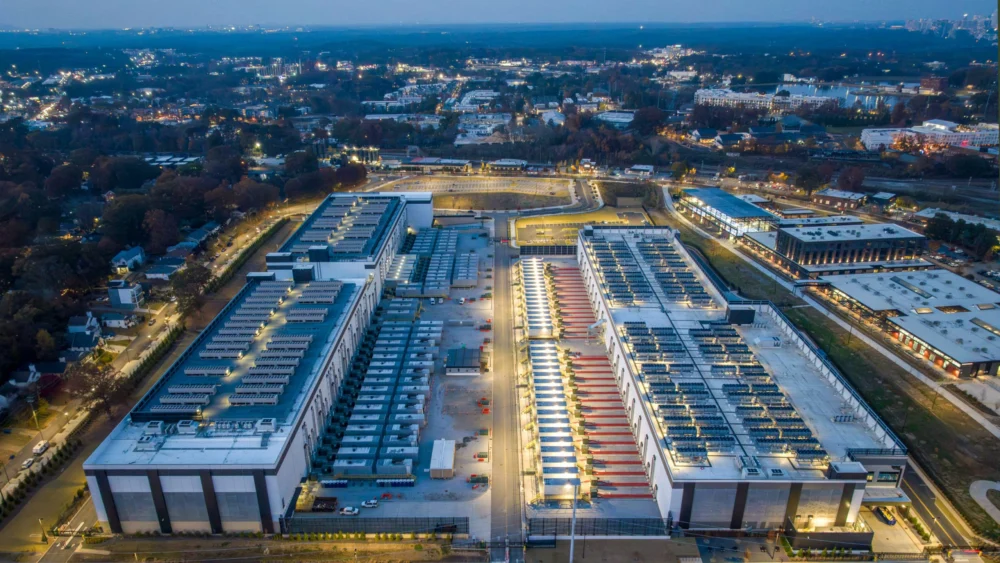
The modern hyperscale data center represents the apex of current industrial engineering, a physical manifestation of the global sprint toward artificial intelligence dominance. These aren’t merely server farms; they are specialized, purpose-built computational factories. Within structures spanning millions of square feet—constructed from immense quantities of reinforced steel, concrete, and aluminum—reside hundreds of thousands of interconnected, high-performance computing units. The sheer density of processing power required to train and run foundation models means that the core component—the specialized graphics processing unit (GPU)—has become one of the most valuable commodities in the global tech ecosystem, with individual chips commanding prices exceeding $30,000 in the open market.
These facilities are designed to operate at extreme efficiency, processing vast quantities of data—often measured in hundreds of thousands of tokens per second—which are the atomic units of large language models. The operational complexity extends far beyond the processors themselves. Generating hundreds of megawatts of continuous electrical demand, these sites create unprecedented thermal load. Consequently, the cooling infrastructure—often involving sophisticated liquid cooling or advanced adiabatic systems—must be an engineering triumph in its own right to maintain operational integrity, adding layers of expense, resource consumption, and technical challenge.
This incredible centralization of digital power has driven a massive infrastructure investment cycle across the United States, yet this technological necessity is colliding head-on with local political realities, generating a profound and growing backlash.
The State of Georgia provides a particularly illuminating case study of this conflict. A politically diverse battleground state, Georgia has witnessed an astonishing surge in data center development, rivaling even Northern Virginia’s legendary "Data Center Alley." This growth was not accidental; it was actively solicited. In 2018, the Georgia General Assembly implemented a suite of aggressive tax incentives, including sales and use tax exemptions on computer systems and cooling equipment, property tax abatements, and job creation credits, effectively rolling out the red carpet for major cloud and AI operators. The result was an infrastructure boom.
However, the political calculus underlying these incentives failed to account for the resulting strain on public utilities. As the centers materialized, drawing immense power, localized energy grids were pushed to their limits, necessitating significant utility infrastructure upgrades. These costs, coupled with the centers’ continuous high demand, contributed directly to rising electricity bills for residential and commercial customers. This energy inflation became a flashpoint, culminating in a highly contentious Public Service Commission election that saw incumbents facing unexpected challenges rooted largely in consumer outrage over utility costs. The political consequence was clear: the economic benefit promised by the industry was being nullified by the visible, monthly financial burden placed upon everyday citizens.
The pushback against specific projects illustrates the depth of community frustration. Consider the events in Monroe County, Georgia, a semi-rural area near Atlanta. Local authorities were tasked with reviewing the rezoning of nearly 900 acres for a massive new data center campus near the small community of Bolingbroke. Despite the developers’ promises of millions in tax revenue, commitment to environmental standards, and economic prosperity, the proposal met with overwhelming, organized opposition. A public meeting drew nearly a thousand residents who voiced near-unanimous rejection of the plan. In a rare victory for local sentiment, the county commission ultimately voted against the development, reversing the usual trend where local officials acquiesce to powerful corporate interests, as had happened in neighboring Twiggs County.
Why are these facilities—heralded by the industry as the engine room for the next era of human prosperity, capable of powering everything from medical breakthroughs to fully autonomous systems—met with such visceral, widespread hostility? The answer lies in a combination of tangible negative externalities and a deeper, more abstract societal anxiety.
The Material Costs: Power, Water, and Noise
The most immediate concerns are rooted in resource consumption and environmental impact.
Energy Drain and Grid Stability: The exponential growth in demand for AI compute power has fundamentally altered long-term energy planning for utilities nationwide. A single, large-scale AI data center can demand hundreds of megawatts—an energy load equivalent to a medium-sized city. In states like Wyoming, the energy required for a planned hyperscale facility could easily surpass the combined consumption of all residential households in the state. While utilities must add capacity to accommodate this demand, the cost structure often dictates that local consumers partially subsidize the infrastructure necessary to serve private, highly profitable tech companies. This perception of private gain subsidized by public cost is a key driver of resentment.
Environmental Impact and Resource Scarcity: Beyond energy, water consumption is a critical variable. Data centers require vast amounts of water for evaporative cooling systems, especially in warmer climates. While the precise usage varies significantly based on cooling technology and climate, and often remains commercially secretive, the scale of demand exacerbates existing water scarcity issues, particularly in the American West and Southwest. This lack of transparency has prompted legislative action in several states aiming to mandate public disclosure of water usage statistics, recognizing that water, unlike bandwidth, is an inherently finite resource.
Furthermore, the pressure to bring massive amounts of power online quickly sometimes leads developers to prioritize expediency over sustainability. The infamous example of utilizing polluting, methane-powered generators to supply initial power to a supercomputer facility in Memphis highlights the willingness of some AI companies to employ "dirty" energy sources when clean alternatives are not immediately scalable. While the long-term solution often points toward nuclear power—specifically Small Modular Reactors (SMRs)—the reality is that even next-generation nuclear technology faces multi-year permitting and construction timelines, failing to meet the immediate, ravenous demand of AI training clusters.
Finally, there is the often-overlooked acoustic pollution. Data centers are not silent neighbors. They produce a constant, low-frequency hum generated by thousands of fans, cooling pumps, and electrical transformers operating continuously, 24 hours a day, 365 days a year. Residents describe this as a perpetual, mechanical drone—a form of sonic intrusion that fundamentally degrades the quality of life and atmosphere of surrounding residential and rural areas.
The Jobs Paradox: A core component of the pitch made by developers to local governments is the promise of high-value job creation and economic revitalization. Yet, once the initial construction phase—which is labor-intensive—is complete, the operational staffing needs of a highly automated data center are remarkably small. These facilities represent immense capital investment, but comparatively minimal operational employment. Local communities find themselves trading their land, resources, and subsidized power for massive, resource-intensive buildings that employ a handful of highly specialized technicians, a poor return on investment in the eyes of the public.
The Abstract Conflict: A Proxy War Against AI
While the material grievances—power bills, noise, traffic—are sufficient to fuel opposition, a deeper, emotional layer is at play. The resistance against data centers functions as a physical, localized proxy war against the abstract, global force of technological disruption embodied by artificial intelligence.
This dynamic echoes the backlash faced by large technology companies over a decade ago during the San Francisco "tech bus protests." In the early 2010s, private commuter buses ferrying high-salaried tech workers from urban centers to suburban campuses became the focal point of widespread anger. While the immediate complaint centered on the use of public bus stops without proper compensation, the underlying fury was directed at the rapid gentrification and socio-economic transformation of San Francisco driven by the tech boom. Citizens felt powerless against the systemic changes being wrought by Google, Apple, and Facebook. They could not halt the march of mobile computing or the restructuring of the housing market. But they could stand in front of a bus.
The data center serves a similar symbolic role today. AI is omnipresent, rapidly integrating into every digital service, generating predictions of mass job displacement, and fueling existential philosophical debates about the future of humanity. For the average citizen, this disruption feels inevitable and uncontrollable. The economic and ethical consequences of generative AI seem too vast to tackle directly.
However, a data center is a fixed, physical target. It requires local zoning approval, utility hookups, and a concrete footprint. The resistance to a data center is, therefore, a tangible outlet for abstract anxiety about the rapid, often unsettling, pace of technological change. It is a community’s attempt to assert local control over a global phenomenon that promises massive, but unproven, benefits to humanity while demanding immediate, quantifiable sacrifices from the community itself.
Industry Implications and Future Trends
The increasing localization of this opposition carries significant implications for the global technology sector. The era of guaranteed, cheap land and subsidized power is rapidly drawing to a close. Tech giants must now integrate community relations and political navigation into their infrastructure planning as a core cost, rather than an afterthought.
Regulatory Response: Policymakers are beginning to respond to public pressure. Beyond Georgia’s political shift, several state legislatures are debating measures that would either cap the amount of power data centers can draw, impose mandatory requirements for renewable energy sourcing, or, most commonly, repeal the lucrative tax incentives that catalyzed the boom in the first place. The original rationale for the incentives—creating high-volume employment—has proven demonstrably false in the context of modern, highly automated AI infrastructure.
Technological Mitigation: The industry is aggressively exploring solutions to decouple compute growth from resource consumption. Advances in chip design (specialized AI accelerators that are more power-efficient) and cooling technologies (shifting from evaporative water cooling to closed-loop liquid immersion cooling) are necessary, but may only slow the rate of consumption growth, not reverse it.
More radically, the need for hyper-localized, on-demand power may accelerate the adoption of SMRs. If data center operators can secure agreements to build and operate small nuclear reactors directly adjacent to their facilities, they could potentially bypass strained public grids, secure long-term, carbon-free energy, and neutralize the most potent political objection. This, however, introduces new complexities related to safety, regulation, and public acceptance of nuclear facilities in residential proximity.
Decentralization and Edge Computing: The long-term trend may push some computational loads away from monolithic hyperscale sites and toward distributed networks closer to the point of use (edge computing). While the massive training of frontier models will always require centralized, high-density infrastructure, the inference phase—where AI models are actually used—could be decentralized, slightly mitigating the strain on specific regional grids.
Ultimately, the clash in places like Monroe County, Georgia, highlights the uncomfortable truth that while the digital world thrives on limitless growth and abstraction, its foundation remains firmly rooted in the physical world, governed by finite resources and local politics. The community resistance, though often successful in the short term, faces a daunting adversary. As was the case with the tech buses—which were eventually regulated but never stopped—the underlying force of the AI infrastructure buildout is immense. Despite the Monroe County Commission’s initial rejection of a data center project, the relentless march of infrastructure continued: shortly thereafter, Google confirmed it had acquired a large parcel of land nearby, signaling its unwavering commitment to building its necessary infrastructure regardless of localized opposition. The resistance may slow the pace, but the question remains whether any community can truly halt the physical construction of the digital future.