

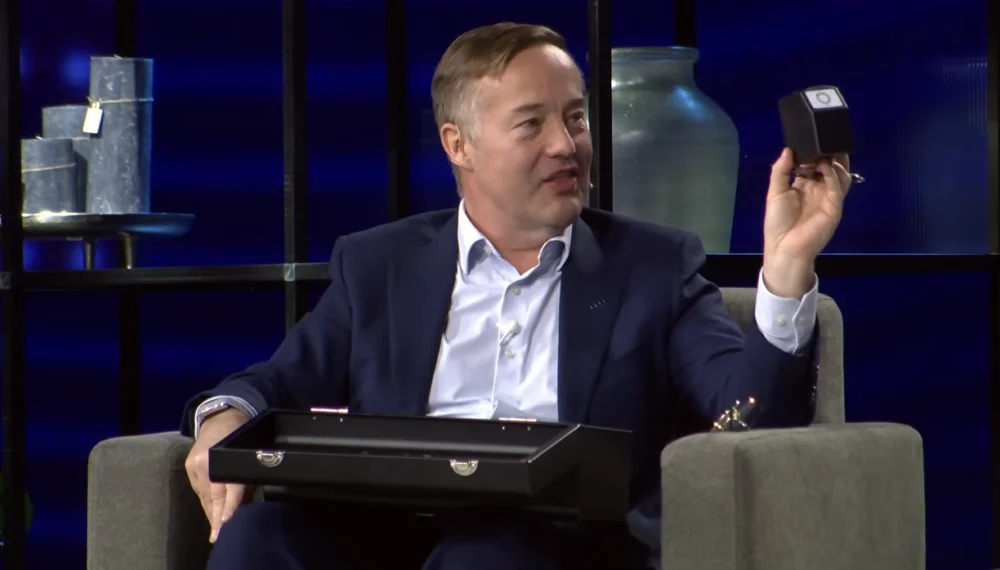
The current technological epoch, driven by the explosive maturation of artificial intelligence, is recognized across the industry as an inflection point unlike any seen since the dawn of the internet. This consensus—that AI is reshaping global commerce, investment dynamics, and workforce structure with unprecedented velocity—was the central theme of a recent high-level discussion featuring two of the most influential figures in global strategy and venture capital: Bob Sternfels, Global Managing Partner of McKinsey & Company, and Hemant Taneja, CEO of General Catalyst. Moderated by seasoned investor Jason Calacanis, the conversation illuminated the seismic shifts occurring in enterprise decision-making and the fundamental contract between employer and employee.
The Capital Shockwave: A New Timeline for Value Creation
The venture capital landscape is currently experiencing a distortion of traditional valuation metrics, a direct consequence of AI’s hyper-efficient scaling capabilities. Hemant Taneja emphasized the dramatic acceleration in capital accumulation for foundational AI companies. Drawing a stark comparison, Taneja noted that historical fintech giants like Stripe required approximately twelve years to achieve a $100 billion valuation. Conversely, newer generative AI players are compressing this timeline into months. He cited the trajectory of Anthropic, a General Catalyst portfolio company, which leaped from a reported $60 billion valuation in one year to figures approaching the "couple hundred billion dollars" mark the next.
This valuation anomaly signals more than just market enthusiasm; it reflects a structural change in how defensible technology moats are constructed. AI companies benefit from powerful network effects driven by data feedback loops, extremely low marginal costs for replication and deployment, and concentrated access to specialized compute resources. Taneja confidently projected that the industry is on the cusp of witnessing a new cohort of trillion-dollar enterprises, specifically naming early leaders like Anthropic and OpenAI as primary candidates for this monumental status. This is not speculative optimism, but a forecast rooted in the realization that these platforms are becoming essential infrastructural utilities, powering productivity across every sector globally.
The speed of this capital aggregation forces a rapid strategic reevaluation among investors. Traditional investment theses—which relied on slower scaling, predictable unit economics, and steady market penetration—are being discarded in favor of models that prioritize data advantage, talent density, and aggressive platform deployment. The competitive window for entering the AI infrastructure race is narrowing dramatically, pushing venture capital firms toward larger, more concentrated investments to secure positions in these future monopolies.
The Corporate Chasm: CFOs vs. CIOs
While venture capital flows at warp speed, the adoption curve within legacy non-technology enterprises remains stubbornly bifurcated. McKinsey’s Bob Sternfels provided an essential perspective on the institutional hesitation that characterizes the current transition. According to Sternfels, the firm’s consultants repeatedly encounter a fundamental conflict at the executive level, encapsulated in the critical question posed by CEOs: "Do I listen to my CFO or my CIO right now?"
This tension represents the modern iteration of the "Productivity Paradox," where revolutionary technology exists but its benefits have yet to translate into tangible, measurable quarterly returns. Chief Financial Officers, driven by fiduciary responsibility and short-term performance metrics, often push for delaying significant capital expenditure on AI implementation, citing unclear returns on investment (ROI), substantial integration costs, and the inherent risk of large-scale system overhaul. From the CFO’s perspective, AI is still frequently viewed as a cost center rather than an immediate revenue driver.
Conversely, Chief Information Officers and Chief Technology Officers argue vehemently for immediate, decisive adoption. Their concerns are existential: the failure to integrate AI tools rapidly will inevitably lead to systemic disruption and the loss of competitive relevance. CIOs recognize that the cost of inaction—technical debt, inability to attract top talent, and market share erosion—far outweighs the current financial uncertainty.
This internal executive standoff results in operational paralysis, particularly within heavily regulated industries or those with significant fixed infrastructure. Many enterprises are engaged in tentative "pilots" and "testing" phases rather than full, transformative implementation. Sternfels’ observation underscores a critical industry implication: the competitive gap between the early adopters (often native tech companies) and the hesitant legacy players is widening at an alarming rate, threatening to redefine industry leadership across sectors from banking and healthcare to manufacturing and logistics within the next three to five years.
The Breakdown of the Static Career Model
Beyond capital and corporate strategy, the most profound implication of the AI revolution lies in its restructuring of the global labor market. Calacanis noted the prevailing anxiety, particularly among recent graduates, regarding the displacement of entry-level and rote-task jobs by sophisticated AI models. This fear necessitates a radical shift in how human capital is valued and developed.
Hemant Taneja articulated this shift by declaring the traditional paradigm—"This idea that we spend 22 years learning and then 40 years working is broken"—to be fundamentally obsolete. This structure, a relic of the Industrial Age that prioritized deep specialization and predictable, decades-long careers, cannot survive in an environment where core technological competencies evolve every eighteen months.
The implication is clear: education is no longer a preparatory phase but a continuous, perpetual state. The onus shifts from relying on institutional learning to proactive, self-directed upskilling and reskilling throughout an individual’s professional life. For young people entering the workforce today, the career mandate is not mastery of a specific toolset, but mastery of adaptation and learning agility.
The Essential Human Value Proposition: Judgment and Synthesis
In a world where AI agents can execute complex, data-intensive tasks with superior speed and accuracy, the essential value of the human worker is shifting away from execution and toward strategic oversight and uniquely human attributes. Sternfels emphasized that while AI excels at handling complex models and processing vast datasets, two core skills remain definitively human and non-negotiable for success: sound judgment and creativity.
Judgment in the AI era is the capacity for ethical oversight, contextual application, and strategic synthesis. It involves determining when and how to deploy AI outputs, assessing the reliability and bias inherent in models, and navigating ambiguous, novel situations where historical data provides insufficient guidance. It is the ability to apply wisdom, emotional intelligence, and ethical frameworks to technological solutions.
Creativity encompasses the generation of truly novel concepts, the ability to frame new questions, and the capacity for lateral thinking that connects disparate domains. AI can optimize existing solutions, but it is the human capacity for imagination and non-linear thought that drives breakthrough innovation and sets new strategic directions.
Calacanis reinforced this view, stressing that relevance in the AI-infused workplace demands more than technical proficiency; it requires personal drive, conviction, and "chutzpah"—the sheer audacity and passion to pursue novel solutions and lead through uncertainty. In a highly automated environment, the differentiator will be the ability to leverage AI as a force multiplier for human ambition, rather than competing with it on speed or calculation.
Organizational Blueprint: Automation of the Middle Layer
The transformation of the workforce is not merely theoretical; it is already being implemented at the highest levels of professional services. Bob Sternfels provided a concrete illustration of McKinsey’s internal reorganization, which serves as a powerful microcosm for future corporate structure across industries.
McKinsey projects that by the end of 2026, it will deploy as many personalized AI agents as it has human employees. Critically, Sternfels noted that this profound integration of AI does not necessarily lead to a net decrease in overall headcount. Instead, the firm is fundamentally shifting the composition and mandate of its workforce. McKinsey plans to increase the number of employees dedicated to working directly with clients—high-touch, relationship-driven, consultative roles—by 25%. Concurrently, it plans to reduce roles in the back office and administrative support functions by the equivalent 25%.
This strategic reallocation reveals the core mechanism of AI-driven restructuring: the automation of the middle layer. Routine data processing, document synthesis, preliminary research, and compliance tasks—the functions typically housed in the back office—are the first to be fully absorbed by AI agents. This liberation of human capital allows organizations to re-deploy their best talent into high-value activities centered on client relationships, bespoke problem-solving, and the development of unique intellectual property.
The implication for businesses globally is that the future organizational chart will be flatter, with a smaller, highly efficient core of administrative staff supported by AI, and a dramatically expanded periphery of client-facing experts focused on nuanced, relationship-based value delivery. This shift demands significant investment not just in AI tools, but in the training necessary to transform former back-office employees into effective, AI-augmented consultants capable of synthesizing complex information for external partners.
Future Trajectories: The Mandate for Dynamic Adaptation
The convergence of accelerated capital deployment and fundamental workforce restructuring suggests a turbulent but potentially high-growth future. The consensus among leading strategists and investors is that the delay tactics currently employed by many non-tech CEOs are unsustainable. The decision is no longer if to adopt AI, but how quickly and how deeply to integrate it before competitors render their business models obsolete.
This requires corporate leadership to move past the immediate ROI conflict and embrace a longer-term vision where continuous learning and dynamic talent acquisition are treated as essential strategic assets, equivalent in importance to physical infrastructure or core intellectual property. Companies must budget for continuous, mandatory upskilling programs, recognizing that employee education is now an operational expense, not a discretionary training cost.
For the individual, the era of the static career path is definitively over. Success will be determined by a willingness to embrace continuous transformation, prioritizing cognitive flexibility, ethical leadership, and the cultivation of those uniquely human skills—judgment, creativity, and drive—that no algorithm can yet replicate. The future belongs not to those who fear the machine, but to those who master the art of collaborating with it, forging a new, constantly evolving professional identity. The mandate for both capital and labor is clear: adapt dynamically, or face obsolescence at an unprecedented speed.