

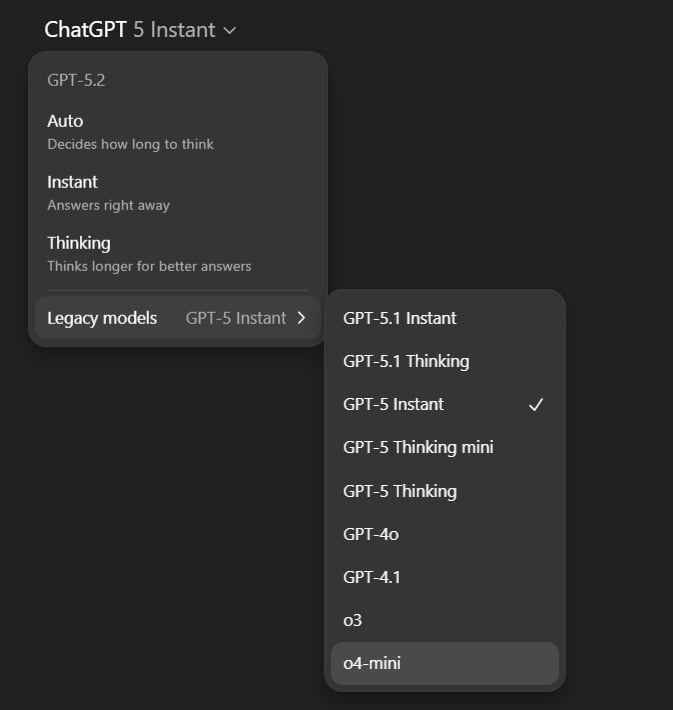
OpenAI has formally signaled the end of the line for several foundational and highly utilized large language models (LLMs), most notably the multimodal powerhouse, GPT-4o. In a recent technical bulletin, the firm confirmed that a comprehensive decommissioning process, scheduled for February 13, 2026, will pull GPT-4o from general availability within the ChatGPT interface, alongside the sunsetting of earlier iterations like GPT-5 Instant and GPT-5 Thinking. This move signals a critical inflection point, underscoring the rapid velocity of AI advancement and the company’s confidence in its latest generation of foundational models, specifically citing GPT 5.2 as the primary catalyst for this systemic overhaul.
The decision to retire GPT-4o is significant, given its status as perhaps the most distinctive model since the initial release of the GPT-4 architecture. GPT-4o was widely celebrated for its enhanced emotional intelligence and fluidity in conversation—a characteristic often described by users as "warmth" or a more human-like conversational style. This particular flavor of interaction proved so compelling that OpenAI previously reinstated the model following a temporary removal, acknowledging explicit user demand from Plus and Pro subscribers who relied on its unique temperament for sensitive applications like creative ideation and complex, long-form dialogue development. The company explicitly noted that the feedback derived from this user cohort was instrumental in refining the subsequent GPT-5 series, particularly versions 5.1 and the now-validated 5.2.
The official announcement, detailed within a support documentation update, stated, "On February 13, 2026, alongside the previously announced retirement of GPT-5 (Instant and Thinking), we will retire GPT-4o, GPT-4.1, GPT-4.1 mini, and OpenAI o4-mini from ChatGPT. In the API, there are no changes at this time." This distinction between the ChatGPT front-end experience and the Application Programming Interface (API) is a vital piece of information for enterprise developers, suggesting that while the consumer experience is being streamlined, the underlying infrastructure supporting third-party integrations retains legacy compatibility for a transition period.
The core rationale for the retirement is empirical validation: adoption rates have overwhelmingly favored the newer architecture. OpenAI quantified this shift, reporting that the vast majority of daily interactions now leverage GPT-5.2, leaving GPT-4o relegated to a minuscule 0.1% of overall user engagement. This statistical reality provides the necessary justification for allocating engineering resources away from maintaining and optimizing the older architecture.
To bridge the stylistic gap left by GPT-4o’s departure, OpenAI has concurrently accelerated the deployment of personalization features within ChatGPT. The introduction of the "Personality" feature is a direct concession to the user base that cherished the specific conversational traits of GPT-4o. By allowing users granular control over output style, tone, and behavioral constraints, OpenAI aims to allow end-users to effectively reconstruct the desired "feel" of GPT-4o within the more robust and capable GPT-5.2 environment.
However, the inherent trade-off between personality and reliability forms a central theme in this transition. Industry observers frequently characterized GPT-4o as possessing a certain "unhinged" quality—a tendency towards creative deviation or less predictable responses that, while appealing for brainstorming, introduced variability that newer, more safety-aligned models seek to eliminate. GPT 5.2, conversely, is positioned as the safer, more predictable workhorse. This suggests a broader strategic pivot by OpenAI: prioritizing predictable performance, lower latency, and enhanced safety protocols over idiosyncratic conversational flair in its flagship consumer offering.
Industry Implications: The Cost of Nostalgia in AI Development
The retirement of a flagship model like GPT-4o, even when superseded by demonstrably superior technology, carries significant industry implications, particularly regarding model lifecycle management and user attachment.
From a technological standpoint, this signals the rapid obsolescence cycle inherent in cutting-edge AI. Unlike traditional software, where major version updates might span several years, state-of-the-art LLMs are being rendered functionally obsolete within months. For developers, this necessitates continuous re-evaluation of their underlying AI stack. Integrating models that are slated for retirement creates technical debt; thus, the swift consolidation around GPT-5.2 minimizes the long-term maintenance burden for OpenAI and encourages rapid migration among its developer base.
The narrative surrounding GPT-4o’s popularity—and subsequent sidelining—is a microcosm of the tension between raw capability and user experience design in generative AI. While GPT-5.2 likely surpasses GPT-4o in benchmarks like reasoning, coding proficiency, and factual recall, the "warmth" of GPT-4o represented a successful, albeit temporary, breakthrough in human-computer interaction (HCI). Companies relying on AI agents that require high levels of rapport or emotional mirroring—such as customer service bots or therapeutic companions—will need to rigorously test the efficacy of the new Personality features in replicating that nuanced interaction previously achieved natively by GPT-4o. If the customization tools fall short, enterprises face the costly prospect of retraining workflows or risk frustrating end-users accustomed to the previous model’s feel.
Furthermore, the decision to maintain API parity for longer emphasizes a strategic understanding of enterprise deployment. Large corporations often require extended deprecation timelines for regulatory compliance, rigorous internal validation, or the sheer inertia of massive codebases. By isolating the ChatGPT retirement to the consumer interface first, OpenAI offers a crucial buffer period, allowing API consumers to transition on their own schedule, contrasting sharply with the immediate, user-facing retirement experienced by general ChatGPT users.
Expert Analysis: Deconstructing the GPT-5.2 Mandate
For AI researchers and engineers, the triumph of GPT-5.2 over its predecessor is a testament to advancements in alignment and efficiency, rather than just raw parameter count. The fact that GPT-4o’s unique characteristics were successfully distilled into the "Personality" feature suggests that the behavioral quirks that users enjoyed were separable from the core performance enhancements driving the GPT-5 series.
One hypothesis circulating among deep learning practitioners is that GPT-4o’s distinctive "unhinged" nature may have stemmed from a specific, perhaps less tightly constrained, alignment process compared to the subsequent GPT-5 iterations. As models scale, the difficulty of maintaining predictable, safe, and steerable outputs increases exponentially. The success of GPT-5.2 implies a significant breakthrough in constraint management—the ability to be highly intelligent while remaining firmly within predefined guardrails.
Dr. Lena Voss, a leading researcher in AI interpretability, commented that the trend is clear: "The market is rapidly polarizing. On one side, you have highly steerable, reliable models for critical tasks—that’s GPT-5.2. On the other, you have experimental, jailbroken, or highly specialized models for niche creative exploration. OpenAI is choosing to dominate the former, leveraging personalization tools to cater to the latter’s aesthetic preferences without sacrificing core operational integrity. GPT-4o occupied an uncomfortable middle ground that is proving unsustainable."
The retirement also frees up substantial computational resources. Maintaining multiple high-capacity models incurs significant inference costs. By consolidating the vast majority of user load onto the single, optimized GPT-5.2 framework, OpenAI achieves economies of scale, which can then be reinvested into developing the next generation or enhancing the safeguards mentioned in their announcement.
Future Impact and Trajectory: The Era of Specialized Layers
The transition away from model-specific identities towards layered, customizable experiences—like the Personality feature—defines the next phase of consumer AI interaction. The future of user interfaces will likely move away from selecting "Model A" versus "Model B" and toward configuring a single, powerful base model (GPT-5.2 or its successors) with specific behavioral overlays.
This approach mitigates the "feature fatigue" associated with constantly launching new foundational models while retaining user satisfaction. If a user loved the conversational cadence of GPT-4o, they are now encouraged to use the "4o Emulation" personality on GPT-5.2, ensuring they benefit from the speed, security, and latent knowledge improvements of the newer architecture underneath the familiar stylistic wrapper.
However, this dependency on post-hoc customization introduces potential fragility. If the Personality feature fails or if the emulation is imperfect, the user experience degrades significantly. The long-term success of this strategy hinges on OpenAI’s commitment to maintaining these personality configurations across subsequent major releases, preventing future deprecation cycles from causing similar user friction.
Furthermore, the API sunsetting delay hints at a competitive landscape where incumbent enterprise integrations are paramount. Competitors like Anthropic and Google are aggressively courting developers wary of platform lock-in or sudden forced migrations. OpenAI’s measured approach to the API retirement—a stark contrast to the immediate impact felt by ChatGPT users—is a clear strategic move to retain high-value enterprise partnerships throughout the transition window ending in 2026.
In conclusion, the decommissioning of GPT-4o is less a failure of the model and more a triumph of iteration. It signifies OpenAI’s successful transition to a platform strategy where underlying model supremacy (embodied by GPT-5.2) is paired with flexible, user-defined interface layers designed to capture the emotional resonance of past successes. The industry watches closely to see if this engineered nostalgia can permanently satisfy users yearning for the unique charm of models that, by necessity, must always make way for the next benchmark. The final curtain falls for GPT-4o in early 2026, marking the definitive end of an important, albeit brief, chapter in conversational AI history.