

The global mobility platform inDrive is executing a determined pivot, accelerating its transformation from a ride-hailing competitor known for its unique bidding-based fare model into a multi-vertical “super app.” This strategic shift, initially conceptualized last year, is materializing through the simultaneous rollout of an advertising business across its 20 largest markets and a major expansion of its grocery delivery operations, specifically targeting the high-potential, price-sensitive environment of Pakistan. These moves represent a calculated effort to insulate the company from the perennial challenge of compressed margins in the fiercely competitive ride-hailing sector while maximizing the value derived from its enormous, established user base.
Headquartered in Mountain View, California, inDrive finds itself operating in an increasingly challenging economic landscape where mobility platforms, especially those focused on emerging and frontier markets, face relentless pressure from local incumbents and global giants like Uber. The core business of ride-hailing, characterized by high operational costs and persistent price sensitivity among consumers, makes commission-based revenue inherently volatile. Diversification is no longer optional; it is a fundamental pillar of sustainable growth. The chosen vectors—advertising and grocery delivery—are designed to address two distinct, yet critical, commercial imperatives: generating superior gross margins and significantly increasing app frequency and user engagement.
The New Digital Real Estate: High-Margin Advertising
The deployment of an in-app advertising platform across key operational territories, which include high-growth economies such as Mexico, Colombia, Pakistan, Kazakhstan, Egypt, and Morocco, is poised to introduce a fundamentally high-margin revenue stream. Unlike the commission structure of ride-hailing, where revenue is intrinsically tied to external variables like fuel prices, driver availability, and regulatory fees, digital advertising leverages existing traffic with minimal incremental cost.
Initial tests conducted in mid-2025 were highly successful, generating hundreds of millions of impressions and attracting significant interest from major advertisers, including multinational consumer packaged goods (CPG) brands and financial institutions. Andries Smit, the company’s chief growth business officer, confirmed that the immediate focus is on monetizing the high-attention moments within the user journey.
These inventory placements include the critical waiting period after a ride is booked, a moment of guaranteed captive attention, and placements displayed while passengers are en route. From a media buying perspective, these are highly valuable digital slots because the user is functionally unable to switch context or multitask effectively, translating to high viewability and click-through rates. This strategy contrasts sharply with the broader, less targeted ad placements often found on social media or general content platforms.
While longer-term plans include physical advertising—such as in-car digital screens or on-vehicle wraps—inDrive plans to prioritize digital, in-app formats through 2026. Smit pointed to the inherent operational complexity and regulatory hurdles associated with scaling physical advertising assets across dozens of emerging markets, favoring the faster, more scalable returns generated by digital placements. This prioritization ensures that the advertising arm can quickly establish meaningful revenue contribution without being bogged down by complex logistics and compliance issues. The aim is clear: utilize the ride-hailing transaction as the foundation for a passive, high-yield digital media network.
Groceries: The Engine of Frequency and Stickiness
The advertising strategy is inextricably linked to the simultaneous push into quick commerce, specifically grocery delivery. The ride-hailing application is typically used perhaps a few times per week, at best. To truly become a "super app," inDrive requires services that drive daily or near-daily engagement. Groceries and delivery services fulfill this need perfectly, offering a high-frequency use case that dramatically increases the application’s utility beyond mobility.
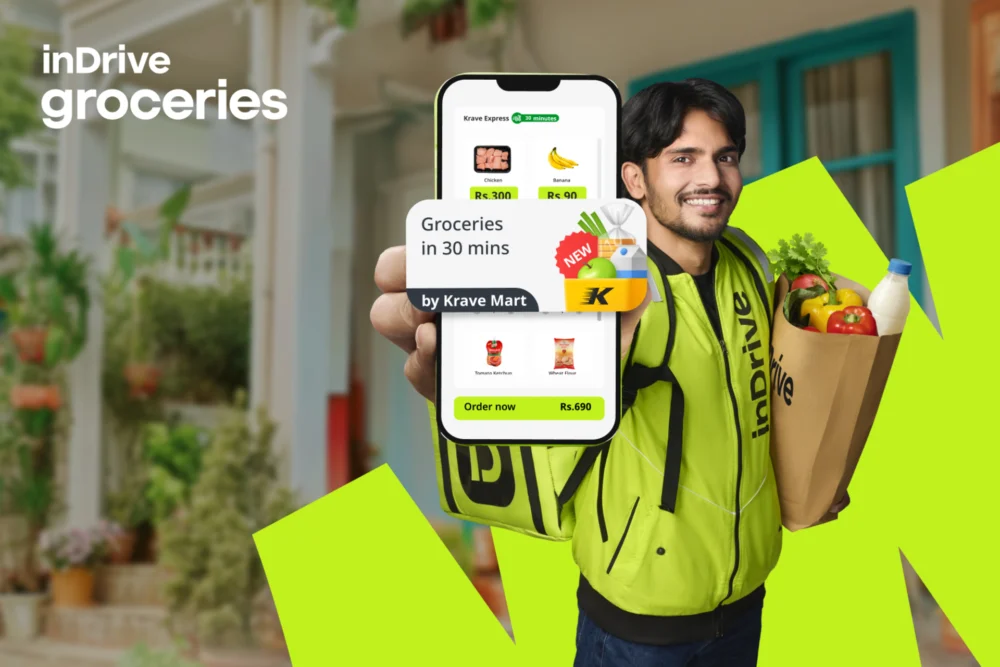
InDrive is scaling its grocery delivery service in Pakistan, its second such market after a successful initial launch in Kazakhstan. This expansion is powered by a strategic partnership and investment in Krave Mart, a local dark-store operator, formalized in late 2024. This collaboration allows inDrive to rapidly access established logistics infrastructure and supply chains without the lengthy capital expenditure required to build proprietary warehousing networks from scratch.
Pakistan stands out as a prime testing ground for this comprehensive super app model. The market dynamics are highly favorable: rapid urbanization is driving demand for app-based convenience services as household time constraints increase, while the traditional retail sector remains largely informal and highly fragmented. InDrive has already achieved significant scale in the country, establishing itself as one of the leading mobility platforms. This existing user base is the crucial advantage; by cross-selling groceries to millions of engaged users, inDrive bypasses the prohibitively high customer acquisition costs (CAC) that have financially crippled many pure-play quick commerce startups globally.
The company’s growth metrics in Pakistan underscore this potential. Since its 2021 launch in the country, ride volumes increased by nearly 40% year-over-year in 2025, and courier service deliveries surged by 67% in the first half of the year. This momentum has cemented Pakistan’s status as one of inDrive’s fastest-growing global markets, with high concentrations of usage in major urban centers like Karachi, Lahore, and Islamabad. The company operates mobility services in over 20 Pakistani cities and intercity transport across more than 200 locations, providing a vast logistical network ripe for commerce integration.
The grocery rollout began in Karachi, the nation’s largest city, where the platform is offering delivery of daily essentials within 20 to 30 minutes. The service promises an inventory of over 7,500 products, encompassing fresh produce, meat, dairy, and household goods. Crucially, the platform is structured to appeal to the price-sensitive local consumer, offering free delivery on orders above a minimal threshold (PKR 499, approximately $2) and eliminating service fees. This aggressive pricing strategy is sustainable only because the CAC for the grocery vertical is subsidized by the existing ride-hailing network.

The Pakistan Gambit: Capital Deployment and Investor Sentiment
InDrive’s commitment to Pakistan extends beyond operational expansion; it is a focal point for the company’s investment capital. Of the $100 million multi-year investment program announced in late 2023 for emerging markets, the largest single share of deployment so far has been directed toward Pakistan. While specific figures remain undisclosed, Smit confirmed that at least half of the total commitment has already been utilized, signaling profound confidence in the country’s long-term economic trajectory.
This intense focus on capital deployment in Pakistan is strategically audacious, especially given the broader market context. Global venture capital and public investors have maintained a posture of extreme caution toward the Pakistani ecosystem, deterred by persistent geopolitical instability and macroeconomic risks. While equity funding showed a modest recovery in 2025, it remains drastically low compared to the peak funding years of 2021 and 2022.
inDrive views this gap between external investor caution and internal on-the-ground demand as a crucial competitive advantage. Companies that specialize in operating across dozens of emerging markets, as inDrive does, are inherently better equipped to manage volatility and are less dependent on fluctuating capital-market sentiment. By leveraging its established local business and deep user engagement, inDrive can provide its partners, such as Krave Mart, with unparalleled scale and low customer acquisition costs—an invaluable proposition when external funding sources are tight. This strategy allows the company to capture significant market share and establish dominant positions in key verticals at a relative discount.
Industry Implications and the Super App Challenge
The pursuit of the "super app" status is a globally recognized, yet notoriously difficult, strategic goal. While models like WeChat in China and Grab and GoJek in Southeast Asia have proven successful, the concept has often failed to gain traction in Western markets, where consumers prefer specialized, single-purpose applications. InDrive’s strategy hinges on the premise that consumer behavior in emerging and frontier markets more closely resembles the consolidated digital ecosystems of Asia.
InDrive’s scale provides the foundational leverage: operating in 1,065 cities across 48 countries, the platform has amassed over 360 million app downloads, maintaining its position as the world’s second most-downloaded mobility app, trailing only Uber. This massive footprint is the prerequisite for launching new services successfully.
The company’s unique value proposition—the peer-to-peer bidding model that emphasizes affordability and driver autonomy—also creates a unique dynamic for diversification. While this model drives high adoption in price-sensitive regions, it compresses the inherent commission margins, making the need for high-margin, complementary revenue streams (like advertising) even more urgent than for fixed-fare rivals. The advertising vertical serves as the financial stabilizer, utilizing the massive volume of low-margin transactions to generate superior profits from data and attention.
Furthermore, integrating disparate services presents significant technical and operational challenges. The success of the super app hinges on seamless data sharing between the mobility, courier, and grocery platforms. This integration must be robust enough to allow for personalized cross-promotion (e.g., offering a grocery coupon to a user immediately after they complete a ride) while maintaining the operational integrity of each vertical’s logistics network. In emerging markets, where infrastructure quality can vary dramatically, managing this operational complexity is a key test of the company’s technological backbone.
Future Trajectory and Financial Services
inDrive’s strategic diversification is already shifting its financial profile. Just a few years ago, ride-hailing accounted for roughly 95% of the company’s total revenue. Today, even as the core mobility business continues its vigorous growth, that figure has moved closer to 85%, reflecting the early, meaningful scale of newer verticals.
Looking ahead, the company anticipates that advertising will become a significantly more material contributor to overall profitability over the medium term, especially as the newly scaled grocery and delivery volumes generate higher frequency data and open up new opportunities for contextual, highly targeted promotions.
The current focus on mobility, commerce, and advertising is viewed as Phase I of the super app strategy. Over the next three to five years, inDrive expects further diversification into higher-value services, including financial technology (FinTech). Leveraging transactional data from both rides and commerce, the company is uniquely positioned to offer specialized financial products—such as driver financing, micro-lending, or in-app payment solutions—to its large ecosystem of drivers and consumers who are often underserved by traditional banking systems in these emerging markets.
The strategic alignment is clear: inDrive is leveraging its existing market dominance and scale in mobility to establish a high-frequency commerce loop, using high-margin advertising revenue to fund expansion, and ultimately aiming to embed itself as an indispensable financial and logistical layer across the economic lives of consumers in key global growth markets. This aggressive, capital-backed approach signals a long-term commitment to a multi-vertical strategy designed not just to compete, but to capture comprehensive digital market share where others have traditionally struggled to harmonize mobility and commerce.