

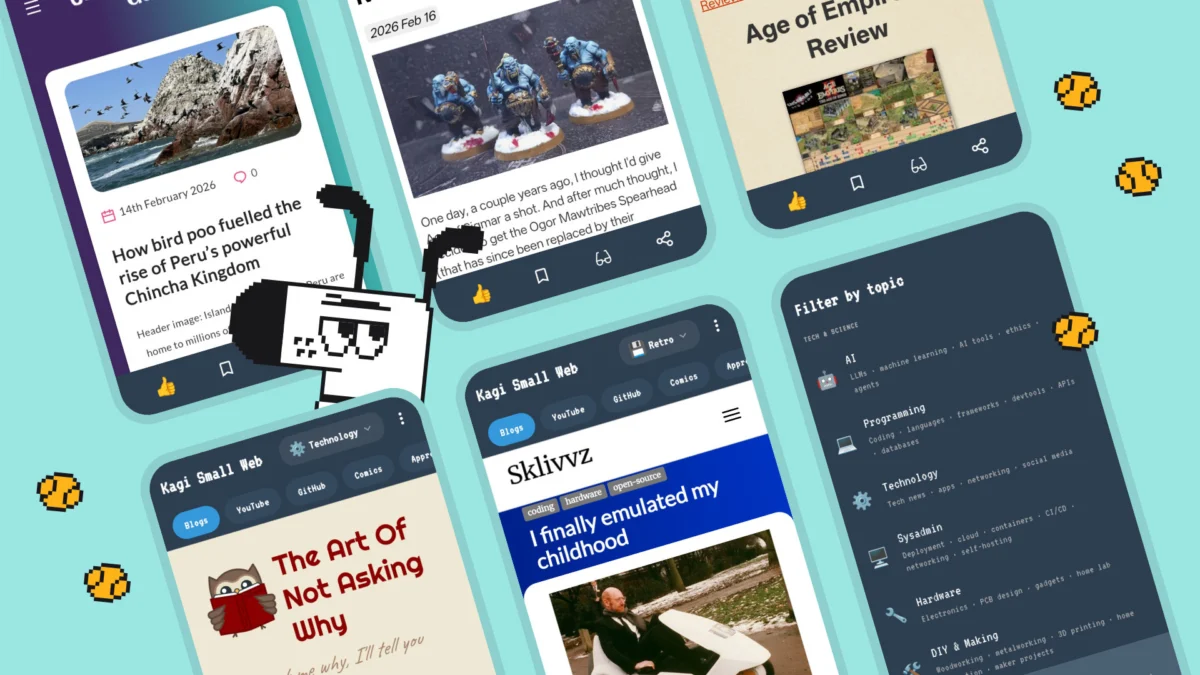
The contemporary internet is undergoing a profound identity crisis, caught between the hyper-optimized efficiency of search engine marketing and a burgeoning flood of synthetic, AI-generated content. In response to this shifting landscape, Palo Alto-based search disruptor Kagi has launched a significant expansion of its "Small Web" initiative, releasing dedicated mobile applications for iOS and Android designed to reconnect users with the human-centric, non-commercial corners of the digital world. This move represents more than just a software update; it is a strategic attempt to rescue the "indie web" from the obscurity imposed by modern search algorithms and to provide a mobile-first gateway to an internet that many feared was extinct.
For the uninitiated, the "Small Web" is a term that encapsulates the spirit of the early internet—a decentralized network of personal blogs, niche forums, idiosyncratic webcomics, and independent repositories of knowledge created by individuals rather than corporations. These sites are often non-commercial, devoid of aggressive tracking scripts, and prioritized for passion over profit. However, in the current era of "algorithmic enclosure," where Google and other major players prioritize ad-heavy platforms and SEO-optimized content farms, these digital gardens have become increasingly difficult to locate. Kagi’s new mobile apps aim to bridge this discovery gap, bringing a handpicked index of over 30,000 human-authored sites to the devices where modern users spend the majority of their time.
The Philosophy of the Small Web
To understand the significance of Kagi’s mobile push, one must first understand the structural decay of the modern browsing experience. For over a decade, the web has been consolidating into a handful of "walled gardens." Platforms like Facebook, X (formerly Twitter), and Reddit have effectively internalized the web, encouraging users to stay within their proprietary ecosystems. Simultaneously, the open web has been colonized by "content creators" whose primary goal is to satisfy search engine crawlers rather than human readers.
Kagi’s Small Web initiative, which originally debuted in 2023 as a desktop-centric discovery tool, is a direct rebuttal to this trend. By focusing on non-commercial and human-authored content, Kagi is attempting to curate a "parallel internet." This index includes personal journals that offer deep, lived-in perspectives on obscure hobbies, technical wikis maintained by obsessive experts, and experimental art projects that have no place in a world governed by click-through rates. By porting this experience to iOS and Android, Kagi is challenging the notion that mobile browsing must be a passive consumption of centralized feeds.
Reimagining Discovery: The Return of Serendipity
One of the most striking features of the Small Web mobile experience is its homage to the "StumbleUpon" era of the internet. The app features a discovery mechanism that allows users to cycle through sites at random, or filter by specific categories such as code repositories, independent videos, or long-form essays. This introduces an element of serendipity that has been systematically purged from the modern web.
In a standard search environment, discovery is a linear process: a user enters a query, and the engine provides the most "relevant" (read: most popular or most optimized) result. Kagi’s approach is non-linear. It encourages exploration for the sake of curiosity. The mobile app includes a distraction-free reading mode, allowing users to engage with these independent sites without the clutter of legacy mobile browser UI. Furthermore, the inclusion of a "favorites" feature and a "recently viewed" list allows users to build their own curated library of the human web, effectively creating a personalized portal into the indie digital landscape.
The AI Crisis and the Need for Human Verification
The timing of Kagi’s mobile expansion is not accidental. We are currently witnessing what some theorists call the "Dead Internet Theory" becoming a tangible reality. As Large Language Models (LLMs) make it trivial to produce vast quantities of authoritative-sounding text, the web is being smothered by "AI slop"—content designed to capture search traffic without providing genuine human insight.
This has created a premium on "human-only" spaces. Kagi’s Small Web index is specifically curated to exclude sites that are primarily commercial or generated by machines. In an era where even reputable news outlets are experimenting with AI-authored summaries, the Small Web serves as a sanctuary. However, this human-centric approach is not without its challenges. Maintaining a "clean" index in a world where AI can mimic human tone with increasing sophistication requires constant vigilance and a robust set of editorial standards.
Kagi currently relies on a mixture of automated filtering and community contributions via its GitHub page to maintain the integrity of the Small Web. Users can suggest new sites, but they must meet strict guidelines: they must be human-authored, non-commercial, and offer unique value. This community-driven model is a stark contrast to the opaque, black-box algorithms that govern the rest of the search industry.

Critical Reception and Technical Hurdles
Despite the praise from digital minimalists and indie web enthusiasts, Kagi’s Small Web has faced scrutiny from the more technically minded segments of the developer community. Critics have pointed out that Kagi’s current selection criteria are somewhat restrictive. Specifically, the system heavily favors sites with active RSS feeds and recent posts. While this ensures that the content is "fresh," it inadvertently excludes thousands of "static" websites—pages that were written years ago but remain incredibly valuable, such as academic primers, historical archives, or personal manifestos that don’t require regular updates.
There is also the persistent threat of "AI leakage." On platforms like Hacker News, some early adopters have reported finding sites within the Small Web index that appear to be using AI-generated or heavily AI-assisted content. This highlights the central paradox of Kagi’s mission: as the tools to fake "humanity" become more accessible, the cost of verifying "humanity" increases exponentially. If Kagi intends to scale this initiative, it may eventually need to move toward a more formal web-of-trust model or a more rigorous peer-review system for site inclusion.
Industry Implications: The Rise of the Premium Search Model
Kagi’s broader business model is also worth noting in the context of this launch. Unlike Google or Bing, Kagi is a subscription-based search engine. It does not sell user data, and it does not display advertisements. This financial independence is what allows Kagi to prioritize the Small Web. An ad-supported search engine has a fiduciary responsibility to send users to sites where they can be monetized; Kagi has a responsibility only to its users.
The success or failure of the Small Web apps will be a litmus test for the viability of the "premium web." If users are willing to pay for a search experience that intentionally hides the "Big Web" in favor of the "Small Web," it could signal a major shift in internet economics. We may be moving toward a bifurcated internet: a "Free Web" that is saturated with ads, tracking, and AI-generated content, and a "Premium Web" that is curated, private, and human-centric.
Future Trends: Toward a Decentralized Discovery Layer
Looking ahead, the Small Web initiative could be the precursor to a new kind of "discovery layer" for the internet. As social media platforms become increasingly fragmented—with users moving away from Facebook and toward decentralized protocols like Mastodon, Bluesky, and Nostr—the need for a cross-platform, human-centric search tool will only grow.
Kagi’s mobile apps could eventually integrate these decentralized feeds, becoming a unified portal for everything that is "not corporate." We are seeing a resurgence of interest in personal knowledge management (PKM) and "digital gardening," where individuals curate their own corners of the web. Kagi is positioning itself as the primary librarian of these gardens.
Furthermore, the expansion into browser extensions and mobile apps suggests that Kagi wants the Small Web to be an ambient part of the user’s digital life, rather than just a destination they visit occasionally. By integrating Small Web results directly into their primary search engine, Kagi is training its users to expect more from their search results than just the top three sponsored links and a Wikipedia snippet.
Conclusion
The release of Kagi’s Small Web apps for mobile devices is a defiant act in an era of digital homogenization. It is an acknowledgment that while the "Big Web" has become a utility—a place to buy products, check the weather, or book flights—it has lost the soul that made the internet a revolutionary medium for human expression.
By mobilizing the Small Web, Kagi is giving users the tools to rediscover the joy of the "old" internet using the "new" hardware of the smartphone era. Whether this initiative can withstand the encroaching tide of AI-generated content remains to be seen, but for now, it offers a rare and necessary alternative to the algorithmic status quo. For those tired of the noise, the Small Web isn’t just a collection of websites; it’s a reminder of what the internet was always supposed to be.