

The landscape of mobile interaction is undergoing a fundamental transformation, moving away from the tactile constraints of the QWERTY keyboard and toward a more fluid, voice-centric future. At the forefront of this movement is Wispr Flow, an AI-powered dictation startup that has officially extended its reach into the Android ecosystem. Following its successful deployments on macOS, Windows, and an iOS launch in mid-2025, the arrival of the Android application marks a critical milestone for the company as it seeks to replace typing with a more natural, cognitive-load-reducing alternative.
For years, mobile dictation was relegated to a secondary feature—a "best effort" tool that often required as much time to correct as it did to record. Wispr Flow, however, represents a new breed of productivity software that leverages large language models (LLMs) to understand not just phonetics, but intent, context, and syntax. With the Android release, the company isn’t just porting an app; it is reimagining how a voice interface should behave when the underlying operating system provides a higher degree of architectural freedom.
The Architecture of "Frictionless" Input
On iOS, Wispr Flow’s integration was primarily achieved through a dedicated third-party keyboard. While effective, this approach is inherently limited by Apple’s sandboxing restrictions, which often create a "stop-and-start" user experience. Android, by contrast, has allowed Wispr Flow to implement a more radical UI: the floating bubble. This persistent, draggable interface element allows users to initiate dictation from anywhere within the OS, regardless of which app is currently in the foreground.
The mechanics are designed for speed. A user can either hold the bubble for a quick burst of speech or tap it once to enter a continuous recording mode. This "overlay" philosophy is central to the vision of Tanay Kothari, co-founder and CEO of Wispr Flow. Kothari has long maintained that for voice to truly supersede typing, the technology must be "frictionless." By utilizing Android’s ability to let apps draw over other applications, Wispr Flow has moved closer to an "ambient computing" model where the tool is always available but never intrusive.
Beyond the interface, the Android launch coincides with a massive technical overhaul of the company’s backend. Wispr Flow has announced a complete infrastructure rewrite that has resulted in a 30% increase in processing speed. In the world of real-time dictation, 30% is the difference between a tool that feels like a delay and a tool that feels like an extension of one’s own thoughts. This reduction in latency is vital for maintaining the "flow" state that the company’s name implies.
The Linguistic Frontier: Beyond Standard English
Perhaps the most significant aspect of this launch is its focus on linguistic diversity, specifically the introduction of a specialized model for "Hinglish." In the global tech market, many AI models struggle with code-switching—the practice of alternating between two or more languages in a single conversation. For millions of users in India and the diaspora, communication is rarely monolingual; it is a fluid blend of Hindi and English.
Most traditional speech-to-text engines attempt to force these utterances into either a pure English or a pure Hindi script, often resulting in nonsensical transcriptions or a failure to capture the nuance of the conversation. Wispr Flow’s Hinglish model is designed to transcribe this mix-coded speech accurately, reflecting the way people actually speak in their daily lives. Kothari’s personal connection to this feature—rooted in his own experiences communicating with family in India—highlights a growing trend in the AI industry: the move away from Western-centric "universal" models toward hyper-localized, culturally aware intelligence.
This focus on localization extends to the app’s broader capabilities, with support for translation and transcription in over 100 languages. This positions Wispr Flow not just as a tool for English-speaking professionals, but as a global communication bridge.
The Venture Capital Magnet: $81 Million and a $700 Million Valuation
The speed at which Wispr Flow has scaled is reflected in its aggressive fundraising trajectory. The startup has become a darling of Silicon Valley, attracting significant capital during a period when investors are increasingly discerning about "AI wrappers." In June 2025, the company closed a $30 million round led by Menlo Ventures. This was followed closely in November by a $25 million injection led by Notable Capital. To date, Wispr Flow has raised $81 million, with its most recent valuation reportedly hovering around the $700 million mark.
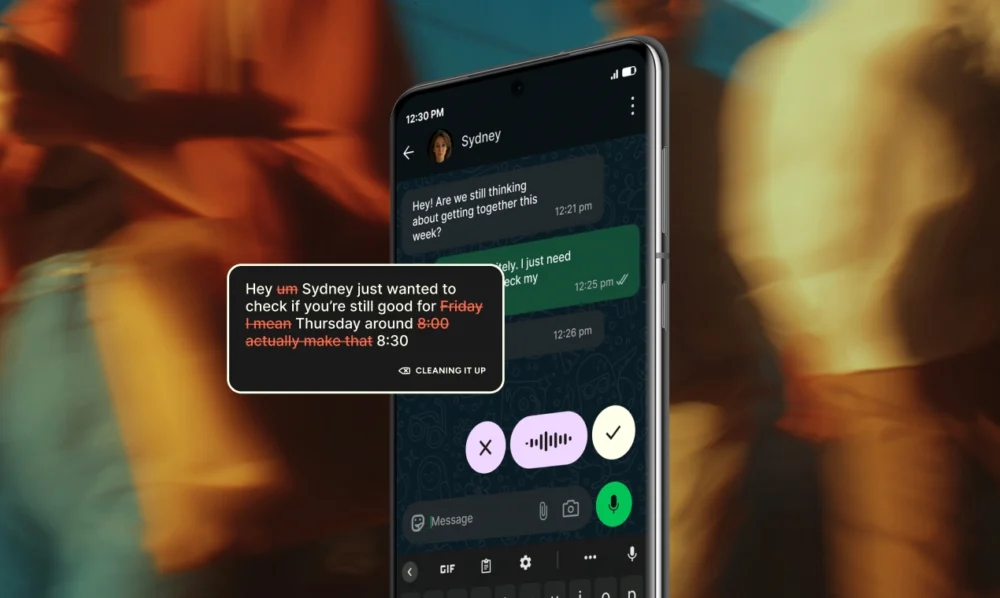
This valuation is a testament to the perceived value of "intent-based" data. While Google and Apple have their own native dictation tools, they have historically focused on verbatim transcription. Wispr Flow’s value proposition lies in its "cleanup" capabilities—the ability to automatically remove filler words like "um" and "uh," correct grammatical errors on the fly, and format text based on the specific context of the app being used. If a user is dictating into Slack, the tone remains professional yet casual; if they are dictating into a formal email client, the AI adjusts the register accordingly.

For VCs, Wispr Flow isn’t just a utility; it’s a potential new layer of the mobile OS. If the startup can capture the primary input method of the user, it becomes the gatekeeper of the user’s digital intent, a position of immense strategic and commercial power.
Industry Implications: The Dictation Wars
The Android launch places Wispr Flow in direct competition with a small but growing cohort of AI-native input startups. While the desktop and iOS markets are increasingly crowded, the Android space for high-end, AI-driven dictation has remained relatively open. Its primary rival, Typeless, launched on Android just last month, signaling that the race to capture the "prosumer" voice market is heating up.
The broader industry implication is the potential obsolescence of the traditional mobile keyboard. For decades, the industry has tried to optimize the "thumb-typing" experience through predictive text and swipe-to-type gestures. However, these are ultimately optimizations of a flawed system. Humans can speak at roughly 130 to 150 words per minute, while the average mobile typing speed hovers around 30 to 45 words per minute. By bridging this gap, Wispr Flow is making a bet that the future of productivity is oral.
This shift also has profound implications for accessibility. For users with motor impairments or those who find small screens difficult to navigate, an intelligent, context-aware voice interface is more than a convenience—it is an equalizer.
Challenges and the Road Ahead
Despite its momentum, Wispr Flow faces significant hurdles. The first is social. While dictating into a computer in a private office is now commonplace, speaking out loud to a phone in a public or open-office setting remains a social taboo for many. The "privacy of the keyboard" is a powerful psychological barrier that Wispr Flow must overcome if it hopes to achieve mass adoption.
The second challenge is the "platform risk" posed by the giants. Both Google and Apple are deeply integrated into their respective hardware ecosystems. If Google decides to bake "Wispr-like" intelligence directly into the Android Gboard, Wispr Flow will have to prove that its third-party solution offers enough incremental value to justify a separate installation and potential subscription cost.
Finally, there is the question of data privacy. As users dictate their most sensitive thoughts, emails, and messages into a third-party AI, the security of that data becomes paramount. Wispr Flow will need to maintain a "best-in-class" reputation for privacy and data handling to win the trust of corporate and enterprise users who are wary of their data being used to train future models.
Expert Analysis: The Evolution of Ambient Intelligence
From an analytical perspective, Wispr Flow’s expansion to Android is a clear indicator that we are moving into the "post-app" era of mobile computing. In this new paradigm, the boundaries between different applications begin to blur, replaced by a central intelligence layer that assists the user across the entire OS.
The floating bubble interface is a precursor to a more integrated "AI agent" experience. As these models become more sophisticated, they won’t just transcribe what we say; they will anticipate what we need to do next. If you dictate a message about "meeting for coffee tomorrow at 2 PM," the next logical step for an integrated AI would be to check your calendar and offer to send an invite.
The fact that Wispr Flow users have already dictated over 1.3 million words in just the first few days of the early Android rollout suggests a massive pent-up demand for this technology. As the infrastructure continues to get faster and the models become more linguistically diverse, the keyboard may soon find itself relegated to the same status as the stylus: a specialized tool for specific tasks, rather than the default way we interact with the digital world.
For now, Wispr Flow is leading the charge in proving that the most powerful tool we have for digital creation isn’t our fingers—it’s our voice. With $81 million in the bank and a presence on every major platform, the startup is no longer just a "dictation app." It is a serious contender for the future of human-computer interaction.