

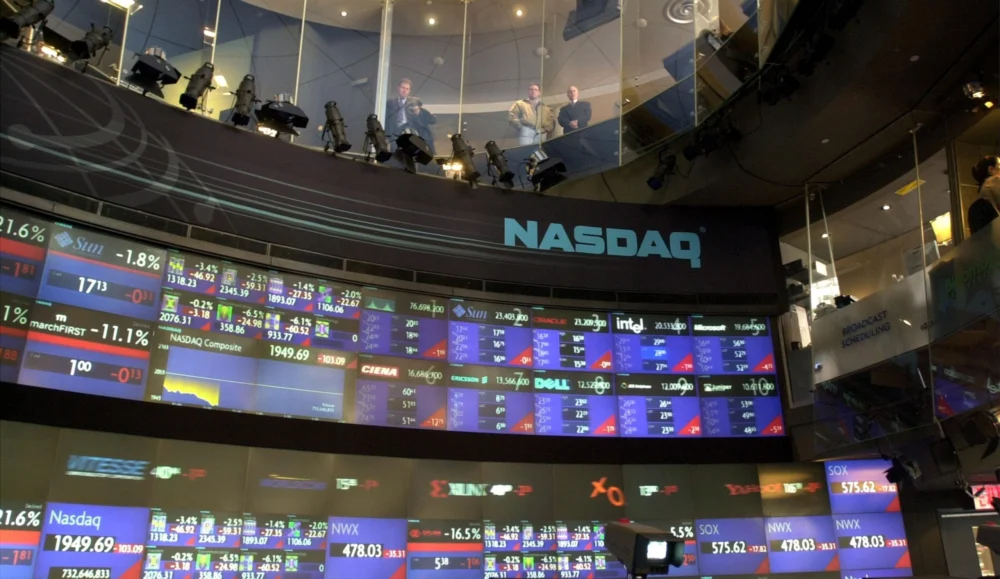
The prevailing narrative on Wall Street suggests a looming apocalypse for the software industry, predicated on the belief that "artificial intelligence" will eventually render traditional code obsolete. However, Nvidia CEO Jensen Huang recently dismissed this notion, characterizing the idea that AI will replace software as "the most illogical thing in the world." To understand why this tension exists, one must look past the frantic fluctuations of the Nasdaq and examine the decades-long evolution of digital information. What we are witnessing today is not the sudden arrival of a sentient technology, but rather the latest and most aggressive stage of a process that has been underway for eighty years: the consumption of the physical and intellectual world by digital data.
The term "artificial intelligence" is perhaps the most successful marketing triumph in the history of modern commerce. Coined in 1955 at the Dartmouth Summer Research Project, the phrase was designed to capture the imagination and, more importantly, to secure government and institutional funding. For nearly seven decades, this branding has oscillated between periods of hyper-optimism and "AI Winters," where the gap between the marketing promise and the technical reality led to massive withdrawals of capital. Today, the cycle has returned with unprecedented fervor, fueled not by government grants but by hundreds of billions of dollars in private-sector investment.
This marketing campaign has created a peculiar cognitive dissonance on Wall Street. Investors find themselves caught between two extremes. On one side is the fear that generative models from the likes of OpenAI and Anthropic will cannibalize the $800 billion global software market, making the specialized tools of companies like Salesforce or Adobe redundant. On the other side is a growing skepticism that the current LLM (Large Language Model) paradigm has hit a plateau of diminishing returns, where massive infusions of capital and electricity no longer yield proportional leaps in capability. Both perspectives, however, often miss the underlying driver of this transformation: the shift from software-defined systems to data-driven intelligence.
In 2011, venture capitalist Marc Andreessen famously declared that "software is eating the world." At that time, his thesis was indisputable. The proliferation of high-speed internet, mobile devices, and cloud computing meant that every industry—from transportation to retail—was being reinvented as a software service. We entered an era where hardware was commoditized, hidden behind the "software-defined" layers of giant cloud providers. Andreessen argued that lower startup costs and a "fully digitally wired" global economy would allow software companies to disrupt every traditional sector.
Yet, a closer retrospective analysis reveals that software was merely the delivery mechanism. The true predator was the data generated by that software. While Andreessen’s examples—Amazon, Netflix, and Google—built exceptional software, their market dominance was not secured by the elegance of their code alone. Their success was rooted in their ability to ingest, process, and monetize the data generated by their users. They didn’t just sell products; they refined the intelligence gathered from every click, purchase, and search to create a feedback loop that competitors could not replicate.
The year 2012 marked a pivot point in this trajectory. While the software-as-a-service (SaaS) model was reaching its peak, a breakthrough in image classification demonstrated that a specific approach to machine learning—deep learning—could solve "cognitive" tasks that traditional software could not. This breakthrough relied on three pillars: "big data" (massive sets of labeled images), parallel computation (powered by Nvidia’s graphics chips), and statistical algorithms. This was the moment the "Data Era" effectively superseded the "Software Era," though it would take another decade for the public and the markets to recognize the shift.
To understand the current market anxiety, one must recognize that traditional software is essentially a set of rigid, human-written instructions. A programmer anticipates every possible "if-then" scenario. Data-driven intelligence, by contrast, is probabilistic. It learns patterns from existing information to predict the next logical step, whether that is the next pixel in an image or the next word in a sentence. The threat to "software-as-we-know-it" is not that code will disappear, but that the value proposition is moving from the tool to the intelligence that powers the tool.

Wall Street’s reaction is a reflection of this transition. For years, the SaaS model was the darling of the markets because of its predictable, recurring revenue. However, if a general-purpose "intelligence" can perform the tasks currently handled by twenty different specialized software subscriptions, the valuation of those software companies must be re-evaluated. This is why we see established giants scrambling to integrate "AI layers" into their products; they are attempting to prevent their software from being relegated to a mere "dumb pipe" for someone else’s intelligence model.
However, the "AI replacing software" narrative remains illogical, as Huang suggests, because data-driven models still require an architectural framework to function. You cannot have "intelligence" without a platform to host it, a database to feed it, and an interface to interact with it. What is changing is the ratio of human-written code to machine-learned patterns. We are moving toward a future of "Software 2.0," where the core logic of an application is not a series of hard-coded rules but a trained model.
The historical context of this evolution is vital. In the 1970s, businesses began to realize that the data residing in their mainframe computers was an asset, leading to the birth of "data mining." In the 1990s and 2000s, the rise of the Web created a global buffet of information. Today, we are witnessing the culmination of this eighty-year trend. We have successfully digitized text, audio, images, and video, and we are now applying the full force of our computational power to extract utility from that digital archive.
Looking forward, the industry implications are profound. We are likely to see a divergence between "commodity software" and "proprietary intelligence." Companies that rely solely on a clever interface or a standard workflow will find themselves vulnerable. Conversely, companies that possess unique, high-quality, proprietary datasets—the "fuel" for modern intelligence—will hold the new high ground in the global economy. This explains the rush for media companies, social platforms, and even Reddit to strike licensing deals with AI developers. Data is the new oil, but unlike oil, its value increases the more it is refined and cross-referenced.
The future of the market will likely be defined by a shift in how we measure value. Instead of looking at "seats" or "subscriptions," investors will look at "outcomes" and "efficiency gains." If a company can use data-driven intelligence to automate a process that previously took a team of fifty people, the value of that intelligence is measured by the time and capital saved, not by the cost of the software license.
Furthermore, we must prepare for the possibility of another "AI Winter" if the current marketing hype fails to deliver on its most grandiose promises. If the extinction-level risks and the "God-like" AGI (Artificial General Intelligence) narratives promoted by some tech leaders fail to materialize, there could be a sharp correction. However, even in such a scenario, the underlying trend of "data eating the world" will continue unabated. The digitization of reality is an irreversible process.
In conclusion, the current volatility on Wall Street regarding AI and software is not a sign of a temporary fad, but a symptom of a fundamental structural change. We are transitioning from a world where we told computers exactly what to do, to a world where we show computers what we have done and ask them to find the pattern. This is not the end of software; it is the maturation of the digital age. Data has been eating the world for eight decades, one task at a time. The "AI" revolution is simply the moment the world finally realized it was being consumed. For investors and developers alike, the challenge is no longer just building the best tool, but owning the intelligence that makes the tool work.