

The Consumer Electronics Show (CES) consistently functions as a dual-purpose barometer for the robotics sector: it is simultaneously a high-octane marketing spectacle and a critical showcase of genuine technological maturity. While the headlines often gravitate toward major announcements—such as the production-ready evolution of iconic systems like Boston Dynamics’ Atlas humanoid, which signals profound advancements in dynamic stability and physical capability—the true state of commercial deployment and near-term progress is best observed in the sprawling, often chaotic, exhibition halls. Here, where function frequently battles spectacle, exhibitors present machines that offer crucial insights into the immediate future of automated labor and domestic assistance.
This year’s event underscored a pivotal moment where robotics firms are transitioning from specialized industrial automation—the traditional domain of fixed-arm machinery—to general-purpose humanoid and service robots, systems demanding unprecedented levels of physical dexterity and cognitive integration, often powered by large language models (LLMs). The demos witnessed ranged from the genuinely impressive application of fine motor control in mundane tasks to the highly entertaining, yet deeply flawed, performances of bipedal movement. Analyzing these machines reveals the current technological constraints and the immense investment driving the next generation of automation.
The Benchmark of Dexterity: From Table Tennis to Textiles
The pursuit of truly capable general-purpose robots hinges less on raw processing power and more on the ability to interact reliably with the unstructured, complex environments designed for humans. This capability is fundamentally tested through dexterity and manipulation.
The Chinese robotics firm Sharpa utilized a full-bodied platform to demonstrate the core capability of its flagship product: an advanced, human-sized robotic hand. The chosen showcase was a game of competitive table tennis. While the robot’s performance against a human staff member was decidedly unhurried, falling behind by a margin of 5-9 during observation, the sheer act of engaging in the sport served a powerful illustrative purpose. Ping pong requires rapid, predictive tracking of a small, fast-moving object, precise timing, and adaptive force application—a complex sensorimotor feedback loop. Although the demonstration highlighted the current limitations in real-time speed and predictive modeling necessary for high-level athletic performance, it successfully showcased the hand’s capacity for fine-grained gripping and controlled motion, positioning it as a viable component for future assembly or fine motor tasks in commercial settings.
A far more significant indicator of commercial readiness, however, was found at the Dyna Robotics exhibit. The challenge of automated laundry folding has long been considered a "dark horse" metric for generalized robotic competence. Unlike the predictable environment of a factory assembly line, textiles are non-rigid, highly variable, and require delicate manipulation to prevent bunching or tearing. The ability to correctly perceive, grasp, orient, and fold a garment, such as a simple T-shirt, represents a major hurdle in perception and manipulation modeling.
Dyna Robotics showcased a pair of sophisticated robotic arms executing this task efficiently, stacking neatly folded laundry. This demonstration was not merely a proof-of-concept; it represented a commercially validated solution. The company has already secured partnerships with large commercial operations, including hotels, factories, and laundromats. Notably, the integration into Monster Laundry in Sacramento, California, which bills itself as the first North American facility to deploy the Dyna folding system, validates the technology’s ability to handle high-throughput, real-world service demands. The commercial faith in Dyna is further substantiated by its recent $120 million Series A funding round, drawing capital from major industry heavyweights including Nvidia’s NVentures, Amazon, LG, Salesforce, and Samsung. This substantial backing indicates that major technology corporations view advanced manipulation models, rather than just flashy humanoids, as the immediate and profitable frontier for automation deployment.
The Uncanny Valley of Bipedal Mobility and Spectacle
While manipulation addresses the "what" a robot can do, mobility addresses the "where" it can operate. The CES floor is often dominated by attempts to master bipedal locomotion, the holy grail of mobility that allows robots to navigate human infrastructure seamlessly.
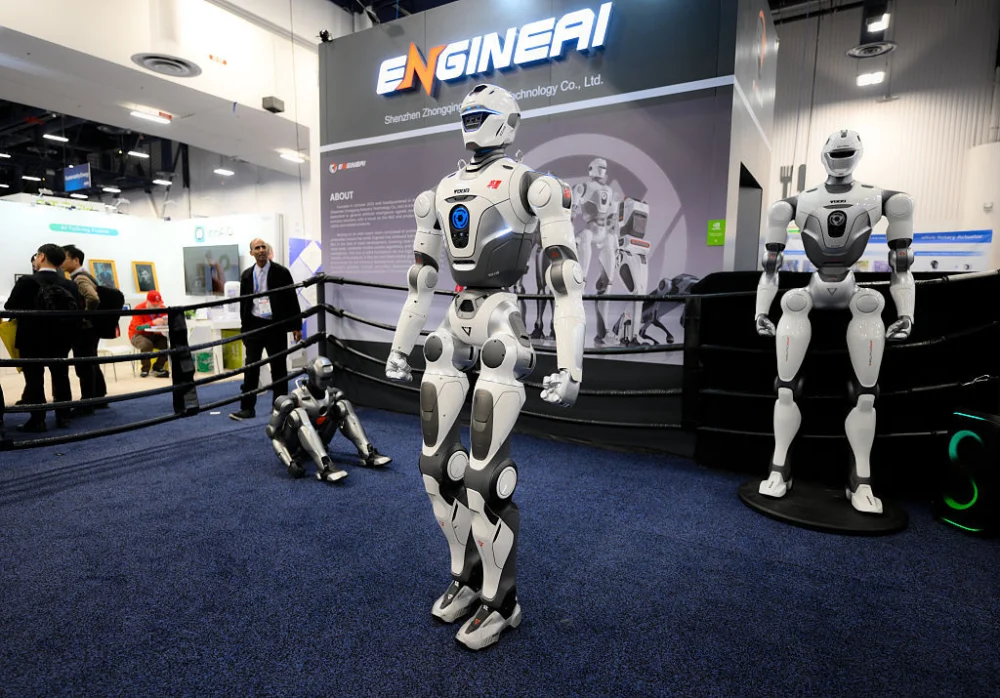
EngineAI, with its T800 series humanoids—a clear homage to cinematic sci-fi—staged a crowd-pleasing mock boxing match. Positioned in a small ring, the bots were stylized as fighting machines. Crucially, the machines never made contact, engaging instead in stylized shadowboxing. This setup highlights a common tension in robotics demos: maximizing visual impact while minimizing the risk of costly failures inherent in complex, high-speed interaction.
The unpredictability of the T800s, however, offered an unfiltered glimpse into the current state of bipedal stabilization. The sight of one T800 repeatedly wandering outside the ring and into the audience, and another dramatically losing balance and face-planting on the floor before a slow, deliberate self-righting sequence, underscored the fragility of current stabilization algorithms. While entertaining, drawing comparisons from onlookers to the clumsy, early days of cyborg representation ("That’s too much like Robocop," one observer quipped), these failures illustrate that reliable, dynamic gait control in unstructured environments remains a massive computational and mechanical challenge, far removed from the controlled environment demonstrations of their highly-funded counterparts like Atlas.
Meanwhile, Unitree, a prominent Chinese robotics manufacturer, continued the CES tradition of the dancing bot. While the display provided lighthearted entertainment, Unitree represents a critical force in the industry, having announced capabilities such as a humanoid model capable of running up to 11 mph—a speed record that emphasizes the rapid advancements in actuator design and motor control outside of Western firms. However, Unitree’s market position is complicated by increasing geopolitical scrutiny regarding potential ties to the Chinese military, a factor that weighs heavily on the international deployment and adoption of advanced robotics technology, particularly in sensitive industrial and institutional settings in the US and Europe.
Integrating Cognition: The Rise of the LLM-Powered Service Bot
The most compelling trend emerging from the service robotics exhibits is the indispensable fusion of physical capability with advanced cognitive processing, primarily through large language models (LLMs) and multimodal AI. These cognitive architectures are designed to allow robots to interpret complex, natural language commands and translate them into physical action chains.
Galbot, another Chinese innovator, showcased this integration by styling its booth as a convenience store. The Galbot unit was synchronized with a menu application, allowing customers to select items, which the robot would then retrieve from the shelves. This demonstration of pick-and-place fulfillment, successfully retrieving a requested box of Sour Patch Kids, illustrates the crucial role of perception and planning in retail logistics. The real-world applicability of Galbot is already evidenced by its deployment in real-world settings, serving as assistants in Chinese pharmacies. In these roles, the robot must not only navigate aisles and locate specific SKUs but also handle customer interactions and maintain inventory accuracy, tasks that demand the multimodal interpretation capabilities Galbot is focused on developing.
The integration of LLMs provides the crucial generalized reasoning layer. A robot that can only execute a pre-programmed sequence for "get item A from shelf 3" is a specialized tool. A robot that can interpret "I need something sweet and chewy for the movie," cross-reference that against its inventory, navigate an unexpected obstacle (like a misplaced shopping cart), and then confirm the selection verbally, is a truly general-purpose assistant.
In the domestic sphere, the challenge of consumer-facing utility was illustrated by LG’s home robot, CLOid. Designed as a household butler, the machine’s appeal lay primarily in its aesthetic design and promised companionship features. However, observation suggested that its operational speed and efficiency, particularly in multi-step domestic tasks like managing laundry, remained rudimentary. The slow pace of operation and limited utility highlight the current chasm between high consumer expectations for an intelligent, always-available household helper and the current technological realities of cost-effective, durable, and swift domestic robotics. While the vision of the robotic butler is appealing, achieving sufficient operational speed and fault tolerance for mass market adoption remains a critical barrier.
Industry Implications and the Road Ahead
The robots showcased at CES, from the high-dexterity folding machines to the stumbling boxers, collectively illustrate several crucial trends shaping the robotics industry.
1. The Primacy of Commercial Validation: The most mature technologies—like Dyna’s laundry system—are those that have moved beyond conceptual demonstrations and secured significant corporate funding based on proven ROI in narrow, high-value commercial environments (like industrial laundries and warehouses). This focus on immediate economic viability is accelerating the development of robust manipulation and object recognition systems.
2. The Arms Race in General Purpose Robotics (GPR): The massive investments from tech giants like Nvidia and Amazon underscore a strategic pivot. They are betting that GPRs, which combine human-like form factors with LLM-driven cognition, will unlock trillion-dollar markets currently inaccessible to fixed automation. The goal is to build a machine that can adapt to thousands of tasks rather than mastering a single one.
3. The Geopolitical Dimension: The dominance of Chinese manufacturers like Unitree, Sharpa, and Galbot in exhibiting highly advanced, cost-effective bipedal and service robotics signals a deepening global competition in hardware production and AI integration. The scrutiny faced by firms with potential state ties will necessitate careful regulatory frameworks and supply chain diversification for Western companies seeking to integrate these capabilities.
4. The Remaining Hurdles: Despite the hype, the performances at CES confirmed that the industry still struggles with three core challenges: Reliable Perception (especially handling deformable objects like clothing or avoiding unexpected collisions), Dynamic Self-Correction (the ability to recover from a trip or fall instantly without human intervention), and Energy Efficiency (ensuring these complex, multi-jointed machines can operate for prolonged periods outside of a tether).
The journey from the spectacular, but fragile, boxing automaton to the discreet, efficient laundry folder defines the current state of robotics. CES confirms that the industry is no longer waiting for the next theoretical breakthrough; it is aggressively working to solve the integration challenge—marrying the sophisticated, generalized intelligence of LLMs with the complex, delicate mechanics of human-like dexterity. The spectacle of the showroom floor may mask imperfections, but it undeniably previews a future where autonomous machines will increasingly move out of the factory cage and into the dynamic environments of our daily lives, transforming labor, logistics, and domestic assistance.